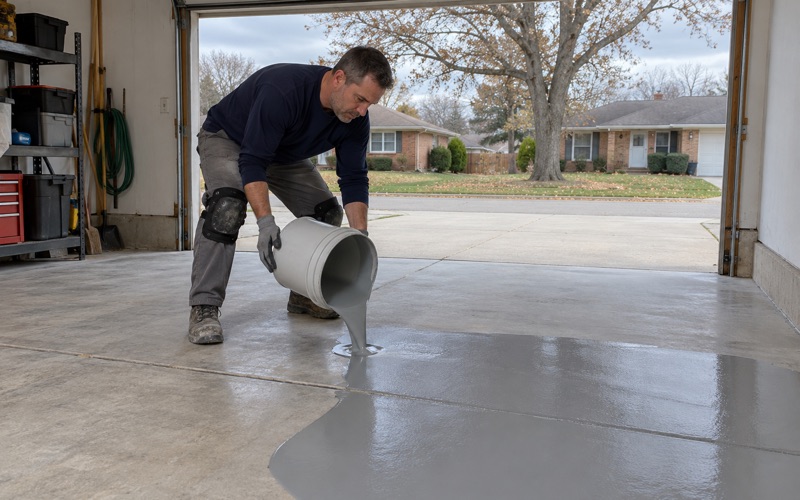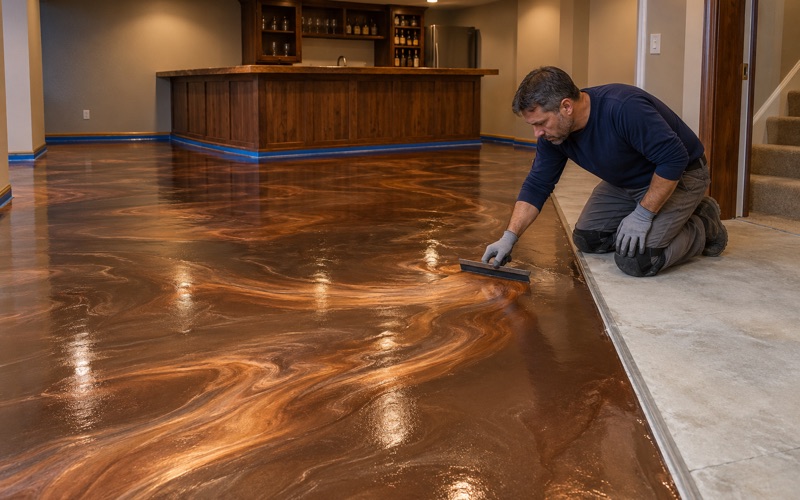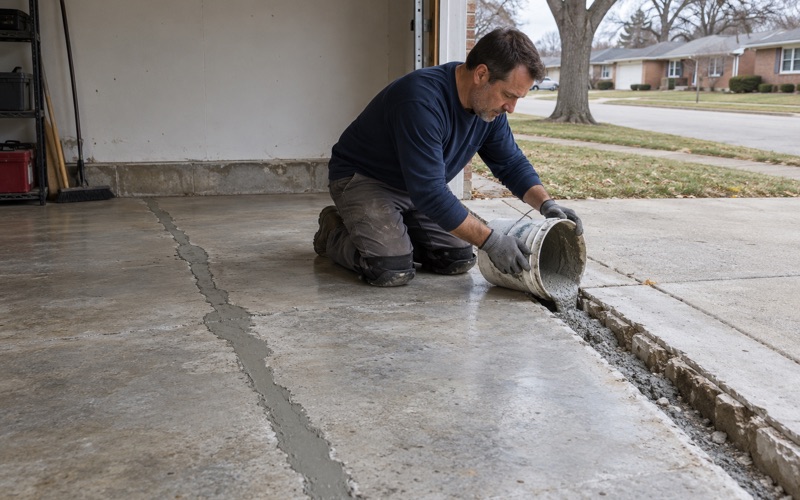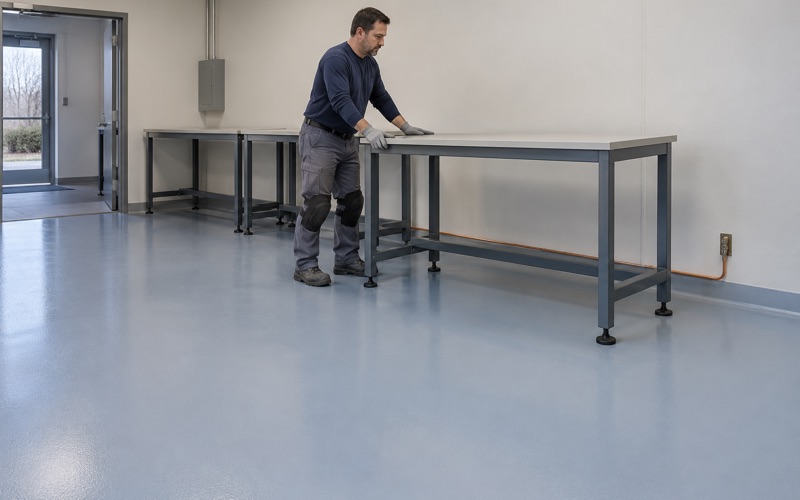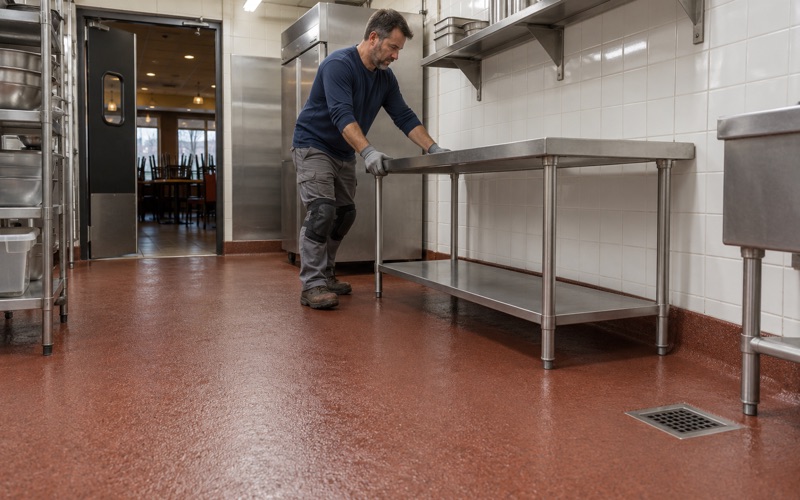
Palatine Epoxy Floors has spent more than 20 years putting epoxy flooring in Wood Dale garages, basements and shop floors, and the first thing we do on any of them is find out how much water the slab is carrying. A coating bonds to concrete, not to dampness, so our scope starts with a measurement rather than a color chart.
That order matters more on some floors than others. A slab that sits low and has been wet once can keep releasing moisture long after its surface looks dry, and no topcoat fixes that from above. Our proposal says which test we ran, what it read and what we plan to put down because of it.
You also get the product named, the system build spelled out and the finished thickness written in, so the floor that goes down can be checked against the quote. If the slab needs repair or drainage work before it can take a coating, we tell you that before you sign anything.
Salt Creek, Mapped Street by Street
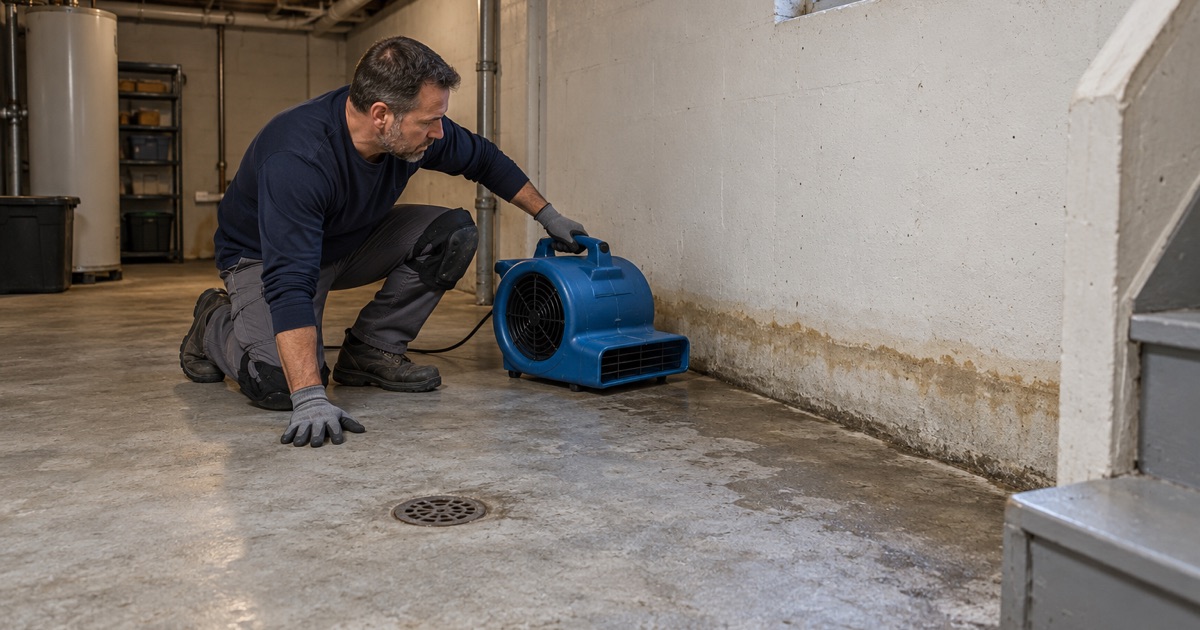
Salt Creek runs through Wood Dale, and anyone pricing a basement or low garage floor here should know where their property sits relative to it. The creek is the reason we ask about water history on every walkthrough in this city.
What the USGS maps show
The U.S. Geological Survey has published flood-inundation maps for a 1.6-mile reach of Salt Creek at Wood Dale, issued as Scientific Investigations Map 3185. Maps of this kind show which ground goes under water at a given creek level, which makes them a practical reference for deciding what belongs on a floor near the channel.
Before we quote, we ask where the home or shop sits relative to that reach and whether the slab has ever taken water. The answer changes the moisture test we run, the primer we specify and the warranty language we read out to you.
1,750 acre-feet of storage, finished in 2002
DuPage County Stormwater Management operates the Wood Dale-Itasca Flood Control Facility at the confluence of Salt Creek and Springbrook Tributary. Its four reservoir cells hold 325 acre-feet that drain by gravity plus a 1,425 acre-foot cell that has to be pumped out, 1,750 acre-feet in all. Work began in the early 1990s, the facility was completed in 2002, and protecting this city was part of its purpose.
That reservoir lowers the risk; it does not erase it. A proposed project has also sought voluntary acquisition and demolition of five residential properties regularly flooded by Salt Creek, a sign that the county still treats some ground along the creek as a recurring problem.
What this means for your floor
None of this makes every basement here a wet one, and we do not assume it does. It means a floor near the creek gets tested rather than guessed at, and an owner who has seen water on a slab should tell us at the first visit. We would rather design around a known history than find it later under a blister.
Looking for epoxy-flooring closer to Wauconda? See Wauconda Epoxy-Flooring.
What a Coating Can and Cannot Do After Water
A floor coating is a thin film that follows the concrete beneath it. It will not stop floodwater, it will not stop seepage through a wall or a crack, and it will not stop a sewer backup from rising through a floor drain. We put that in writing before the job, because a pitch that implies otherwise sets an owner up for a failure no product can prevent.
A coating also has no bearing on flood insurance or on how a property is mapped. If you are weighing a new floor against a flood policy, treat them as separate decisions.
What a sound system does deliver
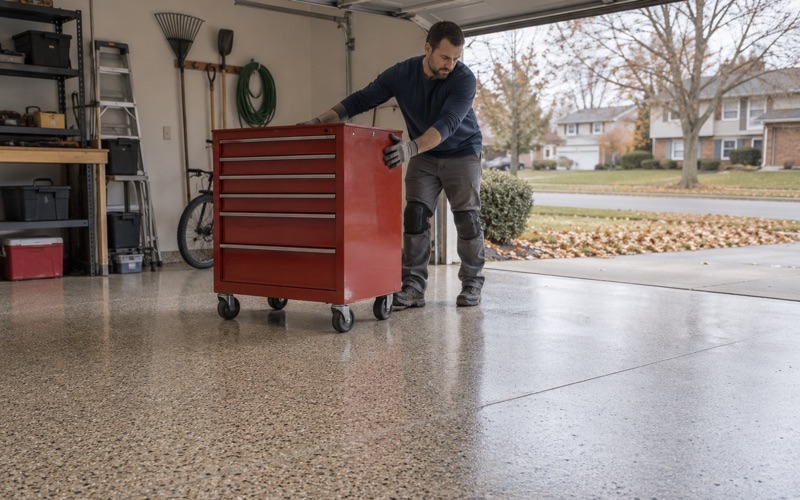
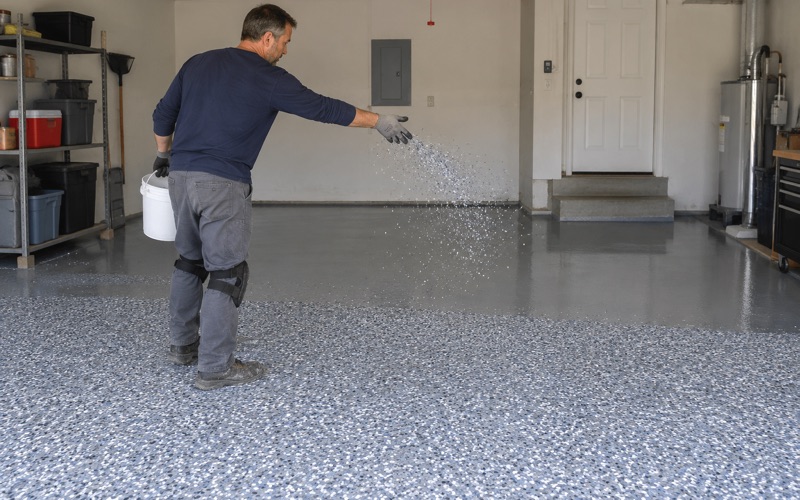
On a slab that is solid and dry enough, a properly built system gives you a surface that cleans up quickly after a spill or a minor leak. A 100% solids epoxy base with a vinyl flake or quartz aggregate broadcast and a polyaspartic topcoat sheds standing water instead of soaking it up, so mud and silt mop off rather than staining bare concrete. That is useful in a basement that sees an occasional wet day from a failed water heater or a sump that fell behind.
Where it goes wrong
The common failure on a floor that has taken water is a coating lifting in blisters or sheets, often with a white crust of efflorescence pushed out underneath. That pattern points to moisture and soluble salts moving up through the slab. Hydrostatic pressure under a basement floor can push hard enough to break a bond no matter how good the product is, so when we read an old coating that failed this way, we tell you the cause before we quote the replacement.
Preparation still comes first
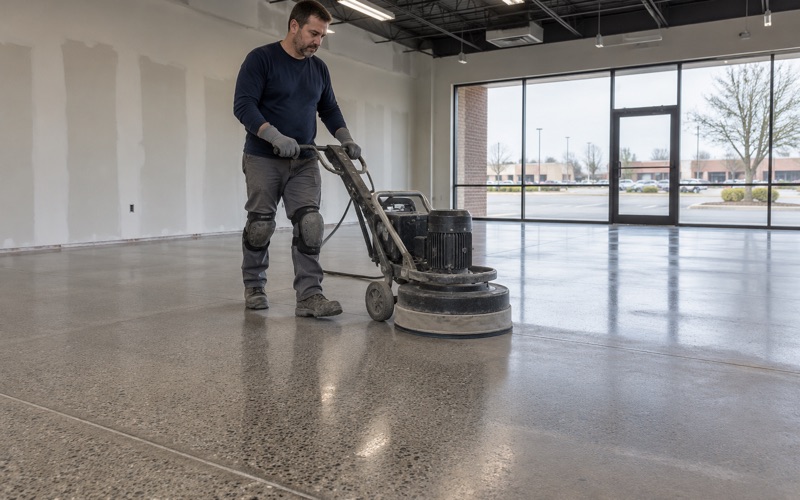
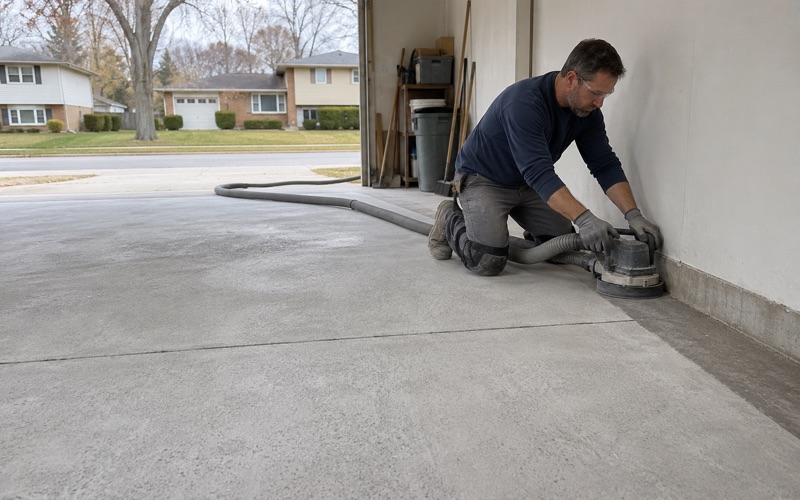
Every slab we coat is opened mechanically with a diamond grinder or a shot blaster to a measured ICRI CSP profile, and we never acid etch. On a floor that has been flooded, grinding also removes the top layer where silt, oils and salts collect. That leaves the primer clean, open concrete to grip.
Testing a Slab for Moisture Before Anything Goes Down
Moisture testing is a priced line item in our scope from the start, on a basement slab and a garage slab alike. It is not an add-on we try to sell after a floor has already failed. On ground near Salt Creek it is the one step we will not skip.
The plastic sheet screen
ASTM D4263 is the simplest check: a sheet of plastic taped tight to the slab, left in place and then inspected for condensation or darkened concrete underneath. It works as a quick yes-or-no screen. A positive result rules out a standard primer, but a negative one is not enough by itself to sign off a below-grade floor.
Calcium chloride and relative humidity probes
For numbers we can write into the proposal, we use ASTM F1869 calcium chloride testing, which measures the moisture vapor emission rate at the surface, and ASTM F2170 in-situ relative humidity probes set into holes drilled in the slab. The probes read conditions inside the concrete rather than only at its face. That matters on a floor that dried on top after a wet spell but still holds water deeper down.
We compare the readings with the coating manufacturer’s published limits and the ASTM F710 moisture thresholds before choosing a system. If the numbers sit close to a limit, we say so and price the margin rather than hoping it holds.
Newer concrete is not automatically dry
A garage poured to code may have no vapor retarder under it at all, because IRC R506.2.3 exempts garage floors from that requirement. Where a basement slab does have one, it may fall short of ASTM E1745 or may have been torn during the pour. So we test before we coat, whatever the age of the concrete.
Curing against real conditions
We schedule curing against slab temperature and the dew point spread at the surface, not against a date on the calendar. A cool, damp basement can form condensation right on the concrete, which leads to amine blush on an epoxy coat and a weak bond for the layer above it. If the readings say wait, we wait.
When the Answer Is Drainage First, Coating Second
Some floors should not be coated yet. When the tests show a slab pushing more moisture than any system can hold, the honest recommendation is to deal with the water and come back for the floor afterward.
Fix the water path
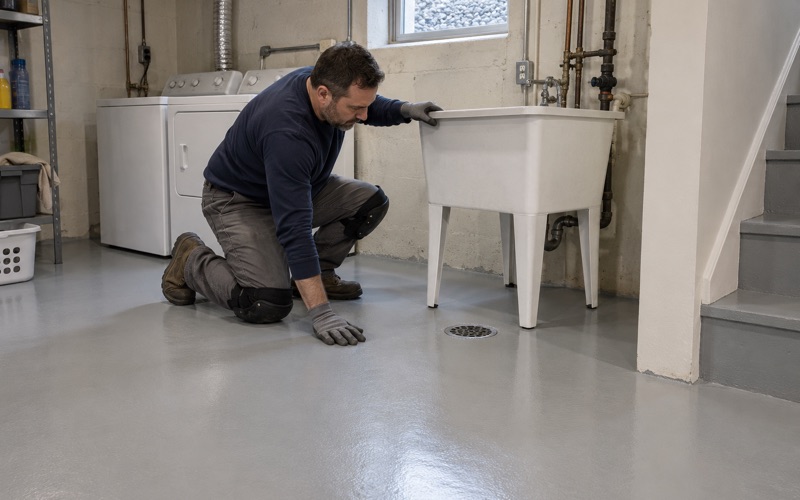
Sump pit and floor drain detailing comes before a topcoat. That may mean a working sump, a check valve or an overhead sewer arrangement to address basement backup, and a plumber or drainage contractor handles that work, not us. Once it is done, we coat to the finished pit and drain so the floor terminates cleanly at both.
Moisture-mitigation primer
Where readings are elevated but within what a mitigation product is rated for, we can lay a moisture-mitigation primer under the build, or use urethane cement where conditions call for it. Those products widen the window, but they have limits. We set the measured numbers beside the product’s rating in the proposal so you can see the margin for yourself.
Warranty and cracks, read before you sign
Warranty exclusions are read out before the job is sold, and moisture is the first one named. On a slab near Salt Creek that is not fine print; it is the main risk, and you should know exactly where coverage stops. Cracks get the same candor: a coating follows a moving crack instead of holding it shut, so we repair what needs repairing and tell you plainly what may still show through.
Paperwork and scheduling for a home job
Every residential project comes with a written contract and the Home Repair: Know Your Consumer Rights pamphlet before work begins, as the Illinois Home Repair and Remodeling Act requires. Wood Dale counts 870 single-family attached units, and on townhome and condominium floors we plan the work around the association’s rules and the neighbors’ access to their own garages. Work also runs inside the hours the city allows for construction noise.
- 20+ Years Coating Concrete
- Moisture Tested Before We Coat
- Free Written Estimates