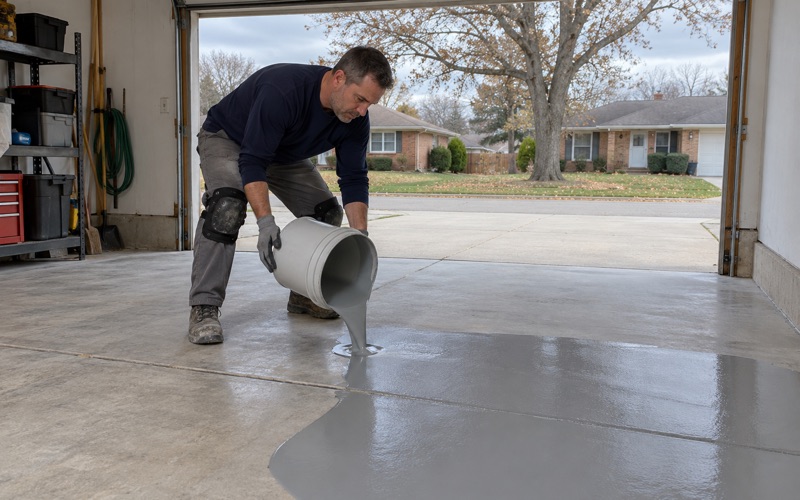
Palatine Epoxy Floors brings more than 20 years of epoxy-flooring in Winfield to a job that usually starts with a question about an old garage slab: coat it as it is, or fix what is wrong with it first. We answer that by looking, not by guessing, and the answer goes into a written proposal before any equipment comes off the truck.
That proposal names the product, the system build and the finished thickness, so you can hold what went down against what was quoted. It also lists moisture testing as its own line item and reads out the warranty exclusions, moisture first, while you still have time to say no.
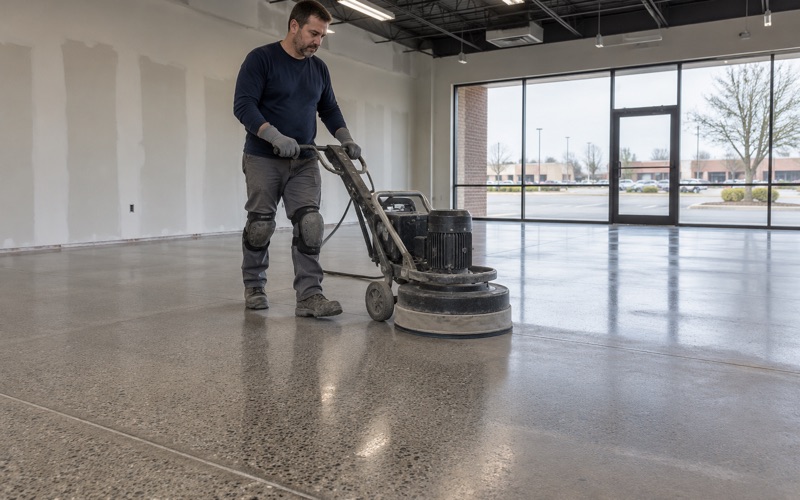
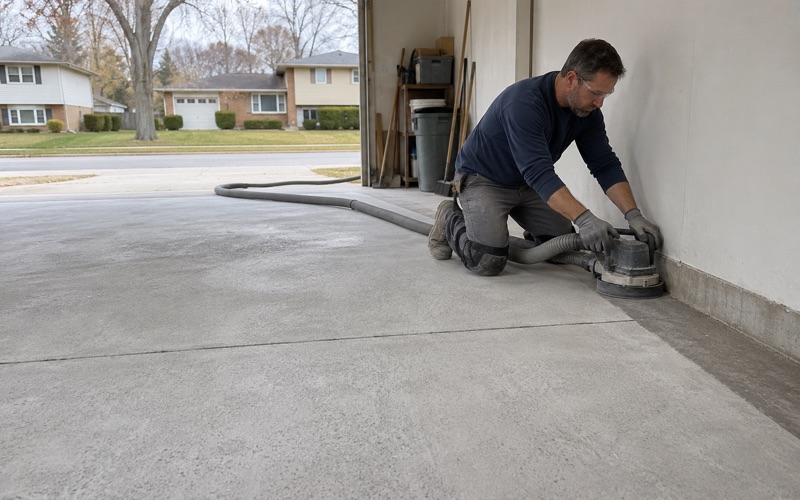
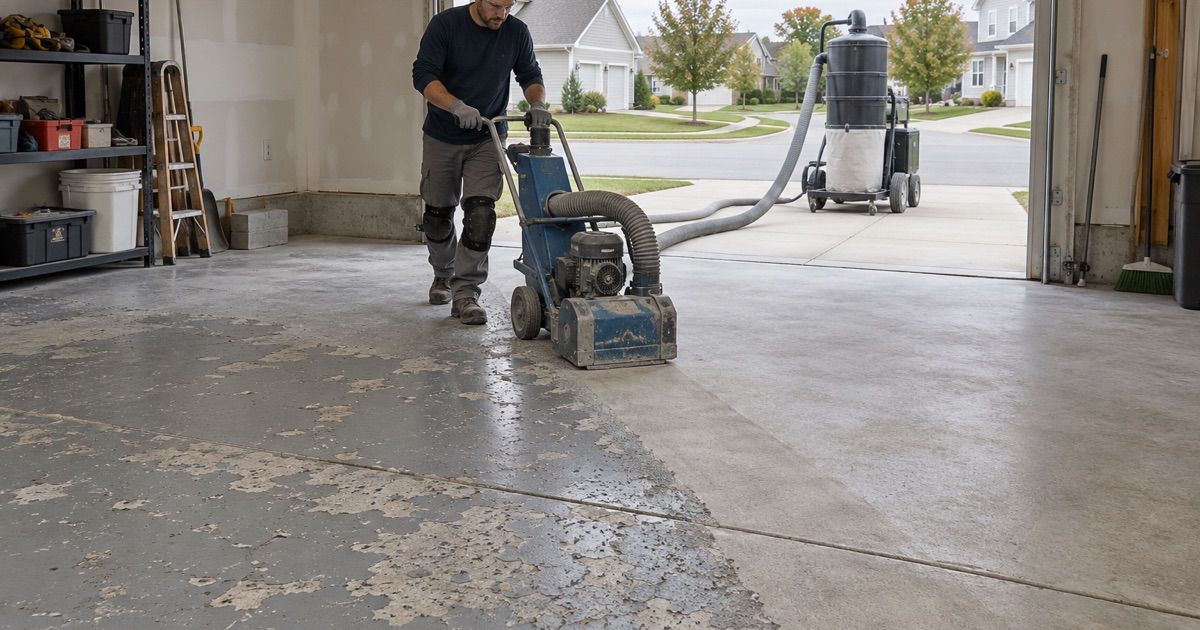
Every slab gets opened mechanically, with a diamond grinder or a shot blaster, and we do not acid etch. On a home job you also get a written contract and the Home Repair: Know Your Consumer Rights pamphlet before work starts, which the Illinois Home Repair and Remodeling Act requires.
The 1980s Built More of Winfield Than Any Other Decade
The Census Bureau’s American Community Survey counts 4,108 housing units in Winfield, and 1,129 of them were built between 1980 and 1989. No other decade comes close, and with the building that followed, 67.6 percent of the village’s housing dates from 1980 or later.
Run the numbers the other way and the picture sharpens. Only 8.0 percent of Winfield’s homes predate 1960, so an old prewar basement describes a small minority of homes here. The floor we are far more likely to be standing on is a garage slab poured somewhere between 35 and 45 years ago.
That matters because age, not just condition, shapes the job. A slab that has carried cars through four decades of northern Illinois winters has a history written into it, and that history decides how much preparation sits between the bare concrete and a finished floor.
A Long Builder Era, Not a Single Builder
We have no source tying Winfield’s 1980s houses to one builder or one garage plan, and we will not pretend otherwise. What we can say is that a slab of that age may have been through more than one owner, and each may have patched, sealed or painted it differently.
Ownership Shapes the Decision
Of Winfield’s 4,019 occupied homes, 3,695 are owner-occupied, or 91.9 percent. People who plan to stay are more likely to ask about a coating that lasts than one that just covers, and that is the conversation we prefer.
Older Roots, Younger Floors
Winfield was incorporated on April 18, 1921, with 310 residents, and was known as Gary’s Mill before it took the name of Winfield Scott. The DuPage River runs through the village, and the Winfield Metra station sits on the UP West Line. Hedges station, dating to 1849, is described as the oldest train depot in Illinois.
That long history sits alongside a housing stock that is mostly much younger. The old depot and the 1921 charter are the village’s story; the garage floors themselves mostly belong to the decades after 1980.
Looking for epoxy-flooring closer to Lincolnwood? See Lincolnwood Epoxy-Flooring.
What a Builder-Grade Slab Looks Like After 40 Years
A garage floor in its fourth decade rarely looks like one problem. It can show a mix of shrinkage cracks, a few spalled patches near the door where deicer has done its work, oil stains that have soaked deep into the paste, and sometimes a dusty surface that sheds powder under a broom.
Reading the Cracks Before We Quote
We read every crack before a number goes on paper. A hairline shrinkage crack that has not moved in years is treated differently from one that steps up on one side, and when a slab needs repair before it can be coated, we say so plainly, up front.
We are also clear about what a coating cannot do. Epoxy is a film that follows the concrete under it, so a crack that is still moving will eventually show through. We would rather tell you that before the job than explain it after.
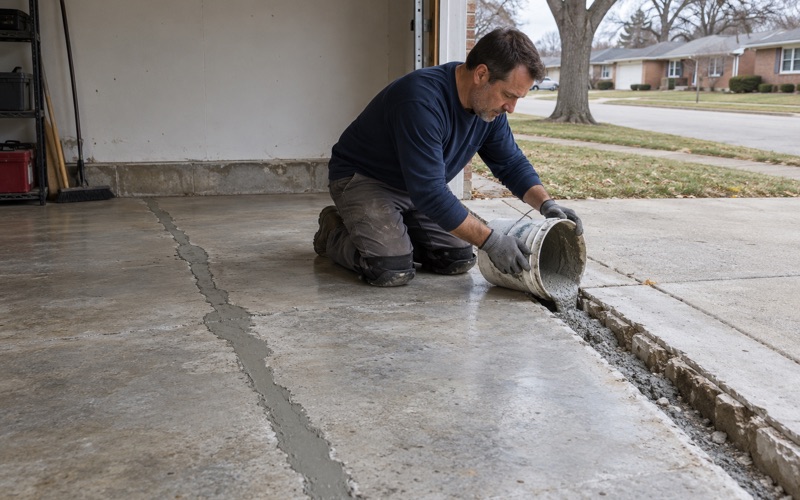
Spalled patches near the door get cut back to sound concrete and filled with a repair mortar compatible with the coating, and control joints are honored rather than buried. Those repairs appear in the written proposal, so you can see what the slab itself needs before the floor goes down.
Salt, Brine and the Surface Profile
Forty winters of calcium chloride brine and rock salt dripping off tires can weaken the top layer of a garage slab. That weakened skin is exactly what diamond grinding or shot blasting removes, cutting down to sound concrete and leaving an ICRI surface profile, typically CSP 2 to 3 for a broadcast system, that the primer can grip.
Oil stains are degreased and, where they have soaked deep, ground out, because epoxy will not bond reliably to concrete saturated with oil. A dusty, weak surface may be ground further until the grinder reaches concrete hard enough to hold a bond.
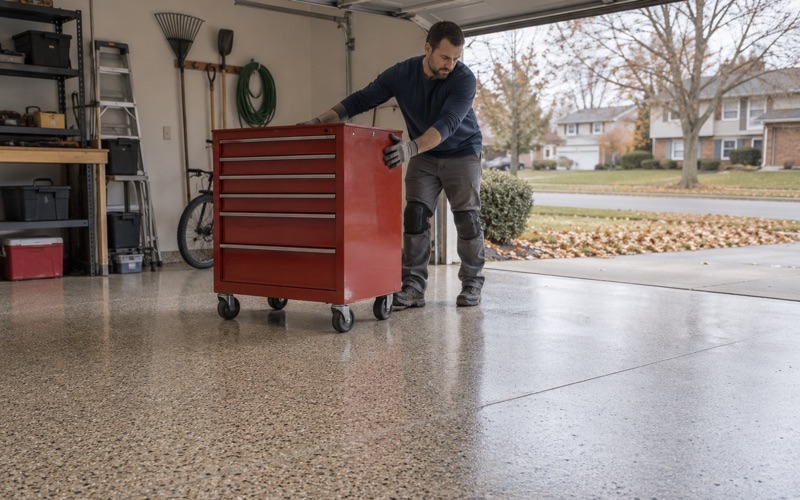
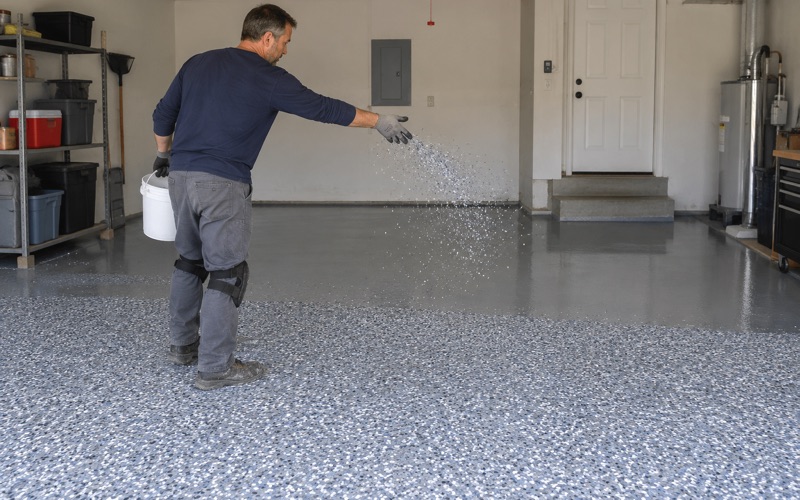
The finished floor we build for this is designed with that same brine in mind. A 100% solids epoxy base, a full vinyl flake broadcast and a polyaspartic topcoat give a garage the chemical resistance and texture it needs to handle a slushy February and resist hot tire pickup in July.
First Coating, or a Failed One to Grind Off
Because so much of Winfield’s housing has been standing for decades, a garage floor here has had plenty of time to collect a coating already. Some are bare concrete ready for a first real system. Others carry a peeling one-part epoxy paint from a weekend project, or a professional coating that has reached the end of its life.
The Bare-Slab First Coating
A slab that has never been coated is the simpler starting point, but not an automatic one. We still grind it and still test it for moisture, because a first coat over a dusty or damp surface can fail as fast as a cheap one.
Moisture testing matters for a reason homeowners rarely expect. The model residential code exempts garage slabs from the under-slab vapor retarder rule in IRC R506.2.3, so a garage floor poured to code may have no vapor barrier at all. We run an ASTM F1869 calcium chloride test or ASTM F2170 relative humidity probes before we coat, rather than assuming an older slab has dried out.
Removing a Failed Coating
A failed coating is a different job. Peeling paint, a coating lifting at the door line, or a white haze under the film all have to come off completely, and we grind through the old material rather than coating over it. Putting a new system on top of a failing one only gives the failure a heavier load to carry.
Removal also tells us why the first coating let go. Delamination over a damp slab points to moisture, a soft chalky layer underneath points to poor preparation, and a sticky or cloudy topcoat can mean amine blush from a cool, humid cure. Knowing which one happened decides what the second system needs.
When the Garage Has to Wait
Curing runs on slab temperature and the dew point spread at the surface, not on the calendar. An unheated Winfield garage in January may simply be too cold for a proper cure, and when that is the case we say so and book the work for spring.
Products and Limits We Work Within
Every product we put down is chosen within the Illinois limits on architectural coating VOC content in 35 Ill. Adm. Code Part 223, which bind the installer as well as the manufacturer. We also do not sell a floor coating as radon reduction, since that work in Illinois requires an IEMA radon mitigation license.
The 1990s and 2000s Houses, and Who Answers Fire Questions
Winfield kept building after the 1980s ended. The 1990s added 766 homes, the 2000s another 504 and the 2010s 380, so the slab next door to a 1980s house may be ten or twenty years younger and at a different point in the same story.
Younger Slabs Still Get Tested
A 1990s or 2000s garage often has less wear and fewer layers of old product, which can mean less grinding and fewer repairs. It does not mean a dry slab. The garage exemption from the vapor retarder rule covers these slabs too, so the moisture test stays on the scope for a 2005 floor exactly as it does for a 1985 one.
Some newer garages may also carry a clear sealer applied when the house was built. Those films have to be ground off before an epoxy primer can bond, and we check for them with a water drop test and a pass of the grinder before we commit to a system.
Townhome Garages
Winfield also has 775 owner-occupied townhomes, about one owner-occupied home in five. A shared-wall garage often falls under an association, so we check its rules on colors, exterior work and contractor access, and we schedule around neighbors who still need to reach their own garages.
Fire Questions Go to a District, Not the Village
One local detail is worth knowing. Fire protection in Winfield comes from the Winfield Fire Protection District, a special district that is separate from the village government. It covers about thirteen square miles and over 30,000 residents, including surrounding unincorporated DuPage County, from two stations.
For a residential garage floor the question seldom comes up. When it does, fire code questions go to the district, while building and zoning questions go to the Village of Winfield’s Building Department at 27W465 Jewell Road. We confirm any permit or registration requirement with the village before a job is scheduled, and we show whatever registration, bond and insurance it asks for, since Illinois issues no state license for flooring or coatings work.
The loudest part of any job is the grinding, so we schedule it inside the hours the village allows for construction noise and confirm those hours at the same time. On a townhome job, that schedule also goes to the association.
- 20+ Years Coating Concrete
- Moisture Tested Before We Coat
- Free Written Estimates