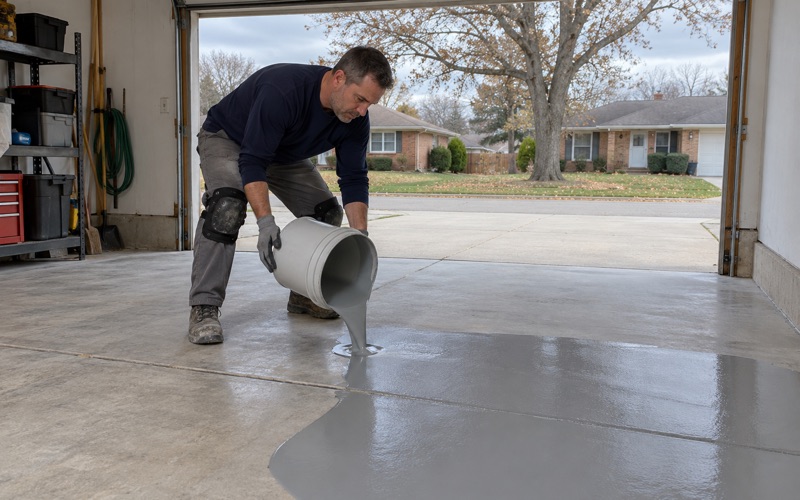
Palatine Epoxy Floors brings more than two decades of epoxy flooring work to Western Springs, where a basement or garage floor is often coated by a homeowner who has already watched water come up through a floor drain. We start every job by asking what the slab has been through, because the history under a floor decides what a coating can be expected to do on top of it.
That question has a clearer answer here than in most suburbs. The village has put names on the blocks where its storm sewers fall short, and it is paying to rebuild them with money residents contribute directly. A floor on one of those streets is not a mystery; it sits inside a drainage story that is written down in public.
So our proposals in this village are built around that record. We test the slab for moisture, open the surface mechanically, and tell you before the job what a resin film will hold back and what it will not.
Ridgewood and Springdale, the Blocks the Village Calls Flood-Prone
Local reporting in June 2023 identified two Western Springs neighborhoods as the ones that flood: Ridgewood, in the southwestern corner of the village along Ridgewood Drive between Birch and Crest lanes, and Springdale. Each has its own capital project, and both projects exist because rain overwhelmed the pipes meant to carry it away. That distinction matters for a floor. The problem on these blocks is storm-sewer capacity, not a river jumping its banks.
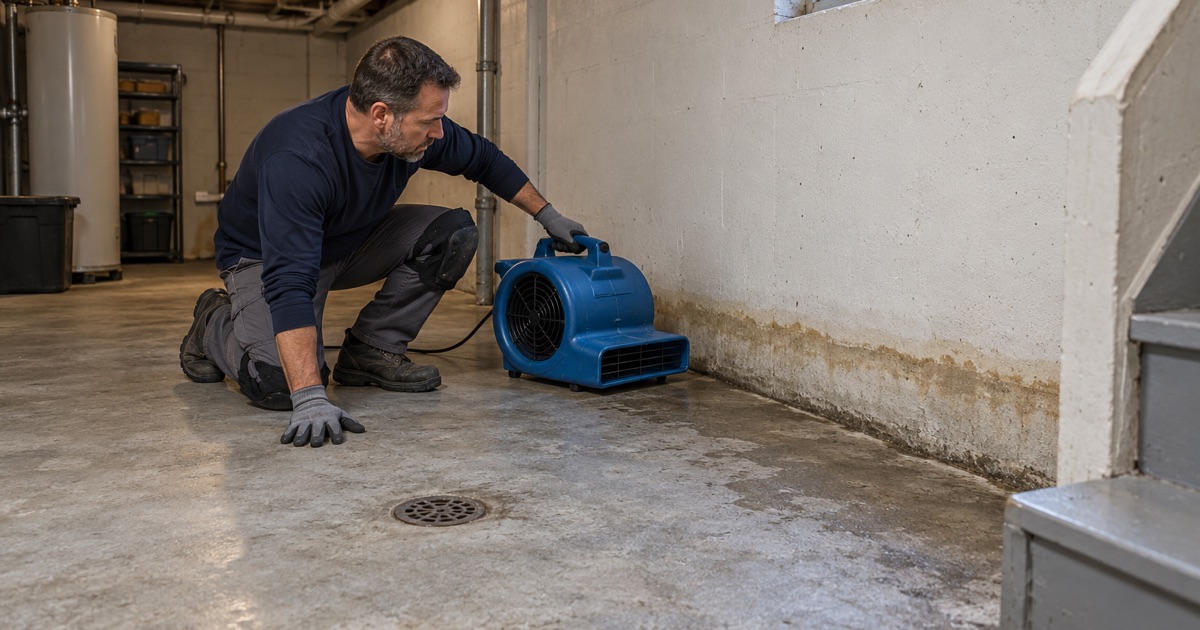
When storm sewers fill faster than they drain, water looks for the lowest exit, and in a house that is often a floor drain, a basement stairwell or the joint where a garage slab meets the foundation. A slab that has taken water that way carries a different history than one that has stayed dry, even if the two look the same once they are swept.
Ridgewood: a larger pipe to Flagg Creek
The Ridgewood project, estimated at $2.3 million, installs a larger pipe that empties into Flagg Creek west of the Ridgewood Drive houses. The idea is to give stormwater a bigger path out so it stops backing up toward homes. We have no confirmation that the work is finished, so we never treat a Ridgewood basement as dry because a project was announced.
What we do instead is ask when water last came in and how high it reached. A slab that took water once years ago and one that takes a little in every heavy storm call for different preparation, and the answer shapes whether the floor needs a moisture-mitigation primer under the base coat.
Springdale: bigger storm sewers and a detention basin in the park
Springdale’s improvements were estimated at $2.5 million to $3.1 million, with larger storm sewers and a detention basin in Springdale Park. The Metropolitan Water Reclamation District of Greater Chicago contributed a $1 million grant toward that work, and the 5400 block of Franklin Avenue was reported as particularly hard hit.
A detention basin holds stormwater for a while and releases it slowly, which takes pressure off the pipes downstream during a heavy rain. For a homeowner on one of those streets that is good news over time, but it does not change what a basement slab has already absorbed. We plan the floor around the slab that exists today.
Looking for epoxy-flooring closer to La Grange? See Epoxy-Flooring Services in La Grange.
A Stormwater Fee Every Household Shares
Western Springs set out to charge residents a stormwater fee starting in the summer of 2023 to help pay for these drainage projects. The reported figure for the average household is about $210 a year, and what an individual property pays can differ. For a floor owner, the point is that the village treats drainage as a shared, ongoing cost and is spending on the neighborhoods it named.
That spending also happens on a regional map. Western Springs lies in Lyons Township, and on April 30, 2026 the village posted that the Township of Lyons, the Metropolitan Water Reclamation District and Cook County had acquired and demolished a property on Wolf Road in La Grange Highlands, outside village limits, for a small detention basin expected to relieve flooding. Projects like these are spread out and take years, which is one more reason we never assume a block’s water problems are behind it.
Why we ask about your drainage before we price the floor
A garage or basement floor on a block the village has flagged deserves a closer read before anyone quotes a system. We ask whether the house has an overhead sewer, a check valve or a sump pit, and where the floor drains sit relative to the low spots in the slab. Those details decide how we pitch the coating toward a drain and how we finish the edges around a sump.
We also look at the old coating, if there is one. Peeling at the base of walls, white efflorescence along cracks and blistering near a drain all tell us water has been moving through the concrete, and we would rather read that before the quote than after a new floor fails.
What the fee does not do for a slab
The fee pays for public pipes and basins. It does nothing about moisture already moving up through an existing slab, and it does not change whether the concrete under your garage has a vapor retarder. Those are questions about your floor, and they get answered with a moisture test rather than with the knowledge that the village is working on the sewer.
Testing and Preparing a Slab With a Drainage History
Moisture testing is a written line item in every proposal we write here, whether the floor is in a basement or a garage. On a slab with a known water history it is the most important step on the page, because a coating laid over concrete that is pushing vapor will lift.
The tests we use
We start with an ASTM D4263 plastic sheet test as a quick screen. Where the results or the history call for numbers, we follow with ASTM F1869 calcium chloride moisture vapor emission rate testing or ASTM F2170 in-situ relative humidity probes set into the slab. Those readings are compared against the product maker’s limits and the ASTM F710 thresholds, and they decide whether a standard primer is enough or a moisture-mitigation primer has to go down first.
A newer garage slab is not automatically a dry one. The model code exempts garages from the under-slab vapor retarder requirement, so a slab poured to code may have nothing beneath it to slow vapor. We test rather than assume.
Opening the surface the right way
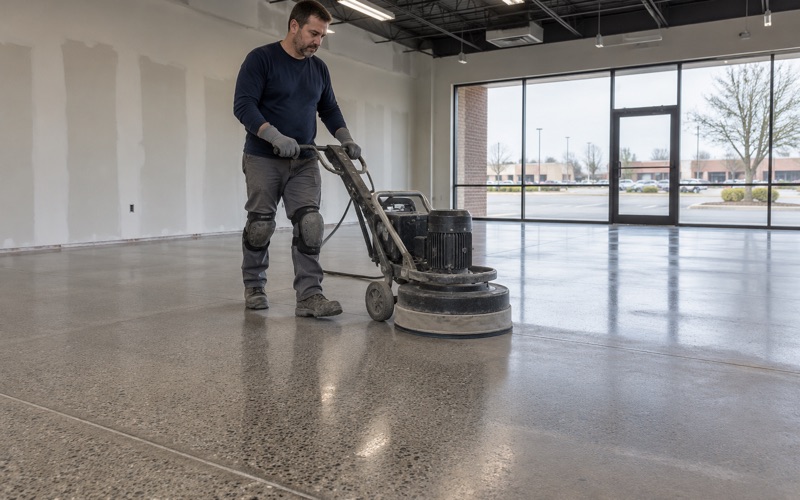
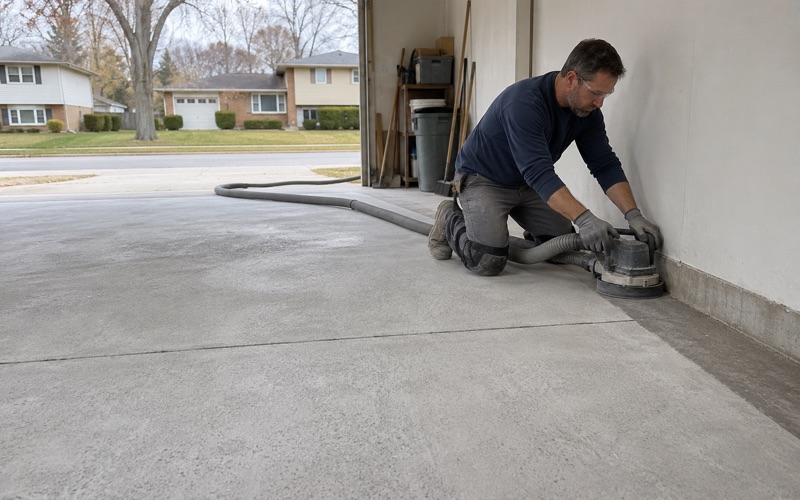
Every slab is opened mechanically with diamond grinding or shot blasting to an ICRI surface profile that suits the system, and we do not acid etch. On a floor that has flooded, grinding also removes weak surface paste and old sealers that would otherwise trap moisture under the new coat.
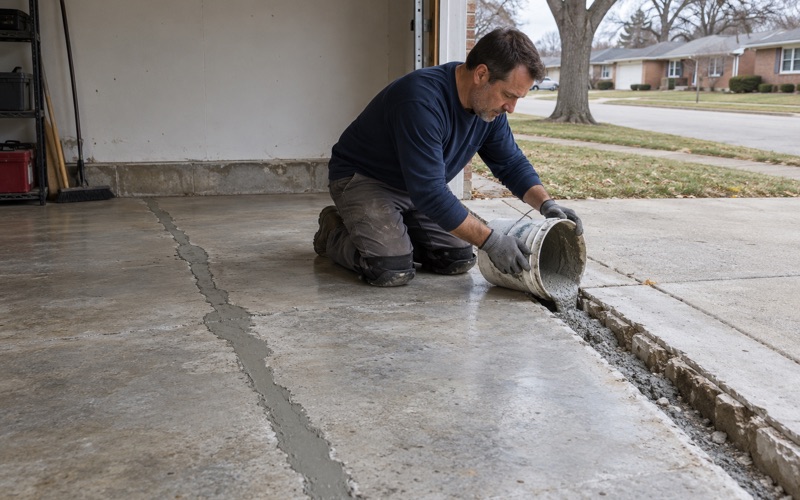
We read the cracks before we quote and tell you plainly when a slab needs repair first. A coating is a film that follows the concrete beneath it; it will not stop a crack from moving, and we say so before the job rather than after.
Choosing the system
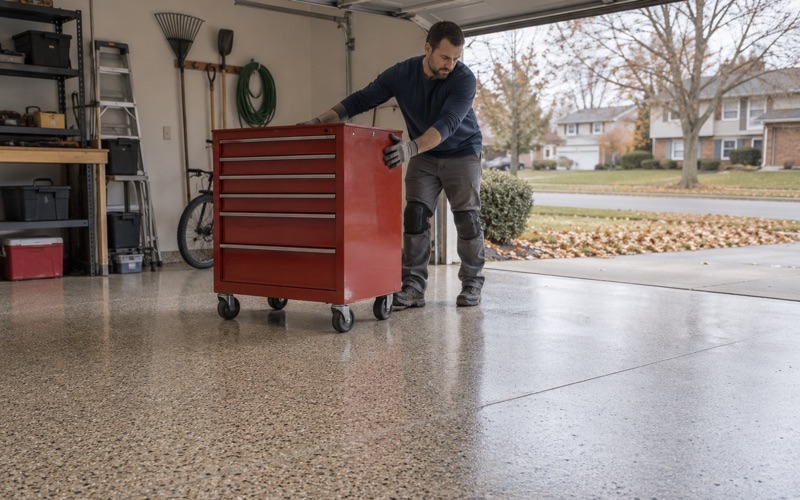
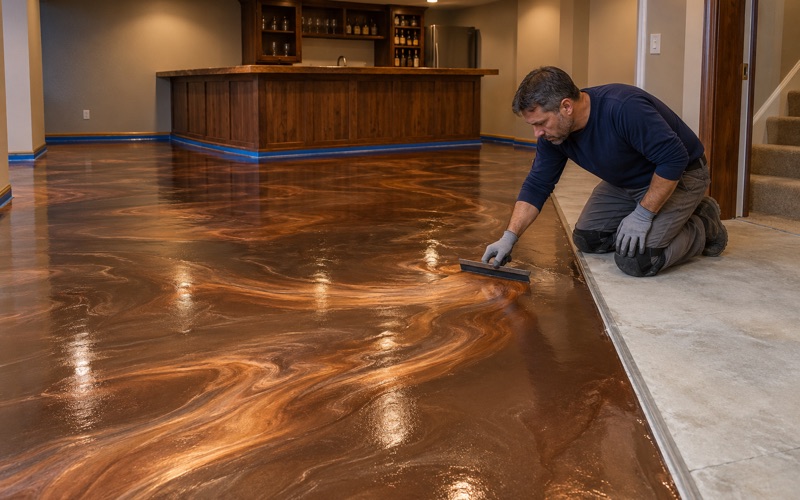
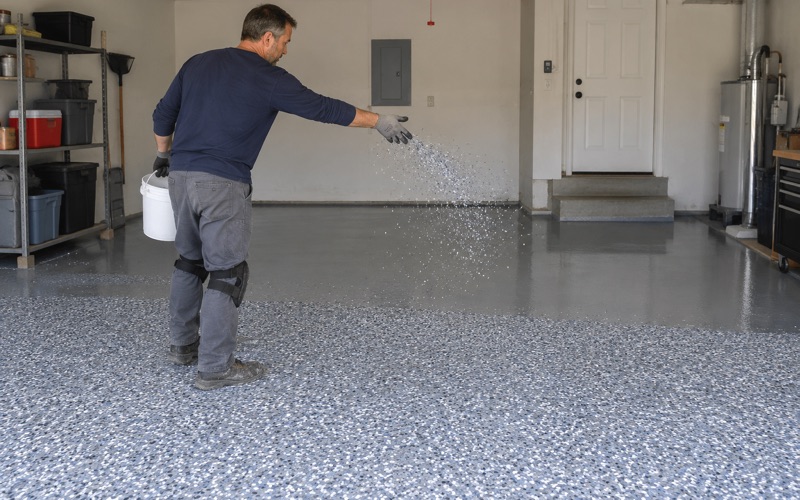
For most garages we build a 100% solids epoxy base, a vinyl flake or quartz aggregate broadcast, and a polyaspartic or polyurea topcoat that stands up to calcium chloride brine and rock salt off winter tires and resists hot tire pickup. In a basement that has seen water, urethane cement is sometimes the better base because it tolerates more vapor. The proposal names the product, the system build and the finished thickness, so you can check what went down against what was quoted, and every coating we use falls within the Illinois VOC limits in 35 Ill. Adm. Code Part 223.
What a Coating Can and Cannot Do After a Sewer Backup
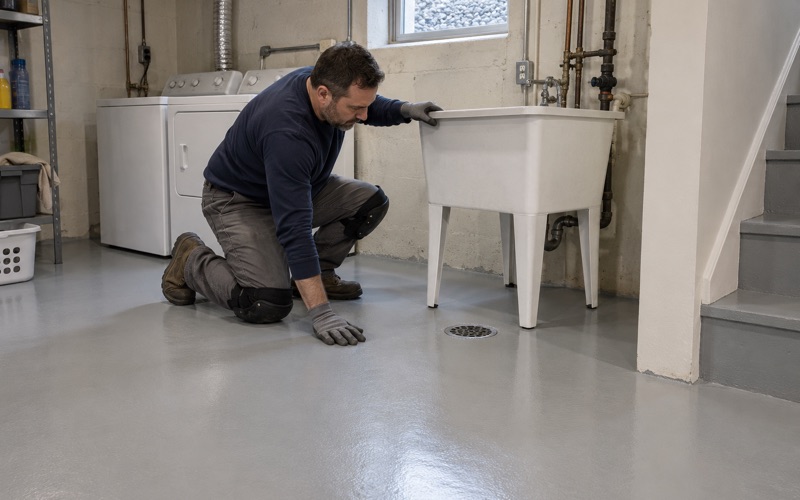
A coated floor is easier to clean after water comes in. Resin does not soak up muddy water the way bare concrete does, a seamless surface wipes down without grout lines, and a properly detailed drain lets standing water leave the room. Those are real benefits on a block that floods.
The limits we put in writing
A coating does not stop flooding, and it does not stop groundwater or hydrostatic pressure from pushing up through a slab. It will not keep a storm-sewer backup out of a basement; that is the job of the village’s pipes, an overhead sewer or a check valve, not a floor finish. We say this before the contract is signed so nobody buys a floor expecting it to do the sewer’s work.
Our warranty exclusions are read out before the job is sold, and moisture is named first. If testing shows a slab that will keep moving water, we tell you, recommend a mitigation primer or a different system, and explain what the warranty covers and what it does not.
Radon is a separate job
Some homeowners ask whether sealing a basement floor helps with radon. We do not sell a floor coating as radon reduction. In Illinois that work requires a radon mitigation license from IEMA, and it belongs with a licensed mitigator.
Paperwork and working hours in the village
Illinois issues no state license for flooring or coating work, so instead of a license number we show the registration, bond and insurance the Village of Western Springs asks for. Every home job gets a written contract and the state’s Home Repair: Know Your Consumer Rights pamphlet before work starts, as the Illinois Home Repair and Remodeling Act requires. We also schedule grinding and installation inside the hours the village allows for construction noise, so the work fits the street as well as the slab.
- 20+ Years Coating Concrete
- Moisture Tested Before We Coat
- Free Written Estimates