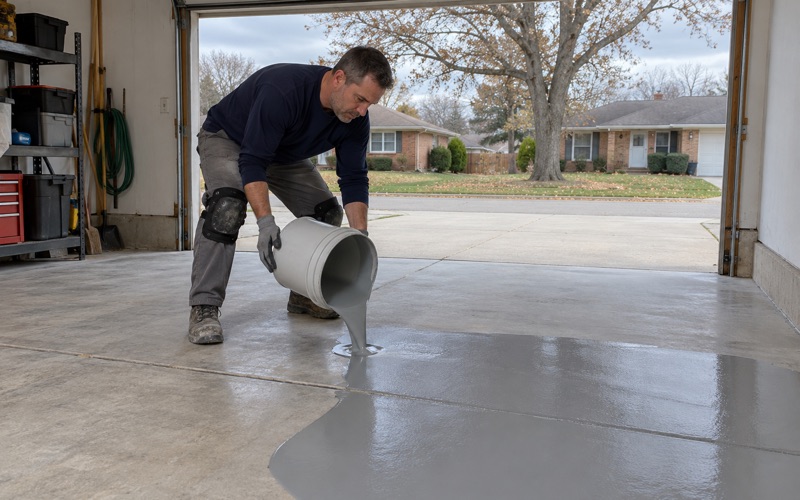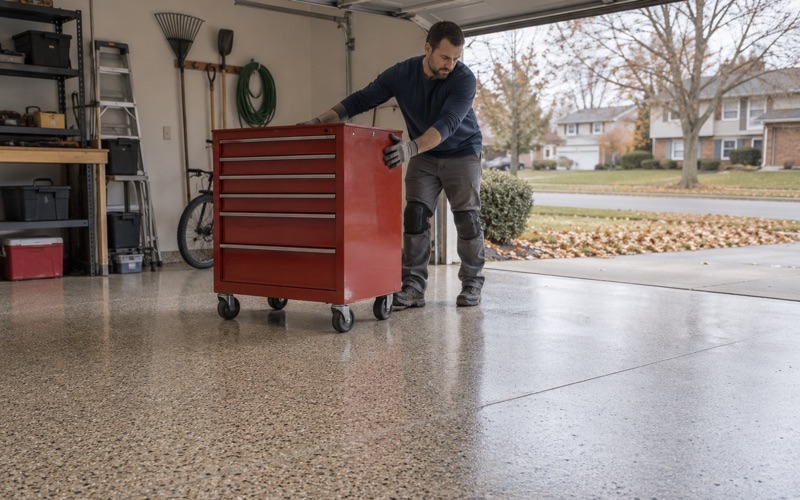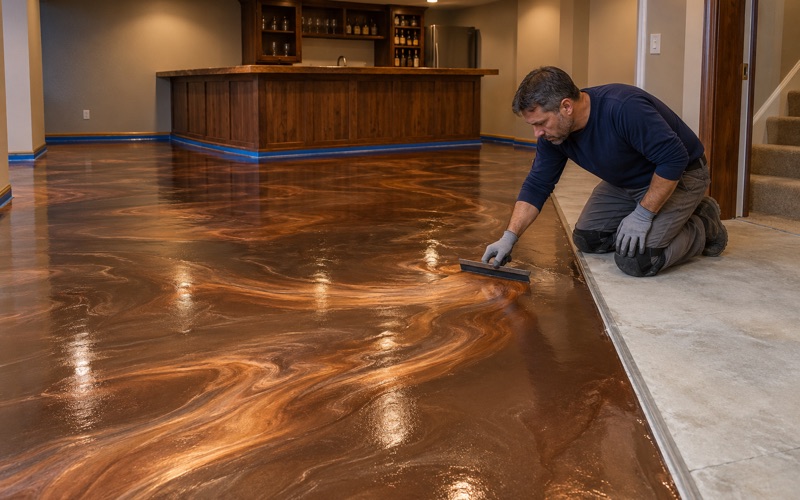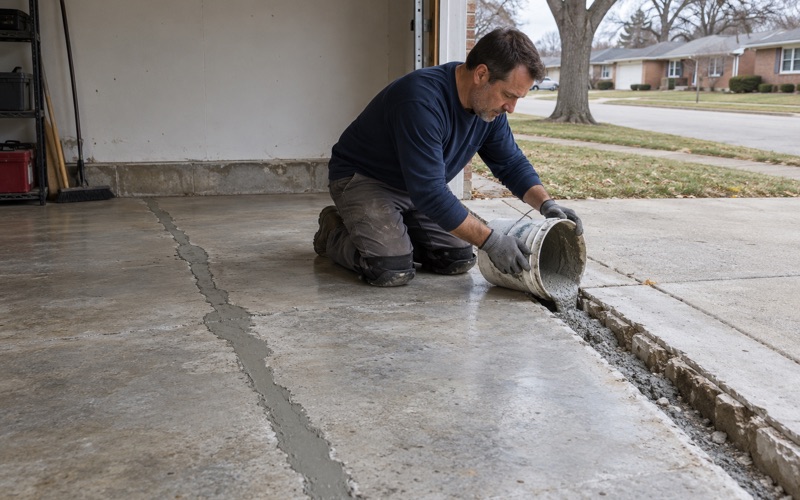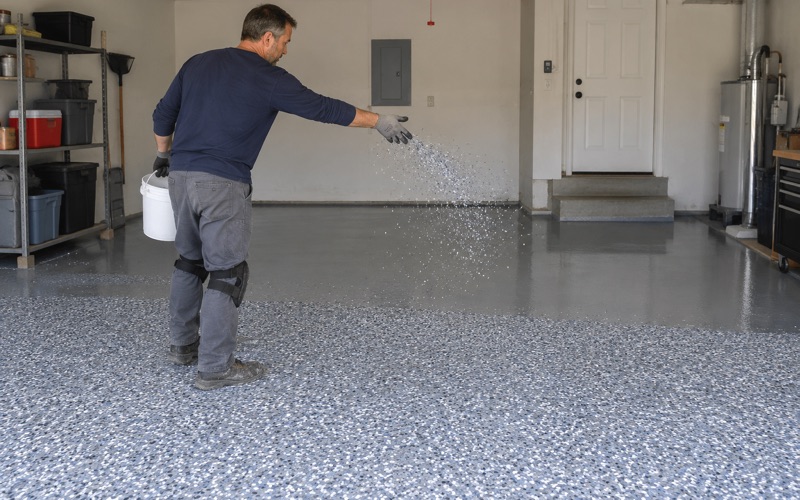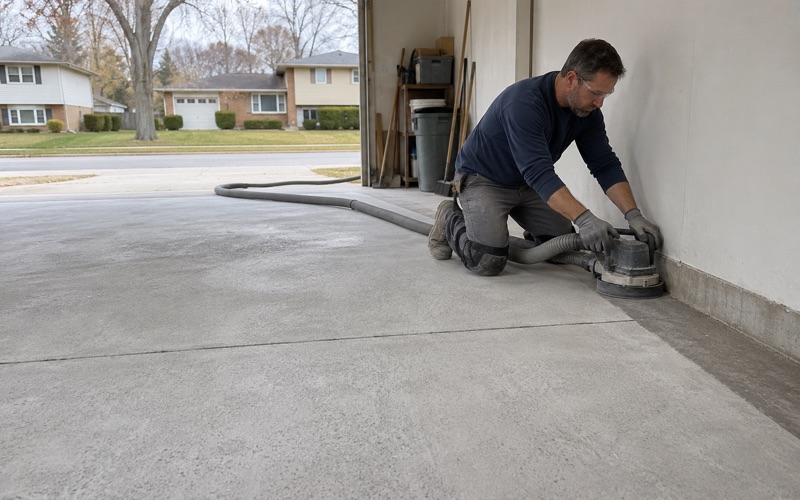
Palatine Epoxy Floors brings more than 20 years of epoxy-flooring in Westchester to a question most coating pages skip: what changes when the floor belongs to a building full of tenants instead of a two-car garage. This page is mostly about that second kind of job, although we coat plenty of the first.
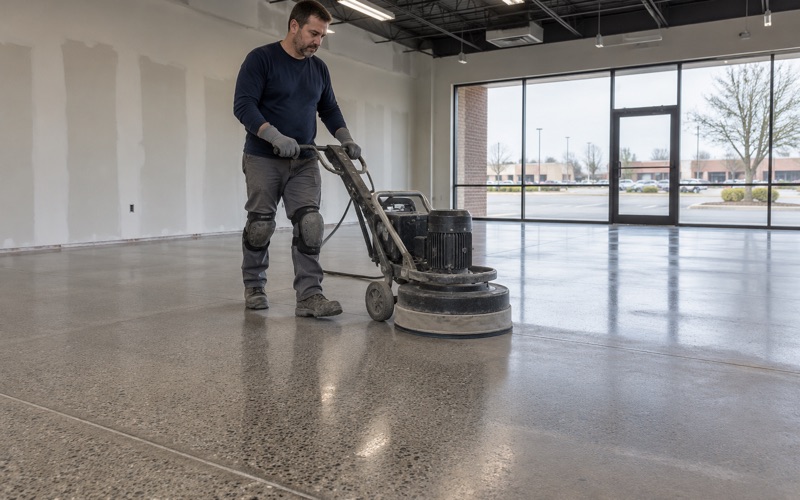
Our method does not change with the address. Every slab is opened with a diamond grinder or a shot blaster to the ICRI CSP profile the system calls for, and we do not acid etch. Moisture testing sits in the scope as its own line item, whether the slab lies under an office service corridor or a basement family room.
The written proposal names the product, the system build and the finished thickness, so a property manager or a homeowner can check what went down against what was quoted. When a slab needs crack repair or old coating removed before it can take a new system, we say so in the proposal rather than after the floor fails.
Five towers, 40 acres and a residential village
Westchester describes itself as primarily residential and built out, with few developable parcels left and edges formed by forest preserve land, cemeteries and a golf course. Of 6,908 occupied housing units, 90.8 percent are owner-occupied. There is no industrial district to speak of, and that shapes what a commercial floor job here actually looks like.
The one large commercial floor estate on record is Westbrook Corporate Center, at Cermak Road and Wolf Road just east of I-294. Listing and builder pages describe five 10-story towers on a 40-acre site, with more than 1 million square feet of office space completed in 1986. Ingredion lists its headquarters address as 5 Westbrook Corporate Center, and Follett Corporation announced in July 2013 that it would move its corporate headquarters to Westchester.
Office floors, not warehouse slab
A commercial pitch in Westchester is not a forklift aisle or a slab under pallet racking. It is lobbies, service corridors, back-of-house rooms and the floors that keep a working office running. Those spaces are smaller, more visible and far less forgiving of odor, dust and noise than a warehouse.
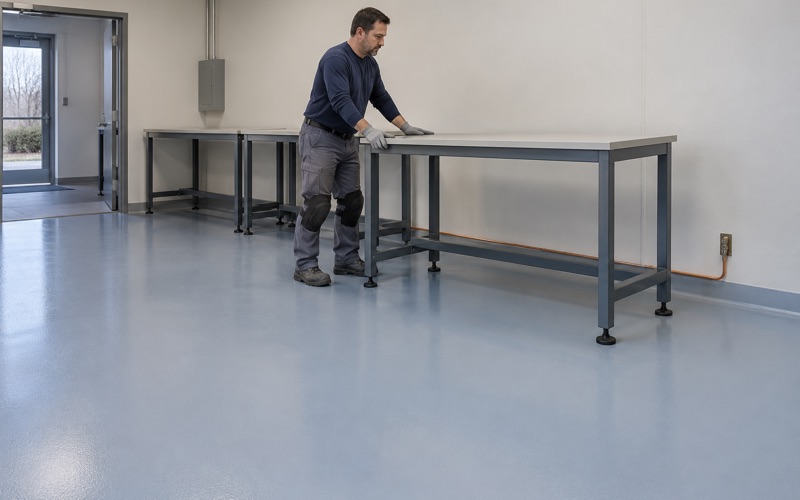
The finish reads differently, too. A gray quartz broadcast under a polyaspartic topcoat looks like a maintained building to a tenant walking a service hall, where a bright vinyl flake finish built for a garage would look out of place.
What 22,800 square feet per floor leaves for coatings
Listings put a typical tower floor at about 22,800 square feet, and in an office tower most of a floor plate is carpet or finished flooring a coating contractor never touches. The coating work in a building like this sits in the spaces between: stair landings, janitor closets, trash rooms, mechanical spaces and service halls. Each one is a small job, and the scheduling is the hard part.
Some back rooms do not need a coating at all. A storage room or a riser closet can be ground and treated with a lithium silicate densifier, which costs less and is easier to maintain than a film that will eventually need a recoat.
Looking for epoxy-flooring closer to Forest Park? See Epoxy-Flooring Services in Forest Park.
The concourse, the deli and the amenity floors
The towers at Westbrook are joined by an indoor pedestrian concourse, and the amenities listed on site include a deli, a fitness center, a conference center, a day care center and 24-hour manned security. Read as a floor schedule, that list is several different problems under one roof.
Concourse and corridor traffic
An indoor concourse carries foot traffic through the working day, which rules out any system that needs the space closed for a week. Where a service corridor or back-of-house walkway runs beside a route like that, we look at fast-return builds: a 100% solids epoxy base with a polyaspartic topcoat can often take foot traffic the next day, depending on slab temperature. Any work along an occupied path is planned with building management, not around it.
Where a coated service floor meets carpet, tile or terrazzo along a public route, the edge matters as much as the field. We grind the transition flush, terminate the system in a saw cut or under a metal strip, and keep the finish line straight so it reads as part of the building.
A deli kitchen under the food code
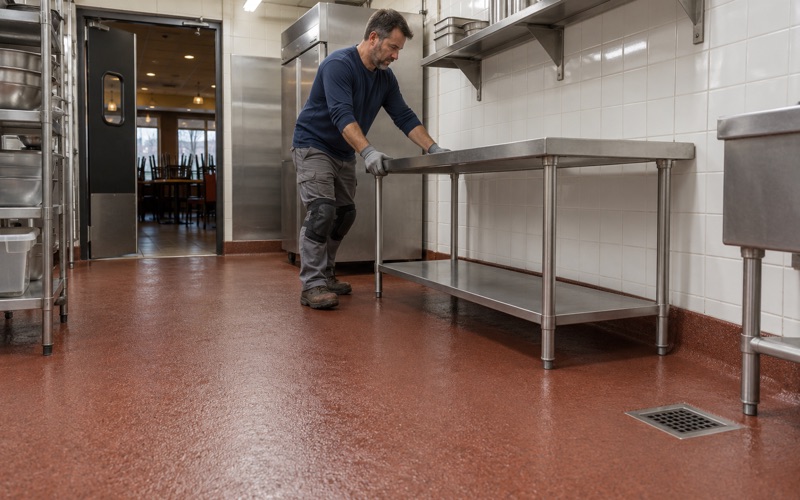
A deli kitchen is the one room in an office complex where the floor finish is written into health rules. The Illinois Food Code adopts the 2022 FDA Food Code, which calls for smooth, durable, nonabsorbent floors in food preparation spaces and, under section 6-201.13, coved junctures where floor meets wall. A urethane cement system with an integral cove is the usual answer in a wet kitchen, because it handles hot washdown and thermal shock better than a thin epoxy film. Section 6-201.11 also makes room for slip-resistant surfaces where safety calls for them, so we size the aggregate broadcast for grip without leaving a texture that holds food soil.
Fitness and child care rooms
A fitness floor and a day care floor ask for different things. Weight rooms are usually finished in rubber over the slab, so our part there is often the slab repair and the moisture test underneath. A child care room needs a seamless, cleanable surface with no sharp texture, and a fine broadcast under a clear topcoat does that job.
Loading docks, mechanical rooms and parking surfaces
The dock and the trash room
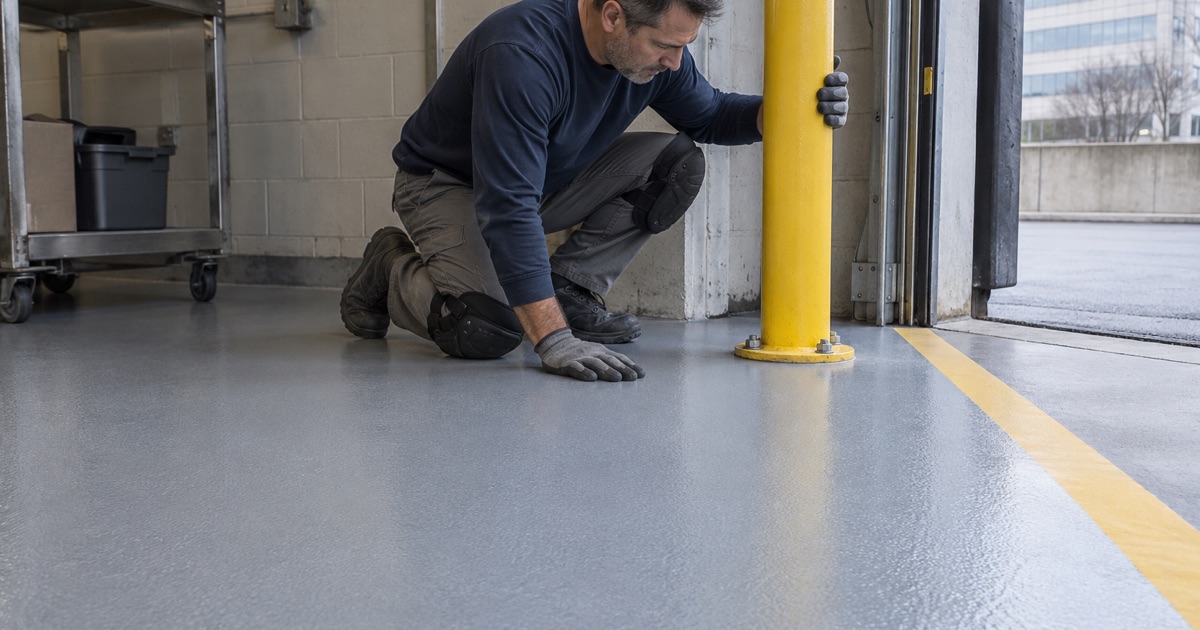
An office tower’s loading dock takes pallet jacks, delivery carts and the drag of dumpsters, and in winter it takes whatever slush comes in from the drive. Northern Illinois roads run on calcium chloride brine and rock salt, so a dock or receiving room gets a build that resists chloride attack and wet abrasion, with quartz aggregate broadcast for traction and a chemical-resistant topcoat.
Dock plates and the slab edge at an overhead door take repeated impact. We cut a keyway at that edge and terminate the system inside it, rather than feathering the coating out where a cart wheel will catch it and start a peel.
Mechanical and electrical rooms
Mechanical rooms are where coatings earn their keep in an office building: chiller leaks, glycol, oil and condensate all end up on the slab. A coated floor with a cove at the walls and around housekeeping pads keeps a spill visible and contained instead of soaking into bare concrete. Floor drains are detailed so the coating slopes into the drain body rather than ending in a ridge that holds water.
Where a room holds electronics sensitive to static, we can specify a static-dissipative system and test it against a stated resistance range instead of describing it loosely. Before any of these rooms is coated, the slab is tested with ASTM F2170 in-situ relative humidity probes or ASTM F1869 calcium chloride tests, and the readings are compared with the coating maker’s limits.
Parking surfaces
Parking at an office property varies, so we quote what is actually there after walking it. When a parking level, a garage bay or a covered drive is in scope, the conversation turns to traffic coatings, deicer exposure, hot tire pickup and drainage, and the price follows the slab’s condition rather than a per-foot figure from a brochure.
Hot tire pickup is the usual failure on a thin coating in a parking bay, where warm tires soften the film and lift it when the car pulls away. A full-build epoxy base under a polyaspartic or polyurea topcoat, over a properly profiled slab, is where we start.
Nights, weekends and the sign-offs
Working around tenants
Commercial jobs are scheduled around the hours a building has to stay open, and in an occupied office tower that usually means evenings, nights and weekends. We plan the grind, the coats and the cure so the space is back in service when tenants return, and we run the grinders with dust collection and close off the work zone. Before any night shift, we walk the route from the dock to the work zone with building staff so materials, grinders and vacuums move without crossing a lobby during open hours.
Work also stays inside the hours the village allows for construction noise, and overnight grinding inside a tower still needs the building’s own approval. Odor matters where one air handler serves several floors, so we choose coatings within the Illinois VOC limits in 35 Ill. Adm. Code Part 223 Subpart C, which bind the installer as well as the manufacturer, and we set ventilation with the building engineer.
Curing in a conditioned building
Cure time follows slab temperature and the dew point spread at the slab surface, not the calendar. Inside a conditioned tower those readings are usually steady, but a dock or a mechanical room against an exterior wall can run colder overnight, and a slab sitting too close to dew point can develop amine blush. We take readings on the night of the job and move the schedule rather than coat into bad conditions.
Village permits and county health review
Building questions here go to the Village of Westchester Community Development / Building Department. The village reports that it has adopted the 2012 International Codes, and we confirm the edition in force before writing a specification. Illinois issues no state license for coatings work, so in place of a license number we show the village registration, bond and insurance the municipality asks for.
Fire questions belong to the Westchester Fire Department, a village department at 10240 W. Roosevelt Road. A food-service space falls to the Cook County Department of Public Health, so a deli operator redoing a kitchen floor should confirm with the county what review the project needs before we set a date.
What a coating will not do
A coating is a film that follows the slab under it, so it will not stop a moving crack or a settling joint, and we say that before the job. Warranty exclusions are read out before anything is signed, with moisture named first.
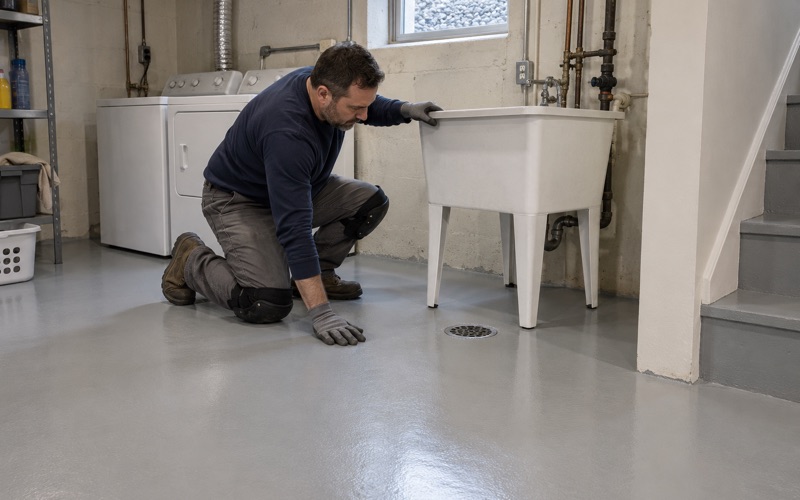
Most of Westchester is still houses, and we coat its garages and basements with the same moisture testing. Every home job gets a written contract and the Home Repair: Know Your Consumer Rights pamphlet before work starts, as the Illinois Home Repair and Remodeling Act requires.
- 20+ Years Coating Concrete
- Moisture Tested Before We Coat
- Free Written Estimates