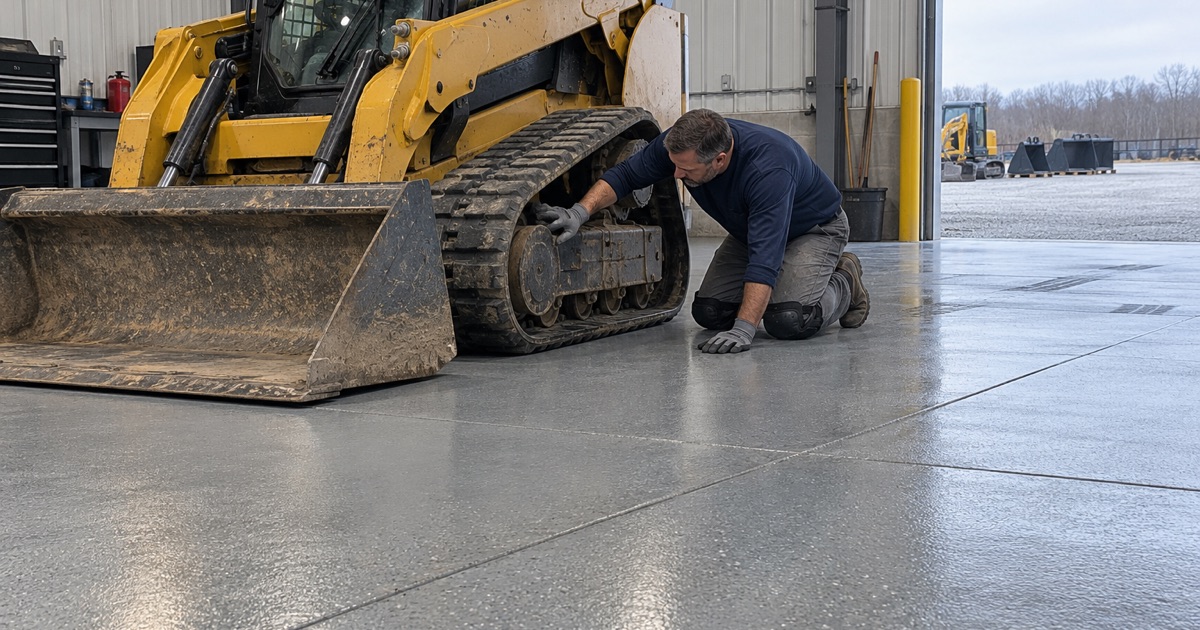
Palatine Epoxy Floors has put more than 20 years into epoxy flooring, and in Wauconda the floors that ask the most of a coating are shop floors: concrete that carries machines on steel, not just cars on rubber. We coat garages and basements in the village as well, but the slab under a tracked loader is where a cheap system shows its limits fastest.
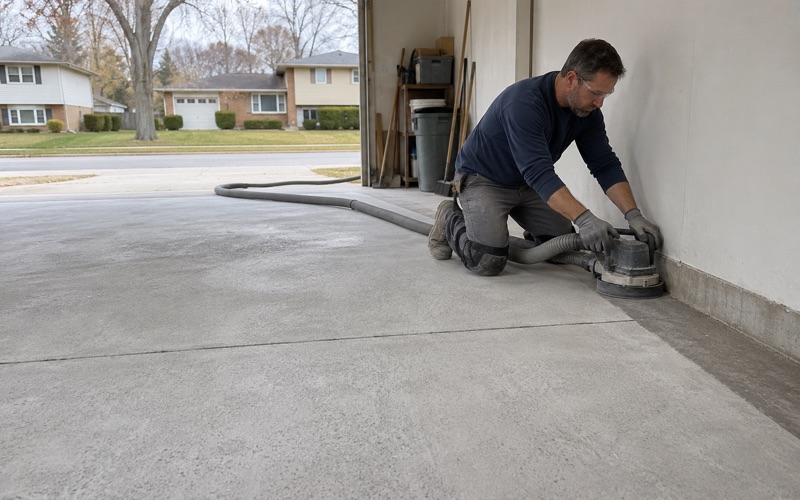
Every quote we write starts by looking before pricing. We read the cracks and any coating already on the concrete, we list moisture testing as its own line in the scope, and we open the surface with a diamond grinder or a shot blaster instead of acid. The proposal then names the product, the system build and the finished thickness, so whoever signs it can check the floor that went down against the paper.
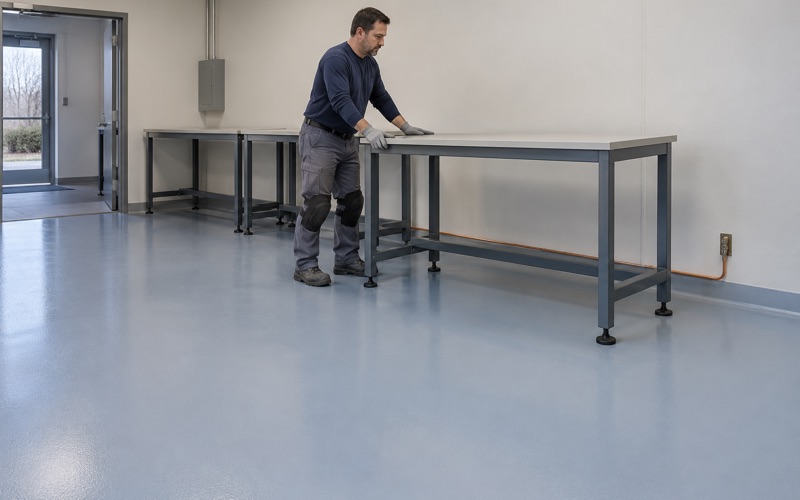
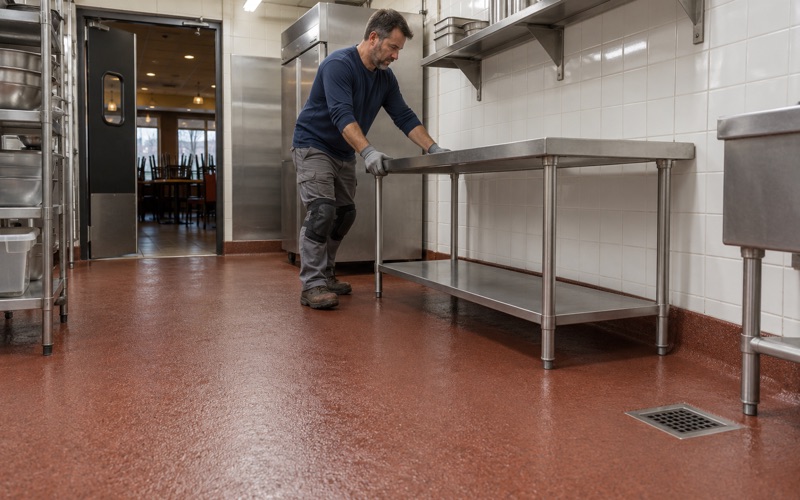
What changes from building to building is the specification. A bay where heavy equipment is serviced and the parts counter beside it are different floors, and we price and build them as separate systems rather than one rate across the whole slab.
A Route 12 Corridor of Equipment Dealers and Makers
The Village of Wauconda’s economic development page says construction supply and equipment dealerships along Route 12, the stretch of Rand Road through the village, serve businesses across Lake, Cook and McHenry counties. The names it gives include Altorfer CAT, West Side Tractor, McCann Equipment and Atlas Bobcat, along with Beacon Building Supply. For a village of 14,084 people, that is a dense cluster of one kind of business, and it decides what most commercial floors here have to carry.
Patten Drive and Old Rand Road
Altorfer Cat’s Wauconda location is at 700 Patten Drive, and West Side Tractor Sales is at 1560 N. Old Rand Road. Both addresses fall inside the village, in Wauconda Township, Lake County. We mention them to describe the type of building that lines this corridor, not because either one is a customer of ours, and we have not read any dealer’s floor standard or seen inside their shops.
What the addresses do tell us is the shape of the work. A business that sells and services tracked and wheeled construction machines generally runs service bays, a parts operation and offices, and each of those rooms puts a different kind of stress on the concrete. The coating question is never just “epoxy or not” but which build goes in which room.
Manufacturers in the Village Too
The equipment trade is not the only industry here. Progressive Components, which develops and distributes componentry and software for the injection mold industry, is headquartered in Wauconda, and Menges Roller Company has made industrial rubber rollers in the village since 1993. A production floor of that general kind brings forklift and pallet-jack traffic, rolling loads and cleanup routines that a residential garage never sees.
We treat any plant floor as its own scope. Before recommending anything we want to know what rolls across it, what drips on it, how it gets cleaned and how many hours a week it can be out of service, because those answers set the thickness and the topcoat more than the square footage does.
Looking for epoxy-flooring closer to Bensenville? See Epoxy-Flooring in Bensenville.
Steel Tracks, Hydraulic Fluid and Point Loads
A service bay for construction equipment loads a slab in ways that a thin rolled-on coating is not built to take. Steel tracks scrape and grind as a machine pivots, outriggers and jack stands press a lot of weight into a few square inches, and dropped attachments chip whatever sits on the surface. The floor system has to be specified for that, from the profile up.
Profile and Thickness
We start by grinding or shot blasting the concrete to a measured surface profile on the ICRI CSP scale, because a heavy coating is only as strong as its grip on the slab. On large open bays shot blasting is usually the faster route; edges and tight corners get the diamond grinder. Acid etching is not part of our process anywhere.
Over that profile, a bay floor typically gets 100% solids epoxy body coats with a quartz aggregate broadcast, which builds thickness and gives the surface texture. Where a floor sees hot-water washdowns or sharp temperature swings, urethane cement is often the better base. The proposal says which one we chose and why, and states the finished thickness in writing.
Hydraulic Fluid and the Cleanup After It
Hydraulic oil, diesel and the degreasers used to clean them up are a chemical exposure, not just a stain. A topcoat for a shop floor has to resist that exposure without softening, and polyaspartic and polyurea topcoats are among the options we weigh against the cleaning products the shop actually uses. Texture is a trade-off as well: more grit underfoot means better footing on an oily floor and slightly more effort with the squeegee.
Cracks, Joints and Honest Limits
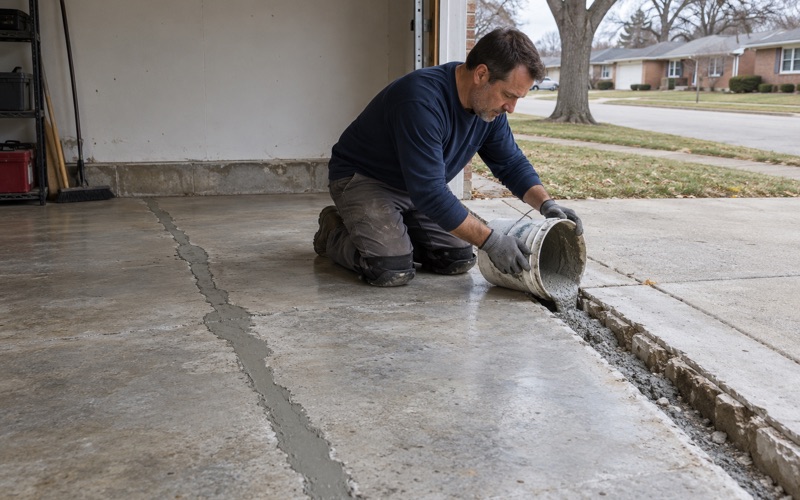
A shop slab that has carried equipment for years usually has cracks, spalled joints and patches from earlier repairs. We read those before quoting and say plainly when a section needs repair before it can be coated. We also say what a coating cannot do: it is a film that follows the slab underneath, so a crack that keeps moving will eventually show through, and no system stops the concrete itself from shifting.
Control joints get their own decision. In a bay where steel wheels and tracks cross them every day, we usually fill joints with a semi-rigid filler so the edges are supported, and we tell the owner that filler is a maintenance item that may need renewing as the slab works.
Service Bays, Parts Rooms and Offices: One Building, Several Specifications
The most common mistake we see in mixed-use commercial buildings is a single coating rolled from the bay door to the front office. That either overbuilds the quiet rooms or underbuilds the working ones. We break the building into zones and write a system for each.
Parts and Storage Areas
Parts rooms and warehouse aisles carry racking, carts and pallet jacks rather than steel tracks. Depending on the traffic and how the space is cleaned, a thinner epoxy build or a lithium silicate densifier on ground and polished concrete can be the right answer. The densifier route hardens the surface without adding a film, which matters where racking anchors are moved often.
Showrooms, Counters and Offices
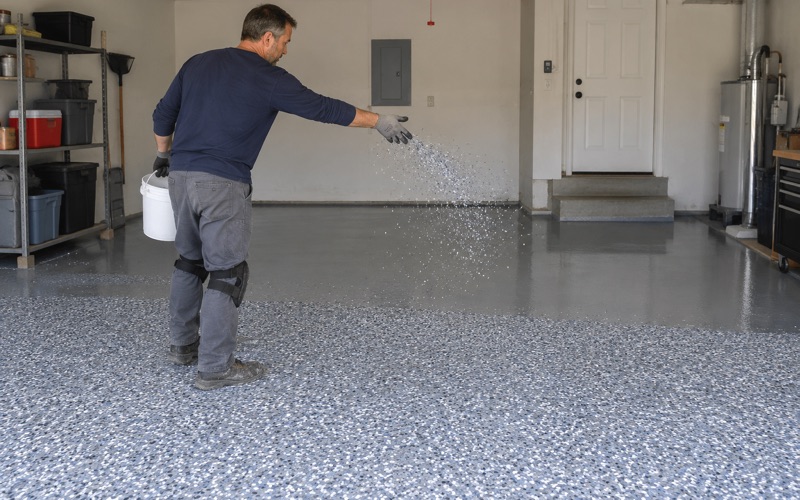
Customer-facing rooms are judged on how they look as much as how they wear. A vinyl flake broadcast under a clear polyaspartic topcoat gives color and hides minor marks, and it can be scheduled so the front of the building stays usable. Commercial jobs are always planned around the hours the building has to stay open, which often means phasing the work room by room.
One exception is worth naming. If machines are driven into a display area, that floor is a working floor no matter how it looks, and we specify it with the same body build as a bay and finish only the topcoat for appearance.
Moisture Testing in Every Zone
We test moisture in every zone before we coat, not just the one that looks damp. Our scope typically calls for ASTM F2170 in-situ relative humidity probes, ASTM F1869 calcium chloride testing or both, measured against the thresholds the chosen product requires. If the numbers are high, a moisture-mitigation primer goes into the build, and the warranty exclusions are read out before the contract is signed, with moisture named first.
The Wauconda Fire Protection District and the Village Line
Fire protection here comes from the Wauconda Fire Protection District, a separate district rather than a village department. It serves the village plus all or parts of 10 other communities, 6 townships and unincorporated parts of Lake and McHenry Counties. That means a shop or yard with a Wauconda mailing address may sit inside the district but outside the village itself, so we confirm early which side of the village line a job falls on.
Who We Check With Before Starting
Inside the village, building matters go through the Village of Wauconda’s building and community development office. Illinois issues no state license for flooring or coatings work, so instead of quoting a license number we show the registration, bond and insurance the municipality asks for. We also keep work inside the hours the village allows for construction noise.
Product Choice in an Occupied Building
Many commercial floors here are coated while the rest of the building keeps operating, so fumes and odor are a practical concern. We choose coatings within the Illinois VOC limits in 35 Ill. Adm. Code Part 223 Subpart C, which bind the installer as well as the manufacturer, and 100% solids epoxy carries very little solvent to begin with. Curing is scheduled against slab temperature and dew point at the surface rather than a fixed number of days.
Garages at Home in Wauconda
The village grew from 9,386 residents in 2000 to 14,084 in 2020, and most of its occupied homes are owner-occupied. On a residential garage, we do not assume a newer slab is a dry one: the model code exempts garages from the under-slab vapor retarder requirement, so we test before we coat. Every home job gets a written contract and the state’s Home Repair: Know Your Consumer Rights pamphlet before work begins, as the Illinois Home Repair and Remodeling Act requires.
For townhome and condominium owners, we schedule around the association’s rules and the neighbors’ access to their own garages. We also keep the two kinds of work separate in our heads: a home garage coating is not a radon fix, and in Illinois radon mitigation takes its own state license, so we never sell one as the other.
- 20+ Years Coating Concrete
- Moisture Tested Before We Coat
- Free Written Estimates