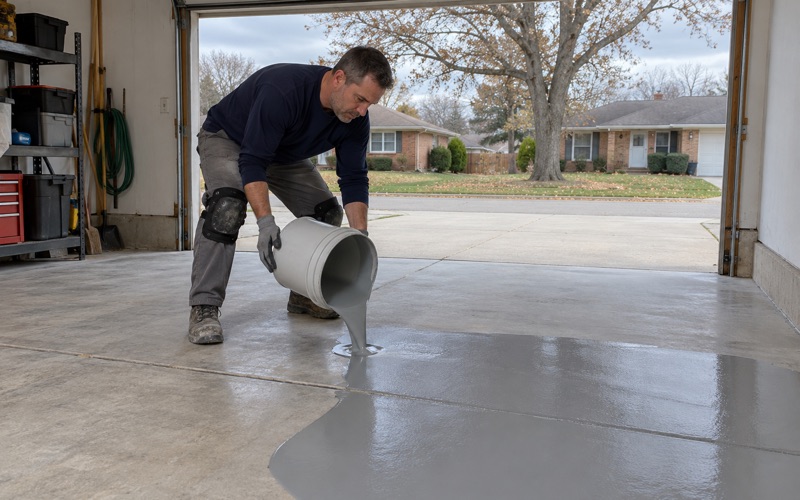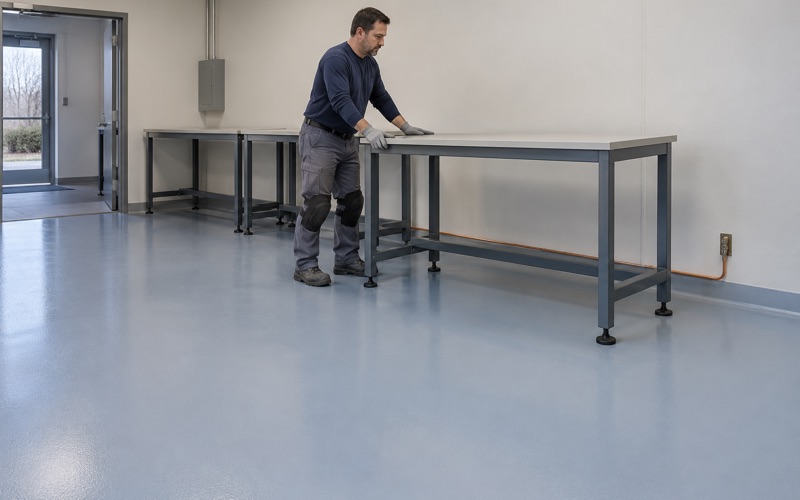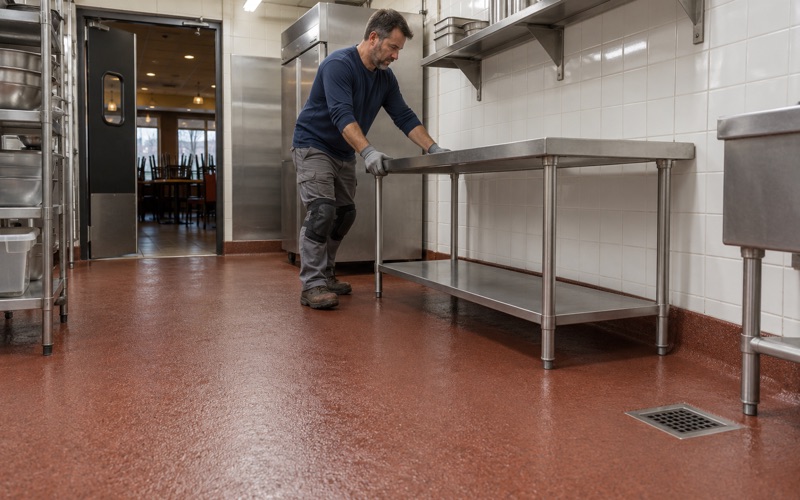
Palatine Epoxy Floors brings more than 20 years of epoxy-flooring work to River Grove, and much of what we quote in this village is a floor people walk on while they shop, eat or wait for service. A storefront stripped to bare concrete, a restaurant kitchen facing inspection and a service bay with oil worked into the slab each shape how we plan a job here.
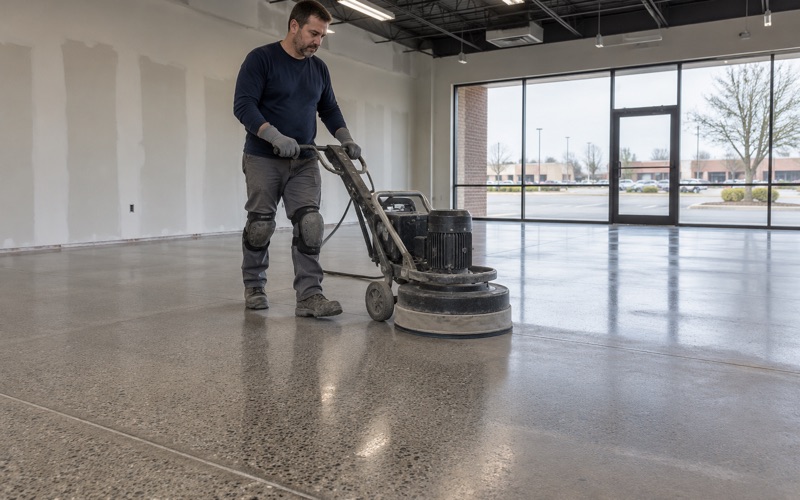
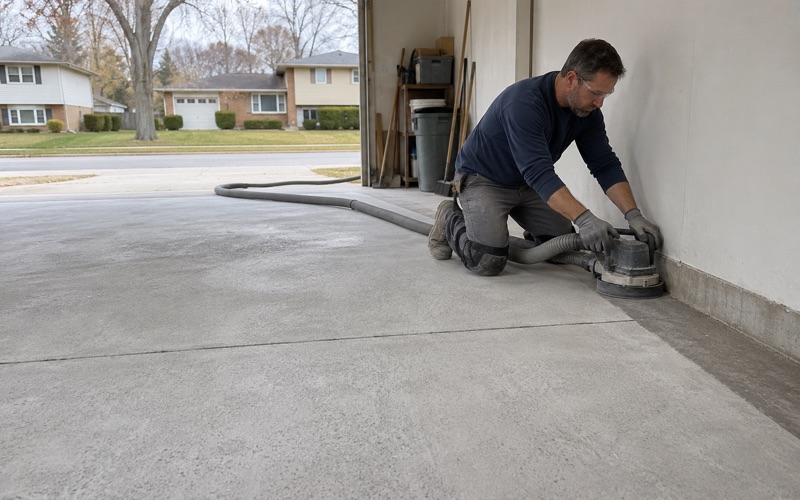
Every system starts with a slab opened mechanically. We grind with diamonds or shot blast to the surface profile the primer calls for, and we never acid etch, because an etched slab gives a coating far less to hold. Our proposal names the product, the system build and the finished thickness, so an owner or landlord can check what was quoted against what went down.
We coat home garages and basements here as well. The commercial side, though, is where the village has pointed its own planning, and that changes how a job is scheduled, reviewed and handed back to the people who run the space.
Three TIF Districts on Grand and Thatcher
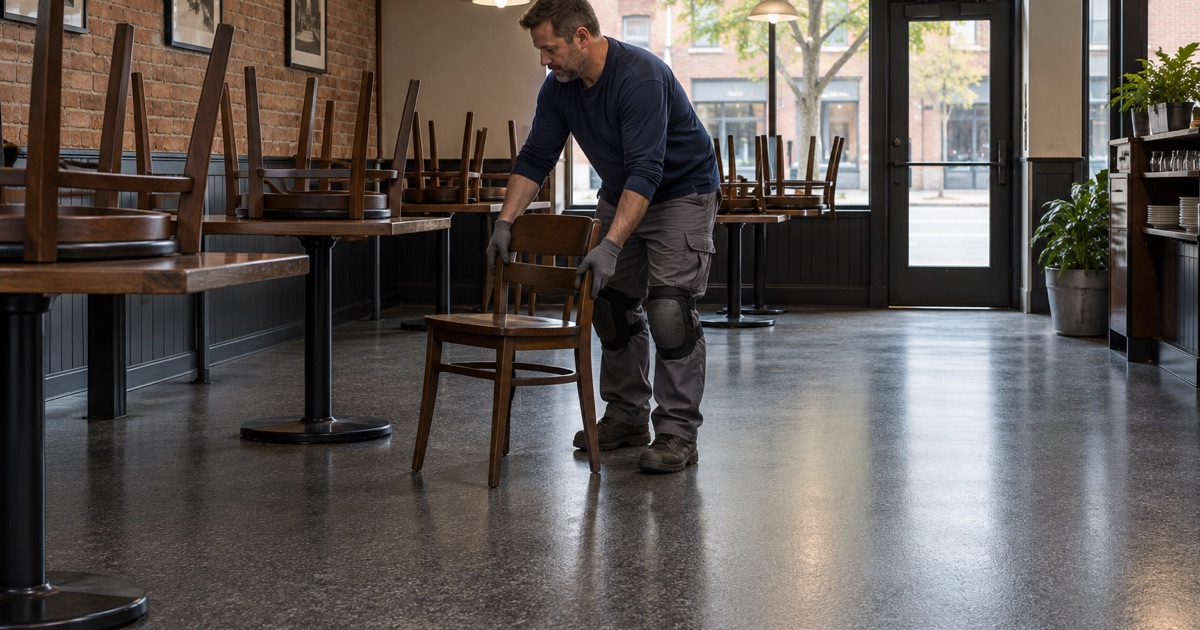
River Grove has decided where it wants new business to land. The village’s 2023 annual comprehensive financial report names commercial and retail development along the Grand Avenue and Thatcher Avenue corridors, backed by tax increment financing in three districts: Grand Thatcher, Belmont Thatcher and the Northeast TIF.
For a flooring contractor, that is less a policy than a pattern of buildings. A TIF corridor tends to collect tenant turnovers, renovated storefronts and owners reinvesting in older spaces, and each one arrives with a slab that already has a history. The Grand Thatcher district puts both corridors in one frame, which is why we treat them as one market when we estimate.
What a Corridor Storefront Slab Usually Hides
A retail space on Grand Avenue, or a tenant bay in a strip center such as Thatcher Woods Shopping Center, may carry layers of vinyl tile, black mastic, thinset and old paint from earlier tenants. We read the cracks and the old coating before we price anything, and we say plainly when a slab needs repair first. Mastic left under a new epoxy is a common reason a commercial floor lets go in patches.
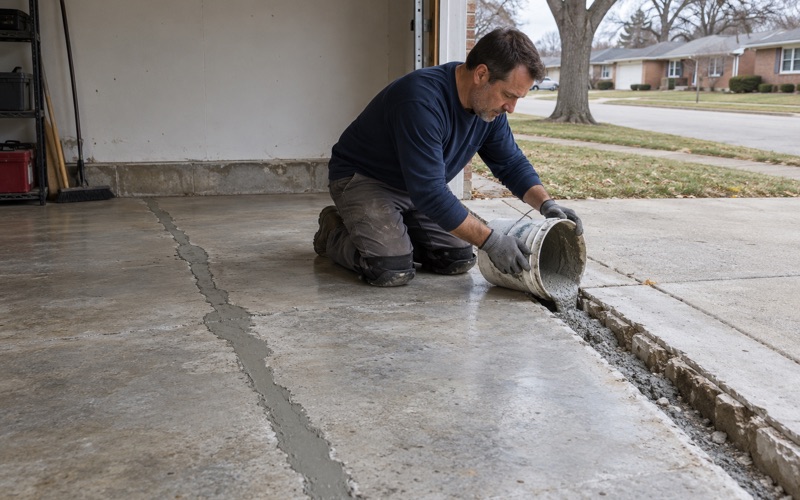
We remove what has to come off, grind to an ICRI CSP profile that suits the primer, and fill cracks and spalls with a compatible repair material. When a crack is a moving joint rather than a settled one, we tell the owner before the job. A coating is a film that follows the slab under it, and no coating stops a building from moving.
From Industrial to Retail: A Rezoned Parcel
The village has also rezoned a long-vacant 90,000-square-foot industrial parcel for retail and service uses, a change the county hazard plan’s River Grove annex quotes from a 2015 village posting. We have not confirmed what, if anything, has been built there, and we will not describe it as if we had.
What the rezoning does show is the direction: industrial ground turning into floors for shoppers and service customers. A reused industrial slab can be thick, stained with years of oil and finished for forklifts rather than foot traffic. Shot blasting opens that kind of surface well, and a section soaked through with oil may need degreasing or cutting out before any primer will bond.
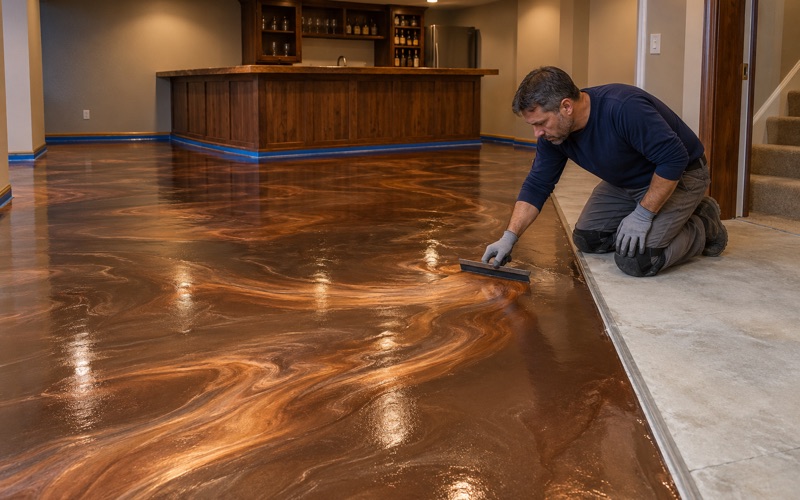
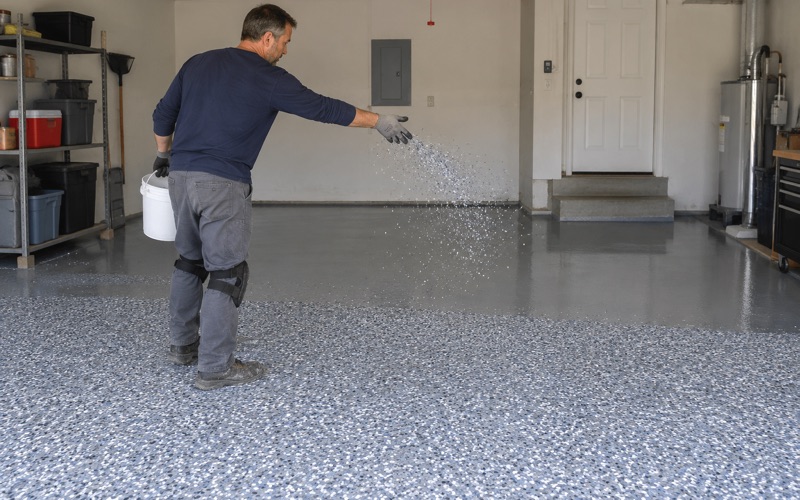
Retail tenants usually want a cleaner look than a plant floor ever had. On a converted slab we often pair a 100% solids epoxy base with a vinyl flake or quartz aggregate broadcast and a polyaspartic topcoat, which holds up to scuffing at entrances and checkout lanes. Where a tenant prefers bare concrete, a ground and polished finish with a lithium silicate densifier is the other route.
Looking for epoxy-flooring closer to Winfield? See Epoxy-Flooring Services in Winfield.
Restaurant Kitchens and Dining Rooms on Grand Avenue
Food service often fills a large share of a commercial corridor, and a kitchen floor is the hardest-working floor on the street. It takes hot water, grease, cleaning chemicals, dropped pans and a mop every night, and it has to stay safe to stand on while wet.
Urethane Cement Where the Heat and Water Are
For a cook line, dish room or walk-in threshold, we usually specify urethane cement rather than a thin epoxy. It tolerates thermal shock from hot washdown water far better, and it takes a quartz aggregate broadcast for slip resistance. Dining rooms and front counters, where the wear comes from foot traffic and chair legs, can carry a decorative epoxy and polyaspartic system that looks finished rather than industrial.
Cook County Health Review for a Food-Service Floor
Restaurants in River Grove answer to the Cook County Department of Public Health, and the village code carries its own Chapter 21 on food sanitation. The Illinois Food Code adopts the 2022 FDA Food Code, which asks for floors that are smooth, durable and easily cleanable, allows antislip surfaces where they are needed under section 6-201.11, and addresses coved floor and wall junctures under 6-201.13.
No floor product carries a health department approval of its own, so we never sell one that way. What we build is the floor an inspector will look at: a cove base run up the wall, tight terminations at floor drains and trench drains, sealed joints and a texture matched to the room. The operator handles the review itself, and we supply the system data the reviewer asks for.
Kitchens on an older corridor often sit on slabs poured long before current practice, sometimes with no vapor retarder underneath. Moisture pushing up through a kitchen floor shows up as blisters under the coating, so we test before we choose the system, and moisture is the first exclusion we read out in the warranty.
Keeping a Shop Open While the Floor Goes Down
A storefront that closes for a week loses a week of sales, so scheduling is part of the scope from the first walk-through. We plan commercial jobs around the hours the building has to stay open, and we keep grinding inside the hours River Grove allows for construction noise.
Working in Zones
In a shop or service counter, we can split the floor into sections and finish one while the business runs in the other. A grinder tied to a dust-extraction vacuum keeps the open side usable, and barriers keep customers off fresh coating. Restaurants usually prefer an overnight start or a closed day.
A service shop with vehicle bays raises a different question: oil, brake fluid and hot tires on a floor that cannot close for long. A broadcast epoxy with a chemical-resistant topcoat, laid one bay at a time, keeps the rest of the shop working.
Fast Topcoats and Honest Cure Times
Polyaspartic and polyurea topcoats return a floor to foot traffic much sooner than a standard epoxy, which helps a business that can spare only a short window. Speed still has limits. We schedule each coat against slab temperature and the dew point spread at the slab surface rather than the clock, because a coat laid on a cold, damp slab can blush or stay soft.
Amine blush left on an epoxy coat keeps the next layer from bonding, so we check for it before recoating. An unheated former industrial space in January is the usual problem case: if the heat is not on, we say so before the job and wait for it.
Who Signs Off in the Village
Commercial work goes through the Village of River Grove Building Department on Thatcher Avenue, and fire-code questions go to the River Grove Fire Department. Its firefighters are part-time and work full-time at other departments, with six full-time equivalents on duty at all times, so we raise any fire-code question early instead of at the end.
Illinois issues no state license for flooring or coatings work. Instead of a license number, we show the village registration, the bond and the certificate of insurance naming the village that River Grove asks of contractors.
Testing the Slab and Choosing the System
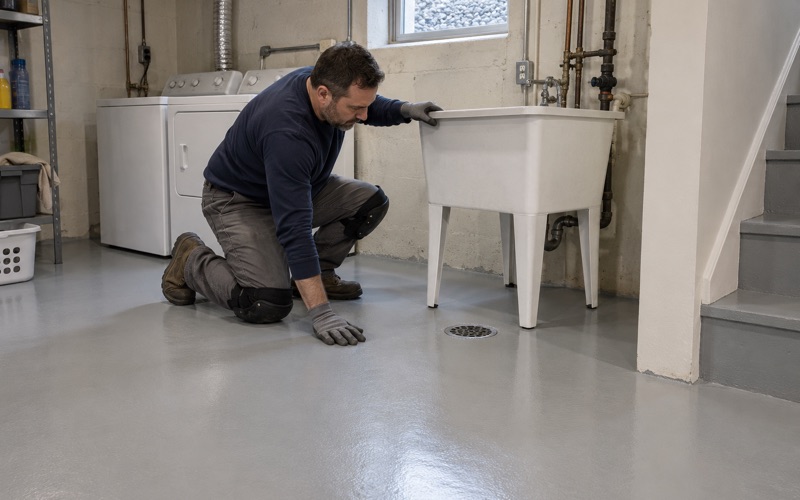
Moisture testing is a line item in every scope we write, on a restaurant slab, a storefront or a home garage. A floor that blisters months after the job usually had a moisture problem that nobody measured, and we would rather find it before the coating is bought.
Three Tests and What They Tell Us
An ASTM D4263 plastic sheet test is a quick first look, but it only shows whether moisture is present. For numbers, we run ASTM F1869 calcium chloride tests for vapor emission rate and ASTM F2170 in-situ relative humidity probes set into the slab. We compare the results against the limits the coating manufacturer publishes, and against ASTM F710 thresholds when a resilient floor might go down instead.
When the readings run high, a moisture-mitigation primer under the system is often the answer, and it goes into the proposal as its own line. When they run too high for any primer we trust, we say that plainly rather than coat the slab and hope.
Garages on a Small Built Footprint
About half of River Grove is open space, with 350 acres of forest preserve and 290 acres of golf courses and cemeteries, so its homes and businesses share a compact built footprint. The garages on the residential streets near the corridors get the same testing as a storefront, because the model code exempts garage slabs from a vapor retarder and a newer slab is not automatically a dry one.
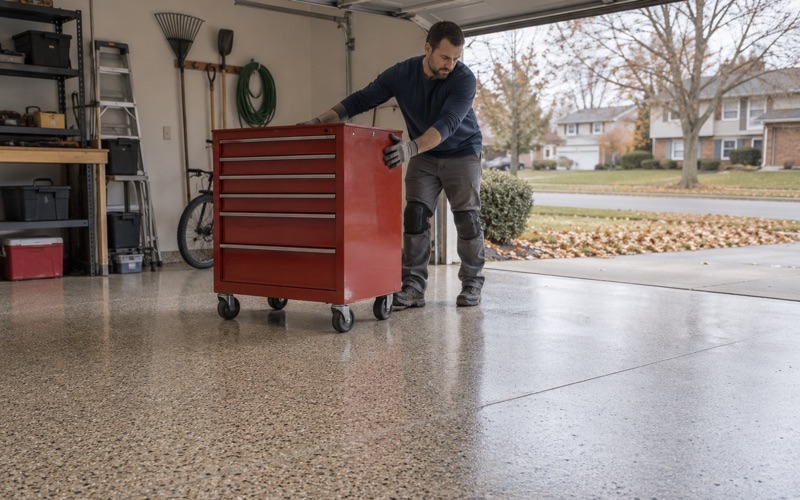
A garage floor here also has to survive calcium chloride brine and rock salt tracked in on the tires all winter, plus hot tire pickup in summer. A 100% solids epoxy base under a polyaspartic topcoat handles both better than a thin store-bought kit. Every home job gets a written contract and the Home Repair: Know Your Consumer Rights pamphlet before work starts, as the Illinois Home Repair and Remodeling Act requires.
Coatings Chosen Within the VOC Limit
Illinois sets a limit on the VOC content of architectural coatings, and that limit binds the installer as well as the manufacturer. We choose floor products within it, which matters most in an occupied storefront or a kitchen that reopens the next morning. We also do not sell a floor coating as radon reduction; in Illinois that work takes a state radon mitigation license.
- 20+ Years Coating Concrete
- Moisture Tested Before We Coat
- Free Written Estimates