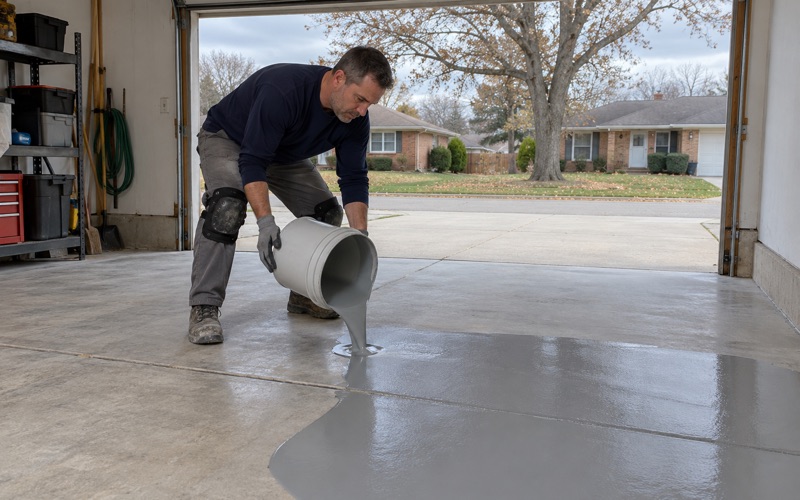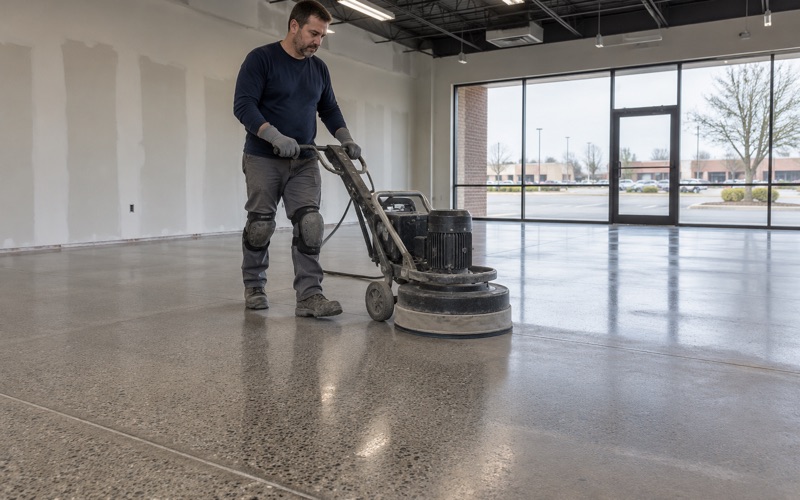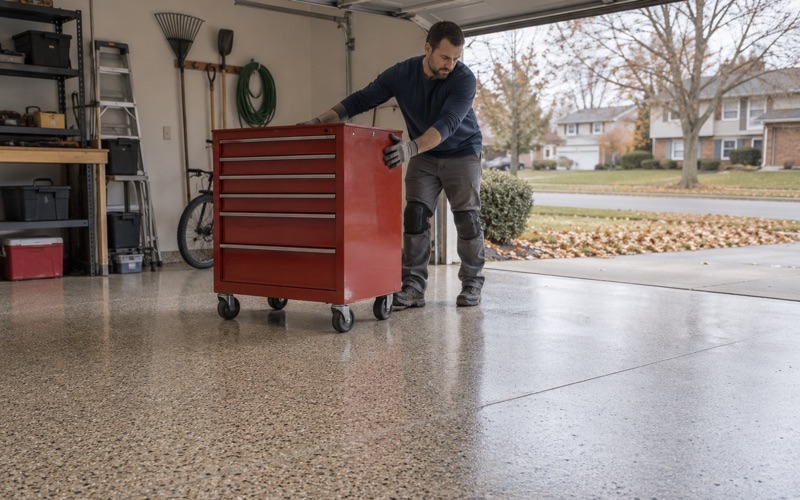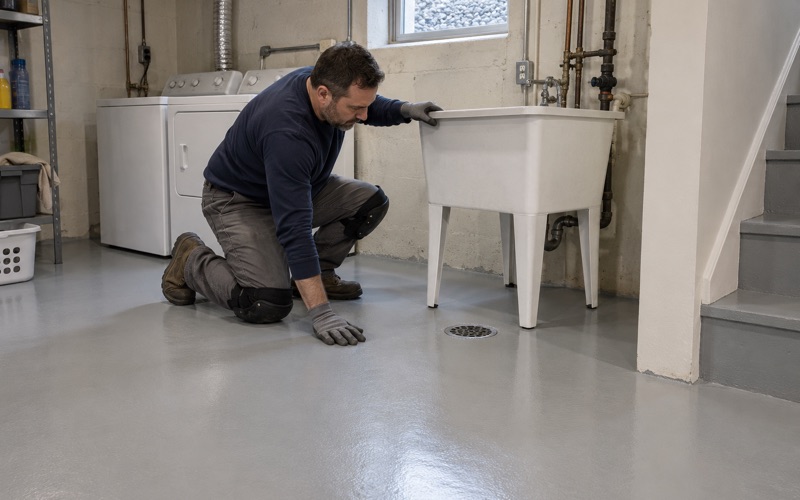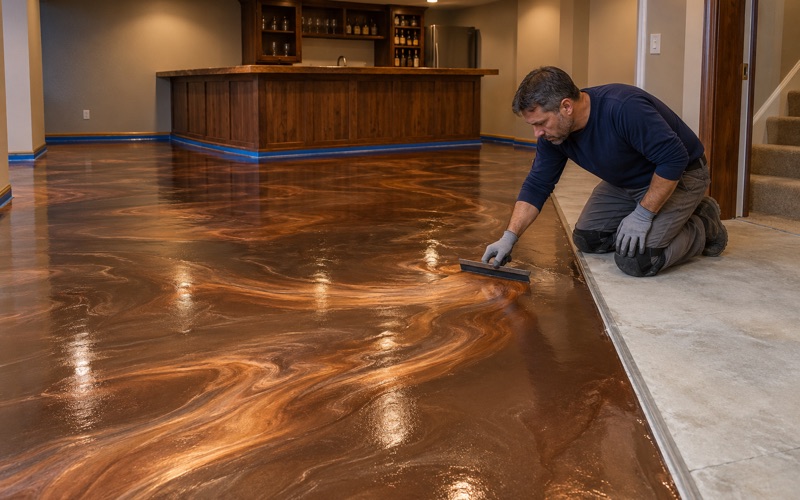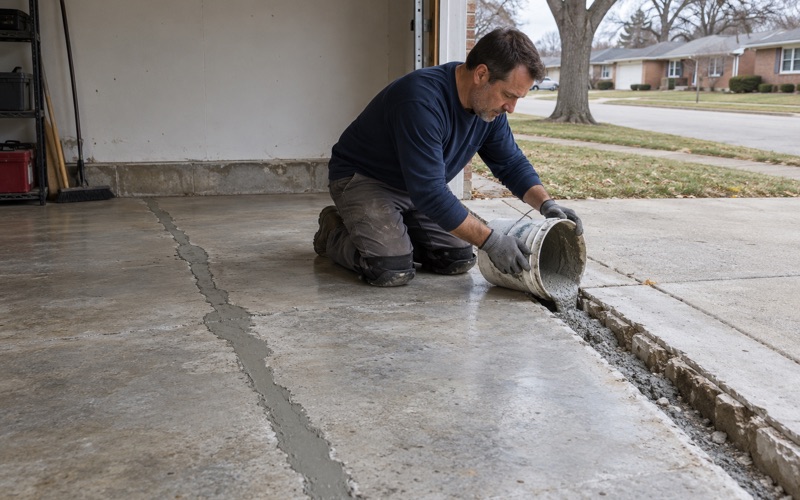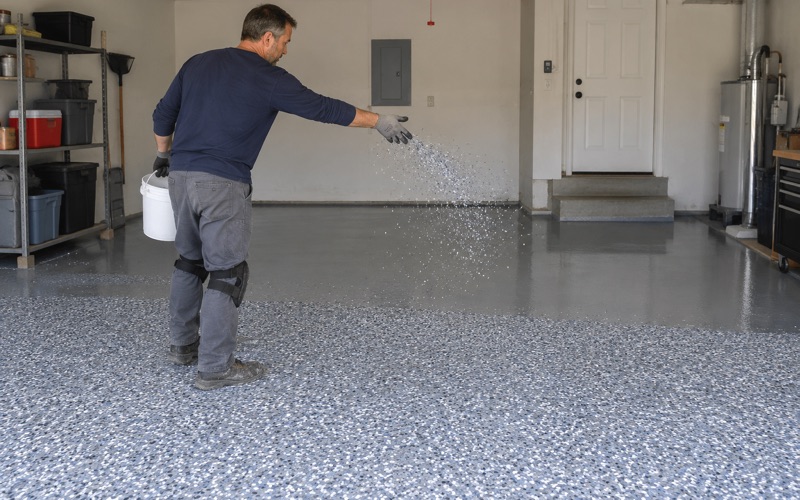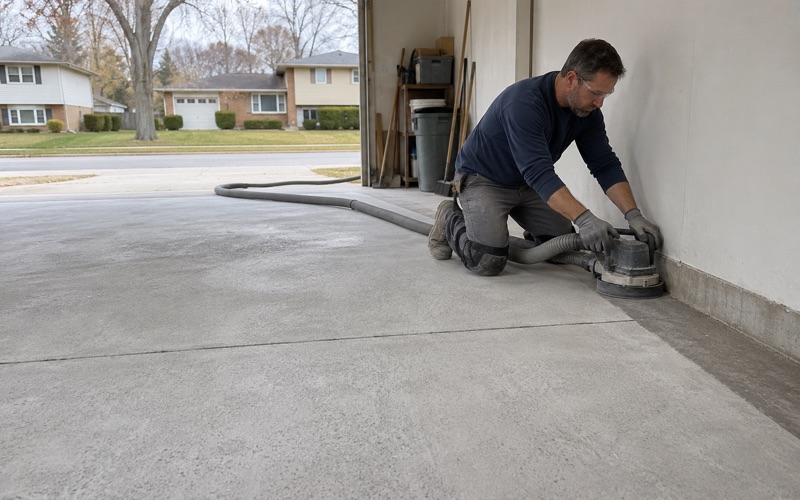
Palatine Epoxy Floors brings more than 20 years of experience to epoxy flooring in River Forest, and each job begins with the slab opened mechanically by a diamond grinder or shot blaster. We do not acid etch. A ground profile is what a 100% solids epoxy or a polyaspartic topcoat grips, and a coating laid over a slick, unopened surface is a coating waiting to let go.
Before any of that, we test. Moisture testing is written into the scope as its own line, whether the slab sits under a house or under a garage door, because a reading taken before the coat costs far less than a blister found after it. The same proposal names the product, the system build and the finished thickness, so the floor that goes down can be checked against the floor that was quoted.
That approach serves a homeowner’s two-car garage and a large institutional building in exactly the same way. In this village, institutional floors make up a large share of everything that is not a house.
A Village That Is Half Tax-Exempt
River Forest is landlocked inside about 2.5 square miles, and the village’s own annex to the 2024 Cook County multi-jurisdictional hazard mitigation plan describes how that ground is used. Half of it is tax-exempt. Twenty-nine percent is forest preserve. Those two figures explain who owns a large share of the floors outside its homes.
With that much ground set aside, the space left for conventional commercial buildings is limited. The village notes that its last major commercial development was Town Center I and II, in the mid-1990s. For a flooring contractor, that means non-residential work here tends to come from institutions rather than from strip centers or warehouses.
The village incorporated in 1880 and is governed by a president and six trustees, with its building codes in Title 4, Chapter 1 of the Municipal Code. It also sits in River Forest Township, its own township rather than part of Proviso. For a homeowner, the practical point is simpler: the Village of River Forest is the building authority, and in place of a license number we show the registration, bond and insurance the village asks for, because Illinois issues no state license for flooring or coatings work.
Two universities inside one small village
Concordia University Chicago and Dominican University, which was known as Rosary College before taking its current name, both make their home here. Add Trinity High School and the result is three campuses sharing one small village.
We want to be plain about our role. None of these institutions is named here as a customer. What we can describe is how the floors inside buildings like theirs behave, and what a responsible coating proposal for them has to cover.
Looking for epoxy-flooring closer to Pingree Grove? See Pingree Grove Epoxy-Flooring.
Campus Floors From Labs to Maintenance Shops
A campus is not one floor but a dozen different ones, each failing in its own way. We scope them separately, because a system that is right for a maintenance bay is wrong for a dining kitchen. Each room also gets its own surface profile. Thin coatings generally want an ICRI CSP 2 to 3 profile, while a heavier urethane cement build calls for a rougher profile, often CSP 4 or more, which pushes the job toward shot blasting.
Laboratories and static-sensitive rooms
Science labs see spilled reagents, rolling carts and frequent wet cleaning, so a seamless 100% solids epoxy with a chemical-resistant topcoat is the usual starting point. Rooms that house sensitive electronics may need static-dissipative or ESD flooring, and that is a specification with a stated resistance range, not a color choice. We build to the range the room’s owner specifies and test against it.
Locker rooms and athletic spaces
Locker rooms and team facilities live wet. A quartz aggregate broadcast locked under a clear topcoat gives bare feet and shoes something to grip, and coving the floor up the wall keeps water out of the joint where wet-room floors commonly start to fail. Floor drains get detailed so the coating turns down into the drain body instead of stopping short at its rim.
Dining halls and food service
Food-service floors in Illinois answer to the Illinois Food Code, which adopts the 2022 FDA Food Code. Section 6-201.13 calls for coved junctures where floor meets wall in the spaces it covers, and section 6-201.11 carries an exception that allows antislip floor finishes. Urethane cement is often the right build for a kitchen that sees hot-water washdowns, because it tolerates thermal shock better than a standard epoxy. In suburban Cook County, the health authority for food service is the Cook County Department of Public Health.
Maintenance shops and grounds buildings
Grounds and facilities shops take dropped tools, forklift or cart traffic, hydraulic fluid and the calcium chloride and rock salt that vehicles track in all winter. We specify a thicker 100% solids build with a polyurea or polyaspartic topcoat here, and we read every crack and patch before quoting. Where a slab needs repair before it can be coated, the proposal says so in writing. For a storage room that only needs dust control, a lithium silicate densifier on ground concrete can be enough, and we will say so rather than sell a full coating.
Forest Preserve Headquarters and a Nature Museum
River Forest is home to the headquarters of the Cook County Forest Preserve District and to Trailside Museum. Buildings that serve an outdoor agency and its visitors tend to see mud, wet boots and grit carried in from outside. We describe below how we approach floors of that kind; we make no claim to have worked in either building.
Entryways, corridors and public rooms
Public-facing floors need to read as clean while hiding the grit underfoot. A vinyl flake broadcast in a muted blend, sealed under a polyaspartic topcoat, does that well, and its fast return to service suits a building that cannot close a wing for a week. Walk-off zones at entrances get extra texture so a wet sole has something to catch. Cleaning crews in public buildings often use auto-scrubbers and neutral cleaners, and we leave written care instructions that match the topcoat we installed.
Vehicle bays and equipment storage
Institutional vehicle bays and equipment storage rooms face the same brine and rock salt as any northern Illinois garage, only at a heavier scale, and meltwater tends to pool around their drains. We detail sump pits and floor drains carefully, and we choose coatings within the Illinois VOC limits in 35 Ill. Adm. Code Part 223, Subpart C, which bind the installer as well as the manufacturer.
Moisture under older institutional slabs
Large slabs poured decades ago may have no vapor retarder beneath them, and a coating sealed over a damp slab can blister once vapor pressure builds. We run ASTM F2170 in-situ relative humidity probes, or ASTM F1869 calcium chloride tests where the specification calls for them, and compare the readings against ASTM F710 thresholds. When the numbers are high, a moisture-mitigation primer goes into the build and the proposal states it before the job is sold.
Moisture is also the first exclusion we read aloud from any warranty, and we say before the job that a coating is a film that follows the slab under it. It will not stop a crack from moving; it will show where the concrete moved.
Scheduling Around Academic Calendars and Households
Institutional floors run on a calendar that someone else sets. A coating job inside a school building has to fit a break, a weekend or an evening window, and the system has to be chosen to fit that window rather than the other way around.
Breaks, weekends and fast-return systems
Commercial and institutional jobs are scheduled around the hours a building has to stay open. Over a short break, a polyaspartic or polyurea topcoat can return a room to foot traffic far sooner than a slow-cure epoxy, though the grinding, patching and testing still take the time they take. For longer breaks, a full 100% solids epoxy build with a urethane topcoat gives more film thickness and more working time.
Curing is planned against slab temperature and the dew point spread at the slab surface, not against the date on the calendar. A cold slab under warm, humid air invites amine blush on an epoxy, which leaves a greasy film that weakens the next coat. We measure before each coat and wait when the readings say to wait. In an unheated garage, that sometimes means telling a homeowner the job has to wait for spring.
Village construction hours
Diamond grinding and shot blasting are loud, and dust collection does not change that. We schedule that work inside the construction hours the Village of River Forest allows, which matters in a compact village where campuses and houses sit close together.
Garages at owner-occupied homes
Most River Forest households own their homes: 3,911 of 4,460 occupied units, or 87.7 percent, are owner-occupied, and 2,617 of those are detached houses. Every home job gets a written contract and the state’s Home Repair: Know Your Consumer Rights pamphlet before work starts, as the Illinois Home Repair and Remodeling Act requires.
A newer garage is not automatically a dry one. The model residential code exempts garages from the under-slab vapor retarder requirement in IRC R506.2.3, so we test a garage slab before we coat it, starting with an ASTM D4263 plastic sheet test and moving to quantitative readings when it shows condensation. Garage systems are built for the deicer brine that tires carry in, and a properly cured polyaspartic topcoat resists the hot tire pickup that lifts thin, poorly bonded coatings. One more boundary: we do not sell a floor coating as radon reduction, because in Illinois that work requires a radon mitigation license from IEMA.
Attached homes and shared driveways
Census figures count 173 owner-occupied attached homes in River Forest, and garage work at a townhome runs on the association’s rules as much as on ours. We set dates that keep neighbors’ own garages reachable, stage equipment where the association allows it, and confirm working hours before the grinder arrives.
Whether the floor belongs to a household or a campus, the sequence does not change: test, grind, repair what needs repair, then coat to the build the proposal named. What changes in River Forest is whose calendar sets the dates, and we plan around it from the first site visit.
- 20+ Years Coating Concrete
- Moisture Tested Before We Coat
- Free Written Estimates