Palatine Epoxy Floors has put more than 20 years into epoxy flooring in Prospect Heights and across the northwest suburbs, and on almost every basement or garage we look at here, the first conversation is about moisture rather than color. A coating is a thin film bonded to concrete. It can only perform as well as the slab under it allows, so we start with what is happening inside that slab.
That means a site visit before a price. We read the cracks, look at whatever coating is already down, and write moisture testing into the scope as its own line item, whether the floor is a basement slab or a garage slab. If the concrete needs repair before it can hold a coating, we say so at that first visit instead of discovering it halfway through the job.
The proposal we hand over names the product, the system build and the finished thickness, so you can hold what went down against what was quoted. Warranty exclusions are read aloud before anything is signed, and moisture is the first one we name. On a home job you also get a written contract and the state’s consumer-rights pamphlet before work starts, as the Illinois Home Repair and Remodeling Act requires.
Levee 37 and the Des Plaines River’s West Bank
Along the western side of town, the Des Plaines River shapes how we approach a floor. Levee 37, also called the Mount Prospect/Prospect Heights Levee, runs between Palatine Road and Euclid Avenue on the west side of the river. It is a Metropolitan Water Reclamation District project, work on it began in spring 2009, and it protects more than 600 existing homes and dozens of businesses in Mount Prospect and Prospect Heights.
That 600-plus figure covers both communities together, so it says nothing about how many of those homes sit on this side of the municipal line. What it does tell us is that a real stretch of the river corridor relies on engineered protection, and an owner there should know where their parcel stands before deciding how much to put into a basement floor.
What a levee changes, and what it does not
A levee is built to hold back river water during high flows. It does nothing about the water already in the ground beneath a house. Groundwater still rises and falls around a foundation, and a slab still releases moisture upward from the soil below it. That vapor drive is what lifts a coating off concrete, and it is why our testing does not stop at a property’s flood status.
Commercial floors in the corridor
The businesses behind the levee have floors too: shop bays, back rooms and showrooms. On a commercial job we schedule grinding and coating around the hours the building has to stay open, and we ask the same moisture questions we ask in a basement. Building and permitting sit with the City of Prospect Heights, while the fire authority is the Prospect Heights Fire Protection District, a separate taxing district rather than a city department. Its roughly 5 square miles do not line up exactly with the city limits, so we confirm which offices an address actually answers to before work is booked.
Looking for epoxy-flooring closer to Deerfield? See Epoxy-Flooring in Deerfield.
Floodplain Status Is a Parcel Question
Prospect Heights covers 4.29 square miles in Wheeling Township, Cook County, and the river corridor is only one part of that. Two houses a few streets apart can carry different flood designations, different drainage and different basement histories. We have not checked any street or neighborhood here against a flood map, and we will not guess at yours. The parcel’s own designation is the place to start, and it is worth confirming before a basement quote rather than after.
Questions we ask before quoting a basement
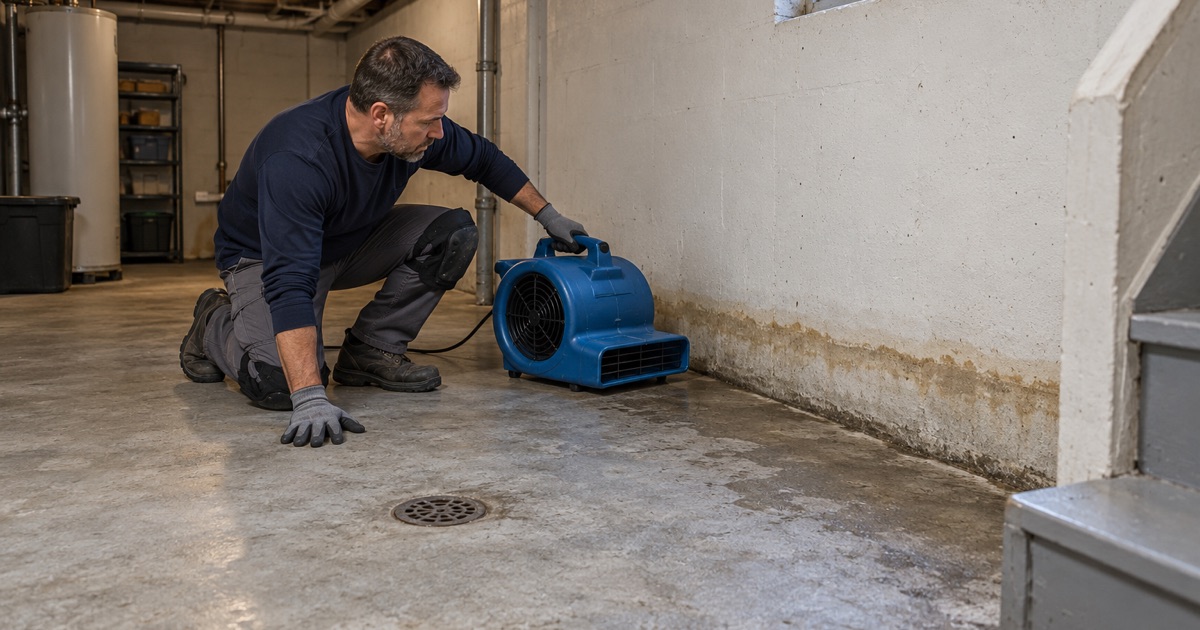
You know your house better than any test does, so we ask. Does the sump pump run often, and in which months? Has a floor drain ever backed up? Is there an overhead sewer, a check valve or a footing drain that was disconnected at some point? Does a white mineral bloom, called efflorescence, show along the walls or in the cracks? Each answer moves the system we recommend, and a few of them move it a long way.
Hydrostatic pressure under the slab
When groundwater pushes against the underside of a basement slab, that hydrostatic pressure can carry moisture and dissolved salts up through the concrete. A standard epoxy laid over that condition will blister. Depending on the readings, the answer may be a moisture-mitigation primer under the system, a urethane cement build, or a plain recommendation to deal with the drainage first. We would rather tell you a floor is not ready than coat it and watch it fail.
Drains, pits and what a coating cannot do
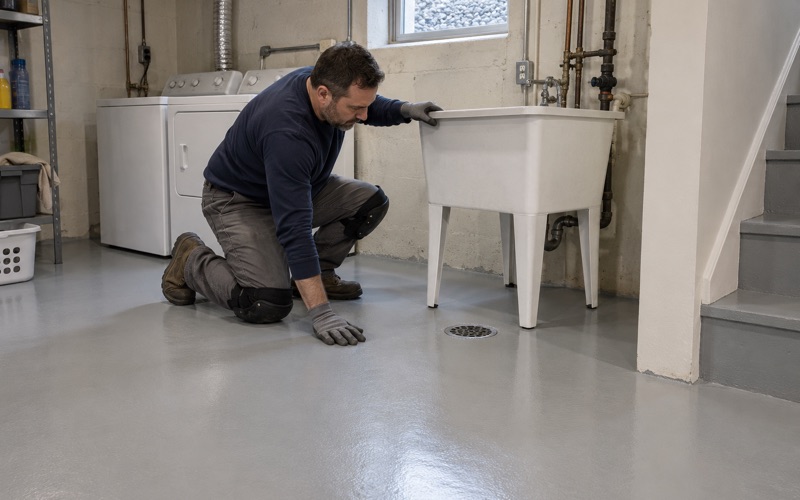
Around a sump pit or a floor drain, the coating has to end in a clean, bonded edge rather than feathering loosely into the opening, and we detail those terminations by hand. No coating keeps river or groundwater out of a basement, and we will not describe one that way. What a well-built system gives a sound slab is a surface that cleans up, resists staining and holds its bond, as long as the moisture under it stays within the product’s limits.
2,147 Homes From the 1950s and 1960s
The city has 6,915 housing units. Of those, 1,237 were built in the 1960s and 910 in the 1950s, which puts 2,147 homes past the half-century mark, ahead of the larger 1970s and 1980s building waves that make up much of the rest. Older slabs are not bad slabs, but they arrive with decades of history we have to read before we price anything.
What an older slab usually brings
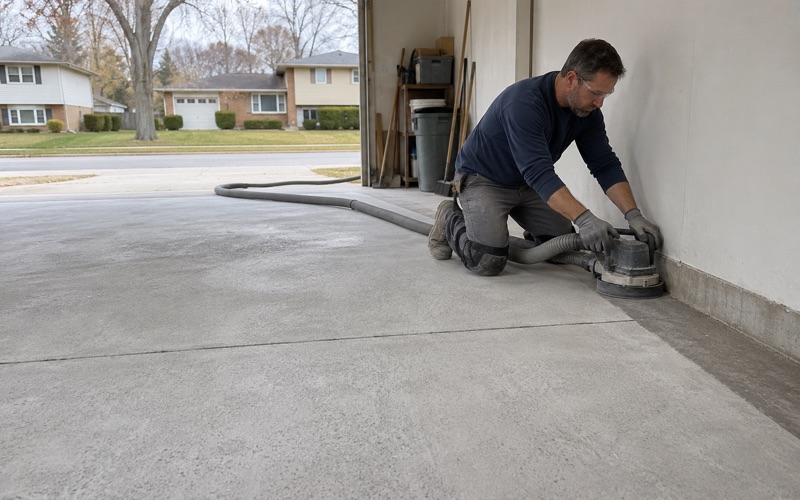
On a basement floor of that age we expect layers: old paint, tile adhesive, sealer from a previous owner, oil stains, and settlement cracks that have opened and closed for years. We do not assume a vapor retarder sits under a slab that old, and we test as though there is none. Every one of those layers comes off with a diamond grinder or a shot blaster, because a coating bonded to old paint is only as strong as that paint. We do not acid etch.
Newer garage slabs are not automatically dry
It is tempting to treat a recent pour as the safe one. It is not a safe assumption. Under IRC R506.2.3, a garage slab poured to code may have no vapor retarder beneath it at all, because the model code exempts garages from that requirement. A 1990s or 2010s garage gets the same moisture test as a 1958 basement.
Detached houses, townhomes and condominiums
There are 2,320 owner-occupied detached houses in the city, but more than half of all housing units sit in multi-unit buildings, and about one in nine is single-family attached. In a townhome or condominium building, a garage or storage-room floor is often an association decision. We schedule those jobs around the association’s rules and keep the neighbors’ access to their own garages open while we work.
Test the Slab, Then Choose the Coating
The order matters. We measure first and choose the system second, because the readings narrow the options more than any brochure does.
How we measure moisture
A plastic sheet taped to the slab under ASTM D4263 is a quick screen, not an answer. For numbers, we run ASTM F1869 calcium chloride tests for moisture vapor emission rate and set ASTM F2170 in-situ relative humidity probes into the concrete. Those readings are compared against the coating manufacturer’s limits and the thresholds referenced in ASTM F710. If they come back high, the scope changes before the price does.
Opening the surface
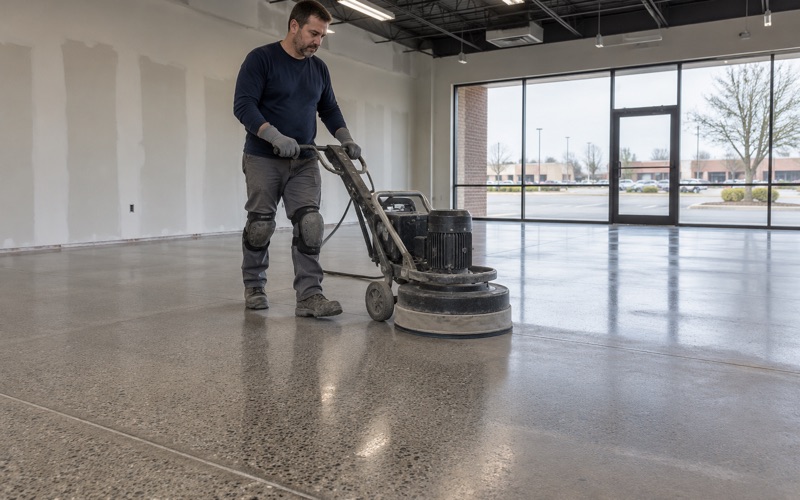
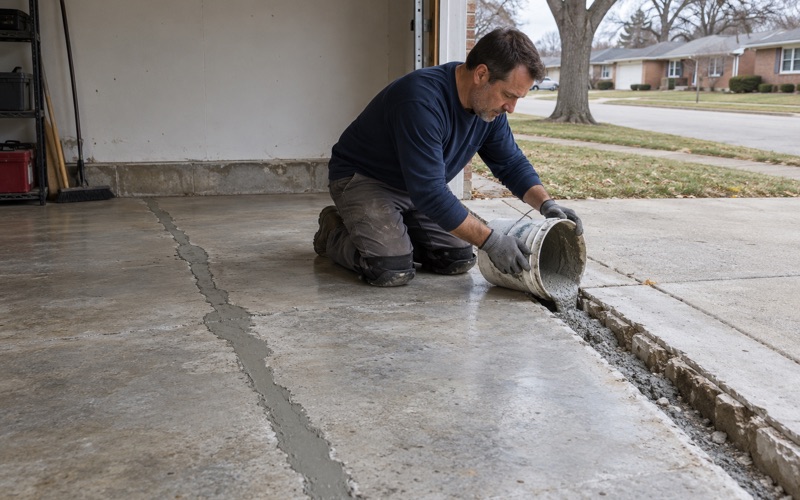
Grinding or shot blasting cuts the slab to a defined ICRI concrete surface profile so the primer can grip, and it shows us the true condition of the concrete once the old coatings are gone. Cracks are routed and filled, and spalls are repaired, before the first coat. We will also say plainly that a coating follows the slab beneath it; it bridges nothing that is still moving, and it will not stop a crack from working.
Building the system
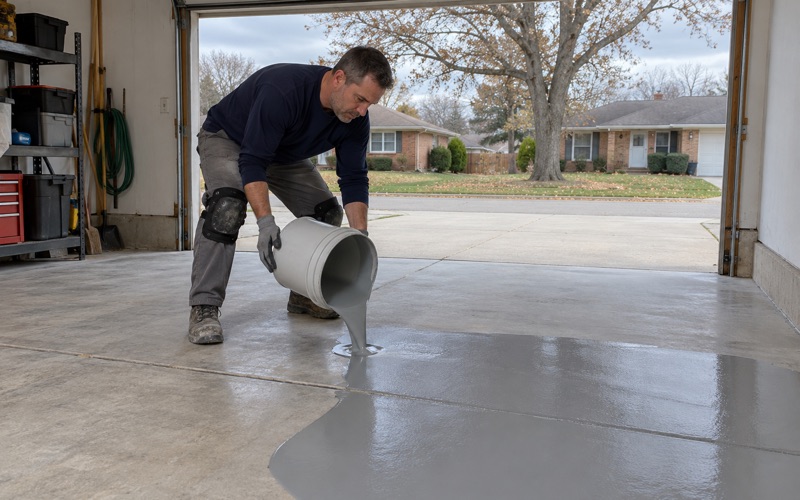
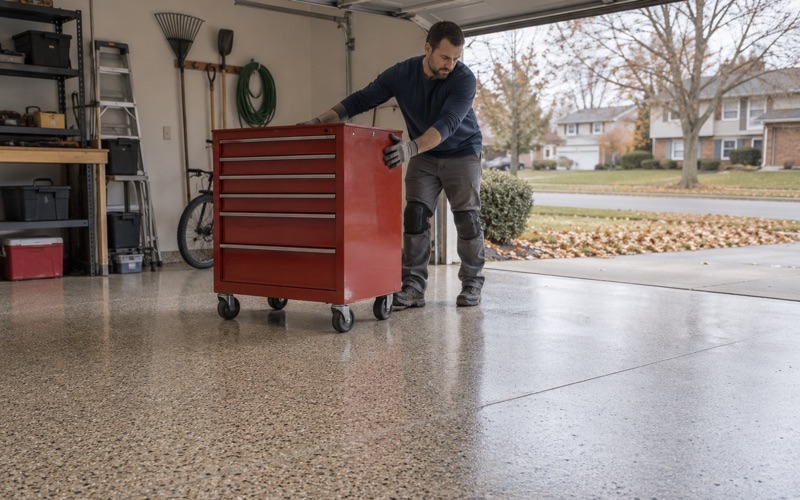
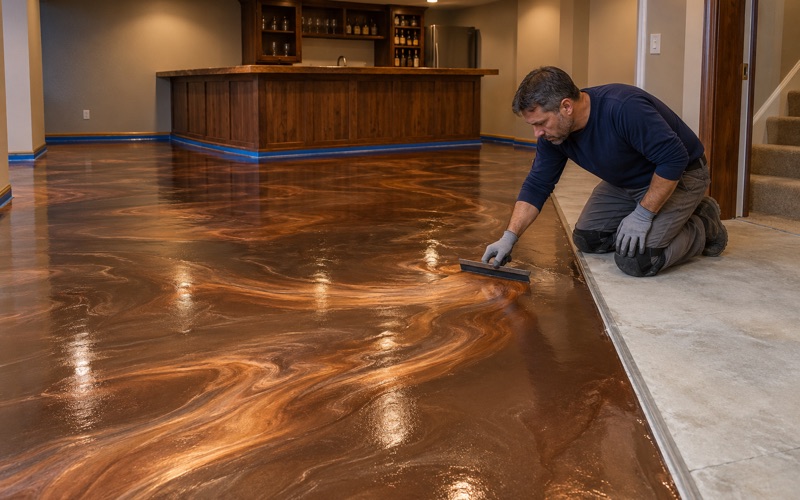
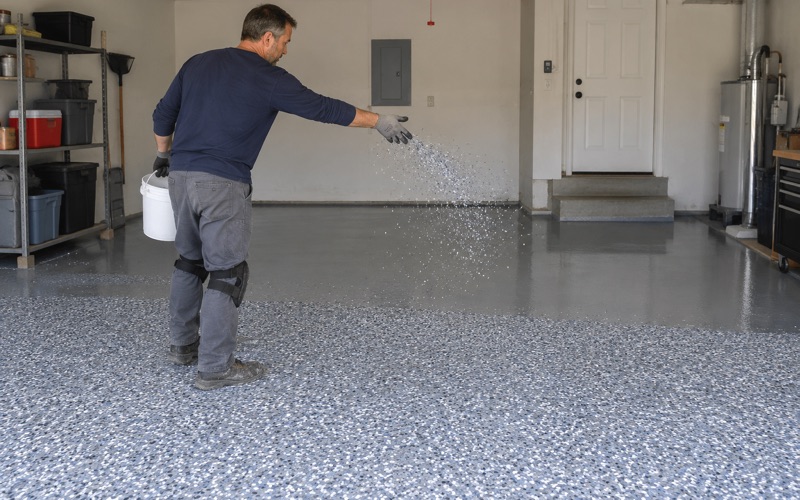
A typical garage build here is a 100% solids epoxy base with a vinyl flake or quartz aggregate broadcast, locked down with a polyaspartic topcoat that resists hot tire pickup. Basements with elevated readings may start from a moisture-mitigation primer or move to urethane cement. Every product we use falls within the VOC limits of 35 Ill. Adm. Code Part 223, which binds the installer as well as the manufacturer. We do not sell any of this as radon reduction, since that work requires an Illinois radon mitigation license.
Scheduling the work
Curing is scheduled against slab temperature and the dew point spread at the surface rather than a date on the calendar, which is how amine blush and soft coatings are avoided. Loud work stays inside the hours the city allows for construction noise. Illinois issues no state license for flooring or coating work, so in place of a license number we show the registration, bond and insurance the City of Prospect Heights asks for before we start.
- 20+ Years Coating Concrete
- Moisture Tested Before We Coat
- Free Written Estimates