Palatine Epoxy Floors brings more than 20 years of work to epoxy flooring in Pingree Grove, where most garage floors belong to one generation of builder-finished slabs. Many of them are now past the years when a new-house floor asks for nothing, and they have reached the point where an owner decides whether to repair, recoat or coat for the first time.
We start every one of those decisions the same way. We look at the cracks and any old sealer before we write a number, we list moisture testing as part of the scope, and we grind the surface open with diamond tooling or a shot blaster instead of etching it with acid. If the concrete needs repair before it can hold a coating, the quote says so first.
What follows is how we approach the floors that make up most of this village: what time does to a builder slab, how attached and detached homes differ on a job, and who has a say in the work. Where we are reasoning from a home’s age rather than from an inspection, we say so.
Nothing built from 1970 through 1989, then 1,519 homes from the 2000s
Pingree Grove’s housing record has an unusual gap in the middle. The ACS 2024 five-year estimates count zero units built in the 1970s and zero in the 1980s, out of 3,637 housing units in the village. A few older homes stand from earlier decades, 58 from the 1960s, 134 from the 1950s and 34 from before 1940, and then the record goes nearly quiet until the turn of the century.
Then the count jumps. The same survey records 1,519 units built from 2000 through 2009, 1,490 from 2010 through 2019 and 335 since 2020. The census population tells the story from another direction: 124 residents in 2000, 4,532 in 2010 and 10,365 in 2020.
Why the 2000s layer matters most
The 1,519 homes from the 2000s are the largest group from any single decade, and their garage slabs are now roughly 16 to 26 years old. That is well past the new-house stage, and young enough that many of those floors have likely never been coated, ground or repaired. We infer that from build era alone; nobody has surveyed these garages, and plenty of slabs from that decade are in sound shape.
For an owner, that age is where the question changes. A floor that looked fine at closing has since carried close to two decades of cars, storage and seasons, so the choice is no longer how to protect a new slab but what this particular slab needs before anything goes on it.
Homes from the 2010s sit just behind that group in number and will reach the same point in the years ahead. For now, the 2000s slabs are the ones where the repair-or-recoat question comes up first.
No middle generation of floors
With nothing built in the 1970s or 1980s, the village has no middle generation of garage floors. Most of what we see here is builder-era concrete, with a small group of older slabs beside it. That shapes how we quote, because the variables are less about removing decades of layered coatings and more about what a builder’s finish has done over time.
Looking for epoxy-flooring closer to Westchester? See Epoxy-Flooring in Westchester.
What two decades do to a builder-finished garage slab
A builder’s garage slab is usually poured, troweled and left. It may carry a cure-and-seal or nothing at all, and over 16 to 26 years it collects tire marks, oil, road grime and whatever spilled near the workbench. None of that is unusual, but each one changes how the surface has to be prepared.
Opening the surface
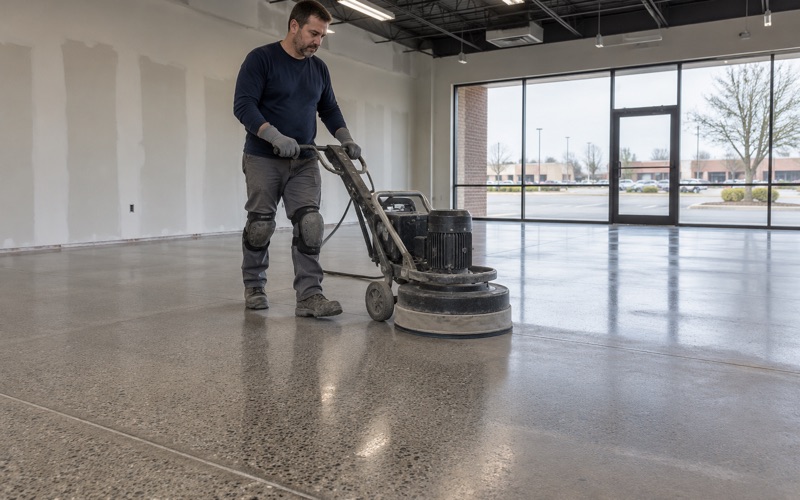
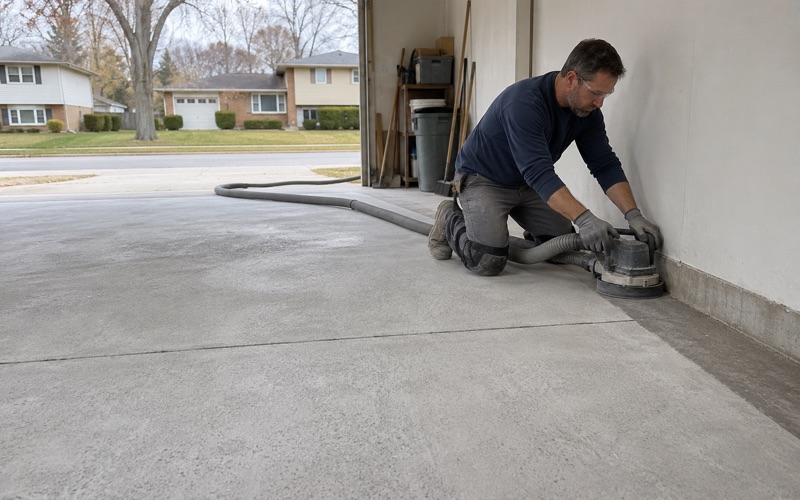
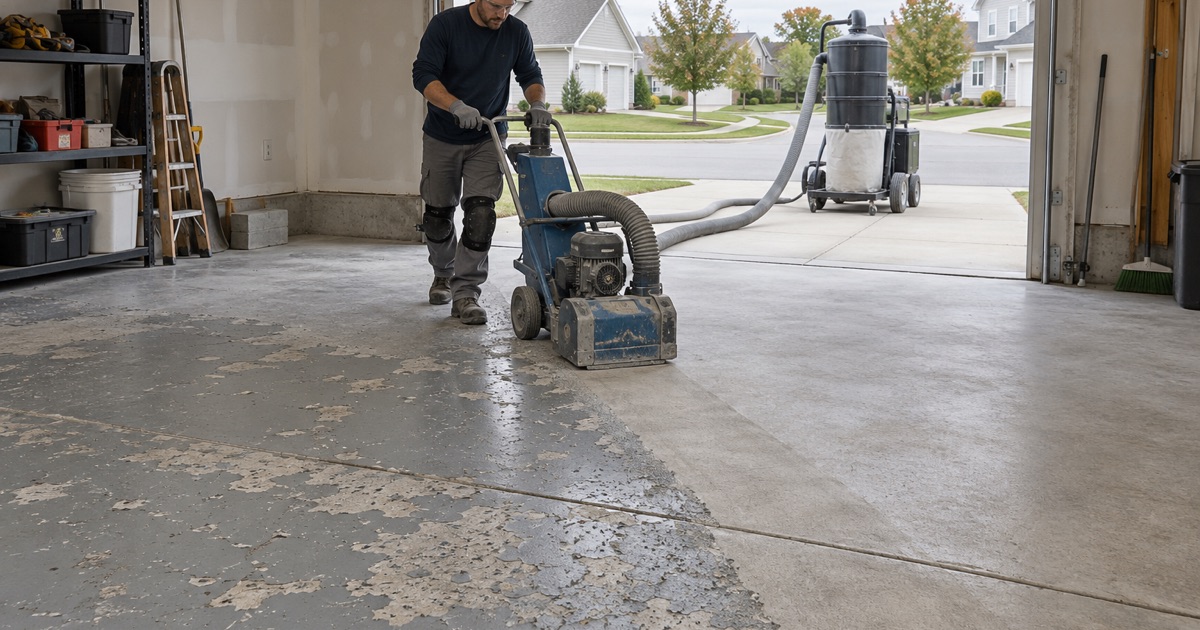
Old sealers, oil and a hard troweled finish all keep a coating from biting into the concrete. We open every slab mechanically, by diamond grinding or shot blasting, to an ICRI CSP profile that suits the system going down. We do not acid etch, because etching leaves a sealer in place and puts water and residue into a slab that then has to dry out.
Grinding also tells us something. How the diamonds cut, and whether the sealer gums them, shows how much of a builder’s finish is still on the slab and how hard the top of the concrete has become.
Reading cracks before quoting
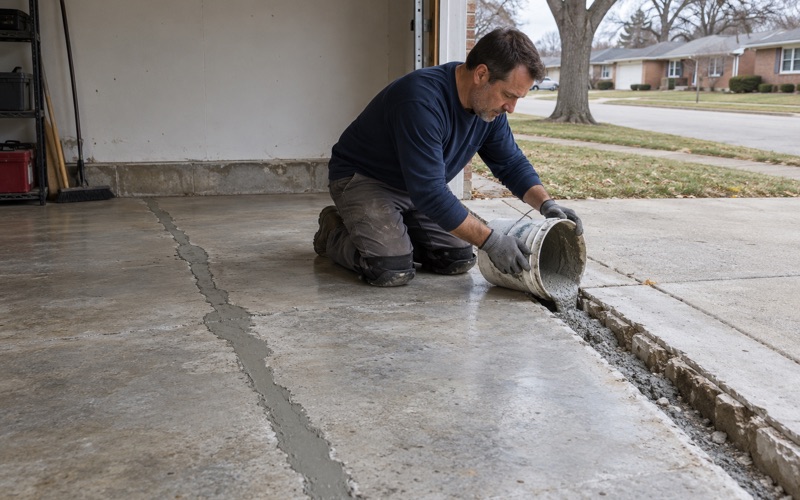
Two decades is long enough for shrinkage cracks to widen, for a control joint to spall at its edges and for a corner to settle. We walk the floor before we price it and tell you which cracks are cosmetic and which need repair first. We also say plainly that a coating is a film that follows the concrete under it, so it will not stop a slab from moving, and an active crack can show through.
Moisture in a slab that looks dry
A garage slab poured to the model residential code may have no vapor retarder beneath it, because that code exempts garages. We have not checked which code edition Pingree Grove adopted, so we assume nothing either way and test instead. Depending on the job, that means an ASTM D4263 plastic sheet test, an ASTM F1869 calcium chloride test or ASTM F2170 relative humidity probes, and if the readings call for it, a moisture-mitigation primer goes into the system.
Moisture is also the first exclusion we read aloud from the warranty, before the job is sold. A slab that tests well today is still concrete sitting on soil, and we would rather you hear that from us than learn it from a blistered floor.
First coating, recoat or repair
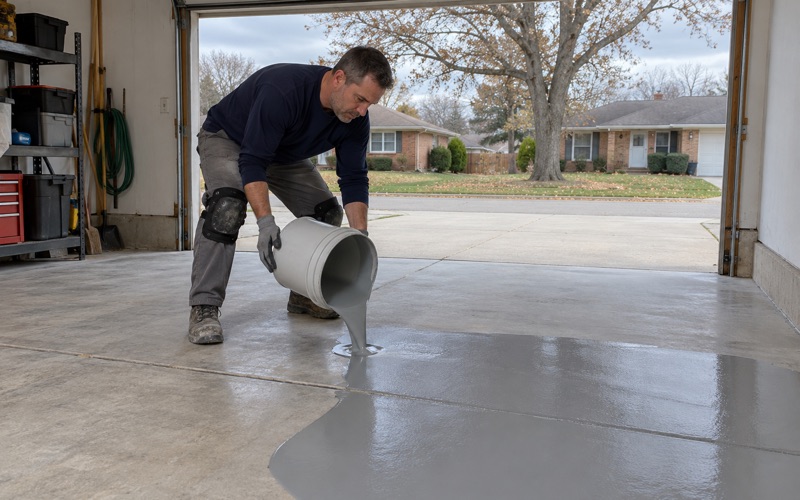
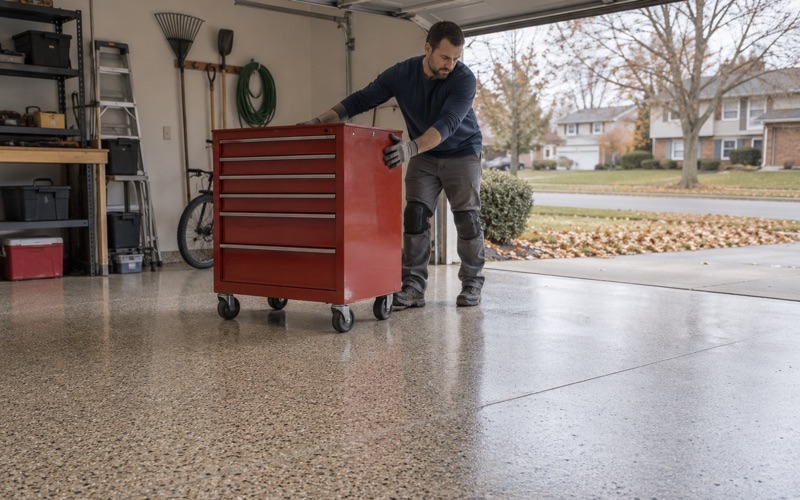
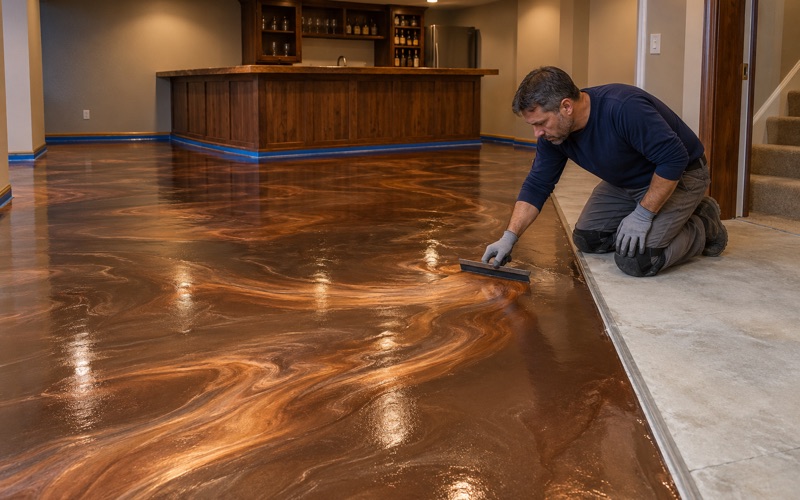
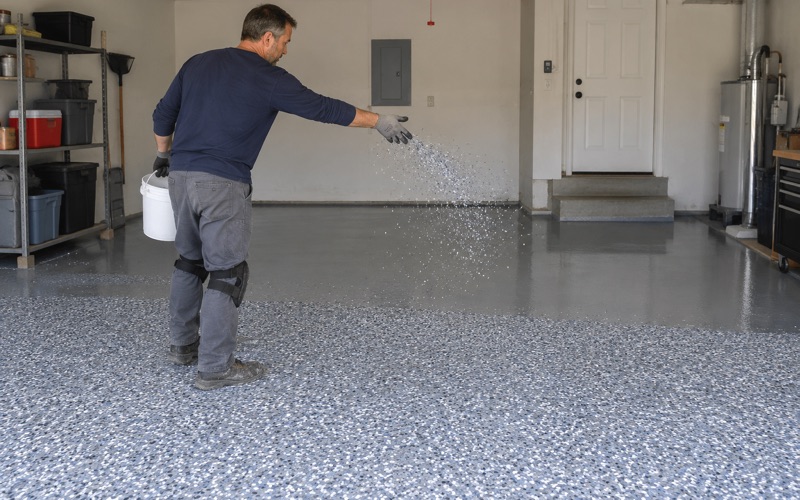
From there the decision is usually one of three. An uncoated slab in sound condition can take a full first system, such as a 100% solids epoxy base with a vinyl flake broadcast and a polyaspartic topcoat. A floor with a peeling store-bought coating needs that film ground off before anything new goes down, and hot tire pickup is a common reason those kits let go.
For a slab that will see heavy use from a workshop or a second freezer, quartz aggregate broadcast in place of flake gives a harder-wearing, more textured surface. Where an owner wants a lower-profile finish, a lithium silicate densifier on a ground slab is an alternative to a coating film.
A slab with structural cracking or heavy spalling gets repaired before it is coated. Whichever path fits, the proposal names the product, the system build and the finished thickness, so you can hold the floor you get up against the quote.
Attached and detached owners in nearly equal numbers
Owners here are split between detached and attached homes in numbers that are not far apart. The ACS counts 2,030 owner-occupied detached homes and 1,486 owner-occupied attached homes, and 98.5 percent of occupied units are owned rather than rented. The buyer for a floor here is nearly always the person who owns it.
Detached homes
In a detached house the garage belongs to you alone, so scheduling turns on your vehicles, the curing window and the weather. We schedule curing against slab temperature and the dew point spread at the surface rather than the calendar, and an unheated garage in the cold months sometimes has to wait for spring. We tell you that when we quote, not after the floor is down.
Attached homes
An attached home often shares a wall, an apron or a driveway with the house next door, and exterior items typically fall under an association’s rules. The interior garage floor usually does not, but that is a document to read rather than an assumption to make. We plan townhome work around the association’s rules and around the neighbors’ need to reach their own garages while one garage is closed off.
In an attached home, the cars, bins and shelving still have to go somewhere for the length of the cure, and a shared driveway leaves less room to stage them. We work out with you before the start date where they will sit and when each vehicle can come back in.
Shared walls also mean shared noise and shared air. We keep grinding inside the hours the village allows for construction work, and we choose coatings within the Illinois VOC limits in 35 Ill. Adm. Code Part 223, which bind the installer as well as the manufacturer.
Kane County, two townships and a fire protection district
Pingree Grove is a village in Kane County, lying within Rutland and Plato Townships. On building matters the Village of Pingree Grove is the authority, and its building permit fees are set in Title 10, Chapter 4 of the Village Code, as amended by Ordinance 2025-O-26. Whether a particular floor job needs a permit is the village’s call, and we ask rather than assume.
The fire protection district
Fire service comes from the Pingree Grove and Countryside Fire Protection District. Kane County’s building division notes that Illinois fire protection districts may adopt and enforce ordinances independent of the county’s building codes, and that new construction must notify the district and meet its submittal, inspection and occupancy requirements. Those requirements are written for new construction, and we have read no district rule on floor coatings, so we make no claim either way about a garage recoat.
Commercial floors and the health department
Food service permits run through the Kane County Health Department, which also handles well and septic permits. For a commercial kitchen or prep room we scope the floor against the Illinois Food Code, which adopts the 2022 FDA Food Code and its coved floor and wall junctures, and we schedule the work around the hours the business has to stay open.
Paperwork on a home job
Illinois issues no state license for flooring or coatings work, so there is no license number for us to quote. We show the village registration, bond and insurance the municipality asks for, and every home job gets a written contract and the Home Repair: Know Your Consumer Rights pamphlet before work begins, as the Illinois Home Repair and Remodeling Act requires. We also do not sell a floor coating as radon reduction, because in Illinois that work takes an IEMA radon mitigation license.
- 20+ Years Coating Concrete
- Moisture Tested Before We Coat
- Free Written Estimates