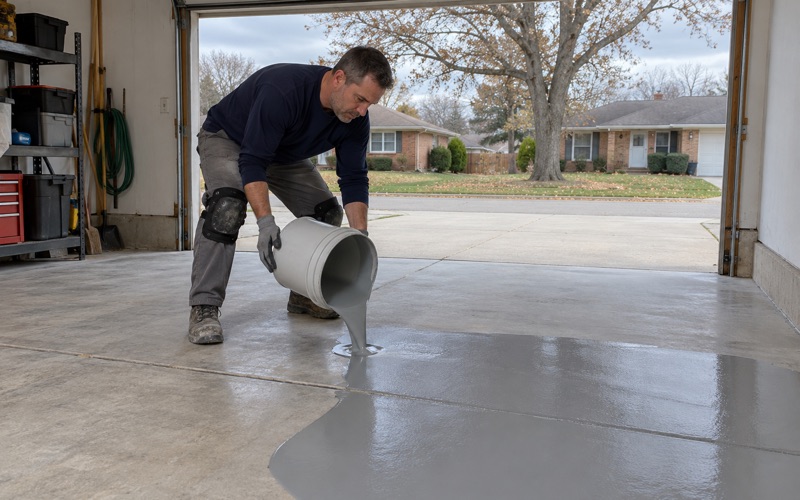
Palatine Epoxy Floors has spent more than 20 years on epoxy flooring in Northlake and the rest of northwest Cook County, and the floors that teach the most are the ones where something other than tires lands on the concrete. A process floor that takes a solvent splash, a pigment spill or a daily hose-down asks for a different coating system than a dry storage aisle, and the specification has to be written with that exposure in mind from the start.
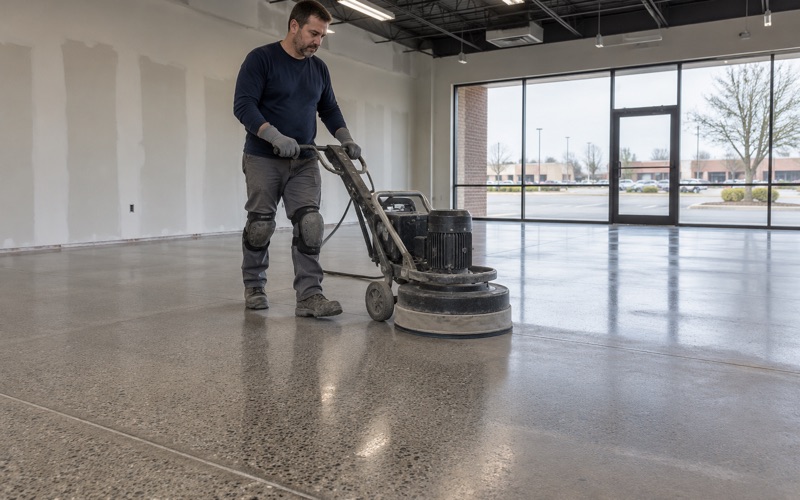
We begin every job the same way: the slab is opened with a diamond grinder or a shot blaster, never acid etched, and the moisture in it is measured as a line item rather than guessed at. Before we price anything we look at the cracks and whatever coating is already down, and if the slab needs repair first, the proposal says so in plain words.
That proposal names the product, the layer-by-layer system and the finished thickness, so a plant manager or a homeowner can hold what went down against what was quoted. Warranty exclusions are read aloud before anyone signs, and moisture is the first one we name.
Sun Chemical and a Bottler on the City’s Own Business List
The City of Northlake’s business page reads like a cross-section of what concrete in this city has to survive. Alongside the big-box retailers and the trucking names, it lists Sun Chemical and American Bottling, and Sun Chemical’s West Lake Street address sits inside the city limits on the Proviso Township side. The same page lists Scholle and notes the Union Pacific railyard along the southern boundary.
Why a business list matters to a floor contractor
A list like that tells us which exposures we should expect to be asked about. Forklift wheels and pallet jacks wear on every industrial slab, but a plant that handles liquids adds chemical attack, standing water and repeated cleaning to that wear. We do not know, and will not guess, what any particular facility runs or how its floors are holding up; what we bring is a set of questions to ask on the walk-through.
What we ask before we quote a process floor
We want the names of the products that reach the floor, how long a spill sits before cleanup, what the cleaning chemicals are and how hot the rinse water runs. We also ask whether the floor has to stay in service during the work, because commercial jobs here are scheduled around the hours a building has to stay open, often in sections over several shutdowns.
Looking for epoxy-flooring closer to Round Lake? See Round Lake Epoxy-Flooring.
Solvents, Pigments and Syrup: Specifying the Coating for the Exposure
A chemical-resistance specification starts with a chart and ends with a test. Manufacturers publish resistance tables for their resins, but those tables are built on immersion in single, pure chemicals, and a real spill is rarely that simple. When a customer can give us samples of what actually reaches the floor, we prepare coupons and let them sit under those liquids before the system is chosen.
Solvent and pigment spills
Ordinary 100% solids epoxy handles water, oils and many mild chemicals well, but aggressive solvents can soften it or stain it permanently. For those exposures we look at higher-crosslink resin systems, a thicker build, and a topcoat chosen for the specific chemistry rather than for gloss. Pigments add a cosmetic problem on top of a chemical one, so a darker or patterned broadcast can make sense on a floor where a perfect light gray would be stained within a month.
Syrup, water and a daily washdown
A bottling floor sees a different mix: sugar syrup, water, cleaning chemicals and constant moisture. Sugar left on concrete can ferment into mild acids that etch an unprotected slab, and hot rinse water puts a thin coating through repeated thermal shock. On floors that are hosed down every shift, urethane cement is often the better answer than a thin epoxy film, because it tolerates heat, moisture and thermal cycling that would cause a film coating to disbond.
Slip resistance that still cleans
A wet floor needs texture, and too much texture holds residue. We set the quartz aggregate broadcast and the topcoat thickness to land in the middle, sampling the finish with the customer before the full floor goes down. The goal is footing that still feels secure when the floor is wet and a surface the cleaning crew can actually get clean.
When a coating is not the right answer
Some rooms on an industrial property do not need a resin floor at all. A dry storage aisle that only sees pallet traffic may be better served by grinding and a lithium silicate densifier, which hardens the top of the slab and cuts dusting without adding a film that can peel. We say so when that is the case, and we keep the chemical-resistant system for the rooms where liquids actually land.
Drains, Slopes and Cove Bases on a Wet Floor
Most failures on washdown floors start at the edges and the drains, not in the open field of the slab. Water that finds its way under a coating at a wall joint or a drain body will travel, and once it does, the bond goes with it.
Moisture testing before a wet-room system
A floor that is wet on top can also be wet from below, and the two problems need different fixes. We run ASTM F2170 in-situ relative humidity probes, and ASTM F1869 calcium chloride tests where the manufacturer asks for them, before choosing a primer. When the readings run high, a moisture-mitigation primer goes under the system, and the proposal says which one and why.
Joints and cracks under a process floor
Control joints in a plant floor exist because the slab moves, and a coating laid straight across them will crack along the same line. We open each joint, decide which ones are still moving, and fill or honor them accordingly. Cracks that have spalled at the edges get rebuilt before the coating goes down, because a chemical system is only as tight as the weakest edge in the slab.
Sloping to the drain
If a floor holds puddles today, a coating will only make those puddles shinier. Where the existing slope does not carry water to the drains, we discuss building slope with a mortar before the topcoat, and we price that work separately so the customer can see what it costs. A coating follows the slab beneath it like a film; it does not correct grade and it does not stop the concrete from moving.
Drain bodies and trench drains
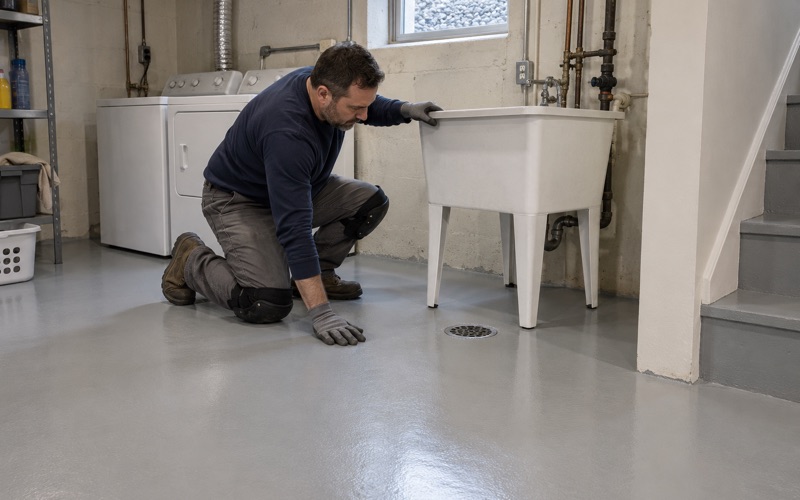
We grind and detail around every drain, terminate the coating into the drain body rather than stopping short of it, and seal the joint so water has no edge to get behind. Trench drains get the same treatment along both lips, which is where hose water and cleaning chemicals concentrate.
Integral cove bases
An integral cove carries the floor coating up the wall in a continuous curve, so there is no square corner for residue to pack into and no seam for water to wick through. The FDA Food Code, at section 6-201.13, describes coved floor and wall junctures for food areas that are cleaned by water flushing, and many process floors outside food service benefit from the same detail.
Health Review, Registration and Fire Questions for a Northlake Floor
A beverage or food-handling floor is a regulated surface, and the coating choice should be settled with the reviewing agency before installation, not argued about after. In the city’s own hazard-mitigation planning, public health capability rests with the Cook County Board of Health, and the Cook County Department of Public Health is the agency we expect to hear from when a floor sits under local health review. Because the right reviewer depends on the specific operation, we ask the owner to confirm which agency covers the space before we finalize a system.
What a health reviewer looks for
No coating carries a health department approval of its own; what a reviewer judges is the finished floor. The Illinois Food Code adopts the 2022 FDA Food Code, which asks for floors that are smooth, durable and easily cleanable, with an exception in section 6-201.11 for antislip surfaces where safety calls for them. That is why the texture choice and the cove detail are part of the conversation with the reviewer.
City registration and paperwork
Illinois issues no state license for floor coatings, and we do not claim one. The City of Northlake instead requires every contractor and subcontractor to register: a $100 license good for one year from issuance, a $10,000 bond and a certificate of insurance naming the city. Those documents are what we show in place of a license number, and on a home garage job a written contract and the state’s consumer-rights pamphlet come before any work starts.
Fire questions go to the district
Fire protection in Northlake comes from a separate fire protection district rather than a city department, so a commercial question about coating materials or occupied-building work goes to the district serving the address, starting with the Northlake Fire Protection District, not to City Hall. Coatings are selected within the Illinois limit on VOC content, and we confirm ventilation and odor plans with the owner before a weekend installation.
Curing on a schedule set by the slab
Cure timing follows slab temperature and the dew point spread at the surface, not the calendar. A cold plant floor or an unheated garage may have to wait for warmer conditions, and if amine blush forms because the surface ran too close to the dew point, we remove it before the next coat rather than burying it.
- 20+ Years Coating Concrete
- Moisture Tested Before We Coat
- Free Written Estimates