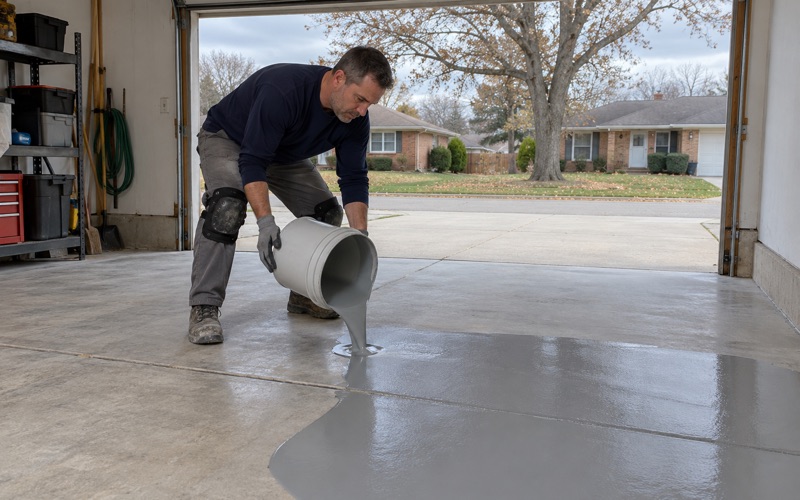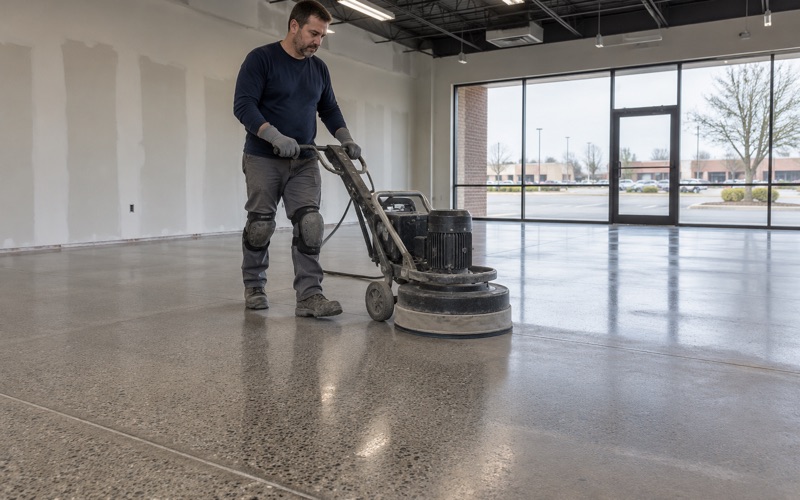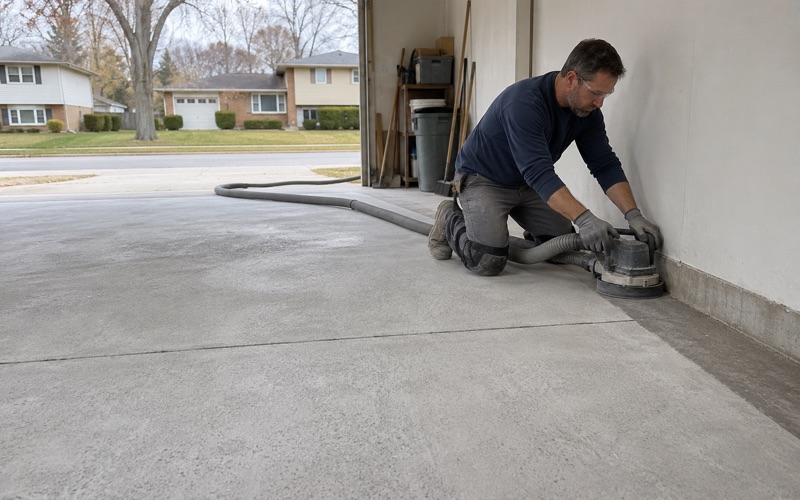
Palatine Epoxy Floors has spent more than 20 years on epoxy-flooring in Lindenhurst and across our northern Illinois service range, and every job starts the same way: a diamond grinder or shot blaster opens the concrete before any resin touches it. We do not acid etch. A mechanically profiled garage, basement or shop floor gives a 100% solids epoxy base and a polyaspartic topcoat something real to grip, and that bond is what the rest of the system depends on.
Before we price a floor, we look at it in person. That means reading the cracks, finding out what was painted or sealed on it before, and running a moisture test that appears as its own line on the proposal. The proposal also names the product, the system build and the finished thickness, so you can hold what we quoted against what went down.
We also tell you what a coating cannot do. It is a film that follows the slab beneath it, so a crack that moves will keep moving, and the warranty exclusions get read aloud before you sign, with moisture named first.
From the Lehmann Farm to 701 Original Slabs
Lindenhurst did not grow lot by lot. In 1952 developer Morton Engle bought the 600-acre Ernst E. Lehmann farm, construction began in 1953, and the village incorporated on January 16, 1957. The first school, B.J. Hooper, was completed in September 1958, which gives a sense of how quickly families arrived on what had been farmland.
The first two decades of houses
The 2024 American Community Survey five-year estimates count 345 housing units in the village built in the 1950s and 356 built in the 1960s. Together that is 701 of 5,224 units, roughly one home in seven. Those houses stand on the oldest residential concrete in Lindenhurst, poured in the years when the farm was turning into a village.
We do not know which of those homes Engle himself built, and nothing we have traces a particular slab back to him. What the numbers do tell us is age: a garage floor from those two decades has carried cars, tools and winters for somewhere between 55 and 70 years before anyone calls us to coat it.
What age changes about the job
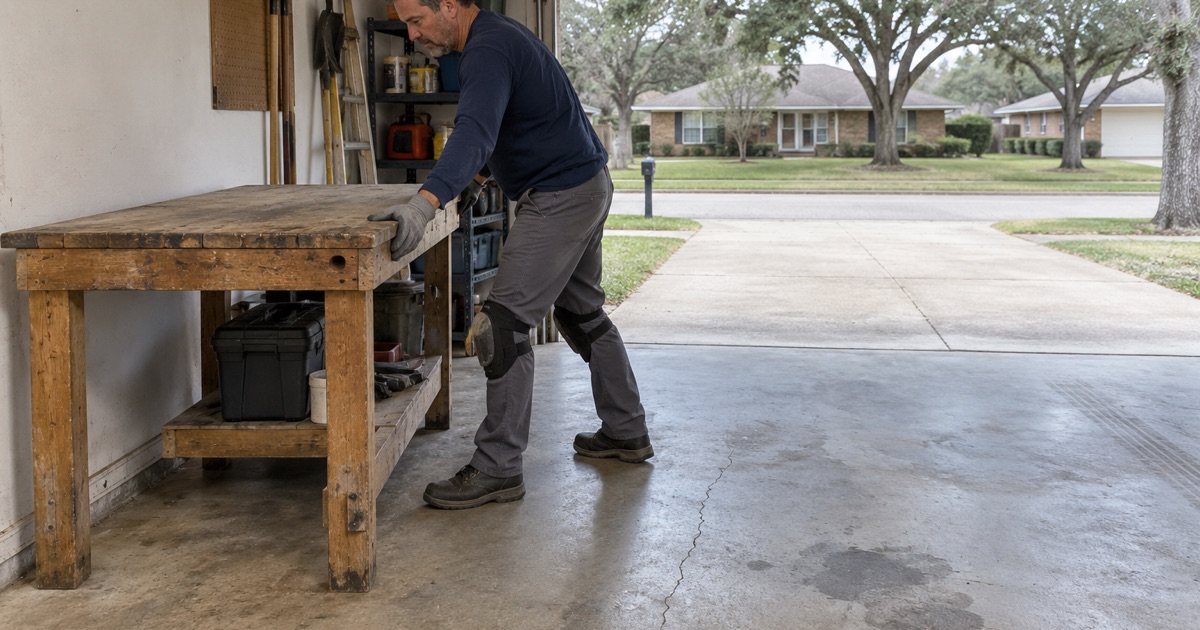
A slab that old has had time to collect a history. It may have been painted once or twice, patched where a workbench stood, or sealed with something nobody remembers buying. None of that rules out a coating, but all of it changes the scope, which is why we will not quote one of these floors from a photo or a phone call.
Older slabs can also hold oil and solvent soaked deep into the concrete from decades of parked cars. Grinding removes the surface stain, but a saturated patch can keep weeping and lift a new coating from below, so we look for it and degrease or cut it out where the floor needs it.
Even today the model code exempts garage slabs from needing a vapor retarder under IRC R506.2.3, so neither an old floor nor a newer one arrives with a promise about what lies beneath it. We do not assume. We test.
Looking for epoxy-flooring closer to La Grange Park? See Epoxy-Flooring in La Grange Park.
Reading a Seventy-Year-Old Slab Before We Quote It
An older floor tells you a lot if you take the time to read it. We spend that time before the proposal is written, because the surprises on a slab of this age are cheaper to find with a flashlight than with a grinder halfway through the job.
Old paint, sealers and what has to come off
The first question on an older Lindenhurst garage is what is already on the floor. A one-part garage paint, a clear sealer or a worn kit coating will not hold a new system, and a new system bonded to a failing one fails along with it. We grind through whatever is there until we reach sound concrete, and if a previous coating proves stubborn, the proposal prices the extra passes openly rather than burying them.
Cracks, spalls and honest repair calls
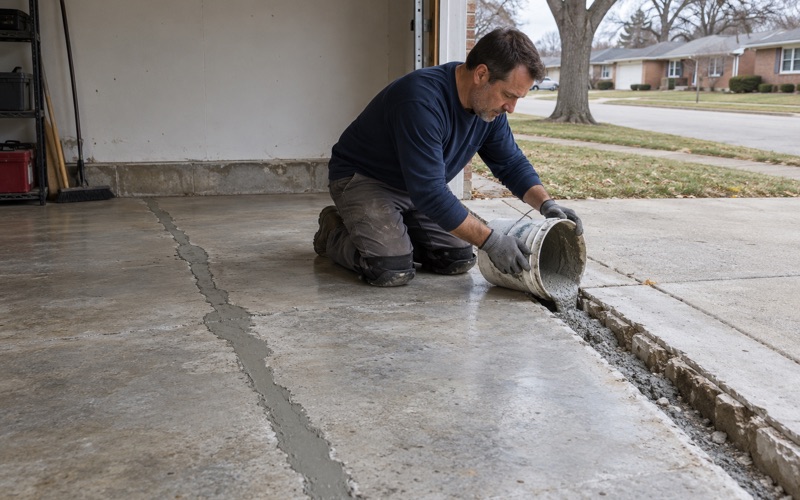
We walk the slab and map the cracks before quoting. Hairline shrinkage cracks are usually filled and coated over, while wider cracks, spalled edges and sunken sections near the apron get a different conversation. When a floor needs repair before it can take a coating, we say so plainly and price that repair as its own item.
A coating cannot stop a slab from moving. If a crack has been opening and closing for decades, it will likely show through the new floor in time, and we would rather tell you that up front than explain it afterward.
Profile and build
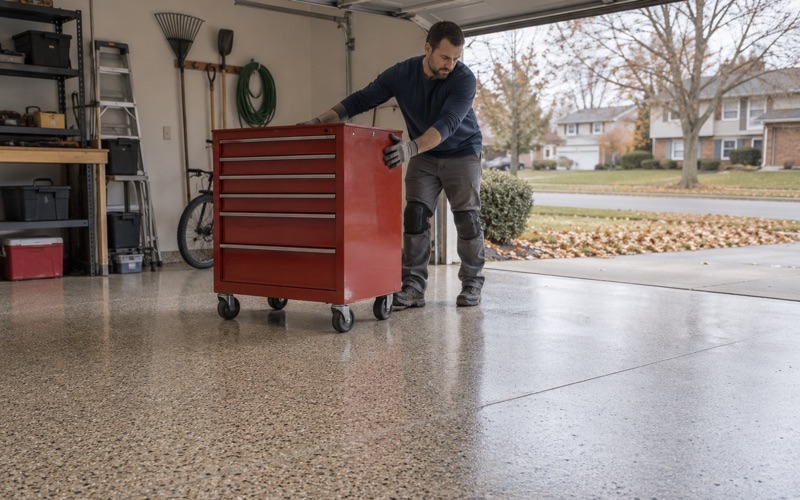
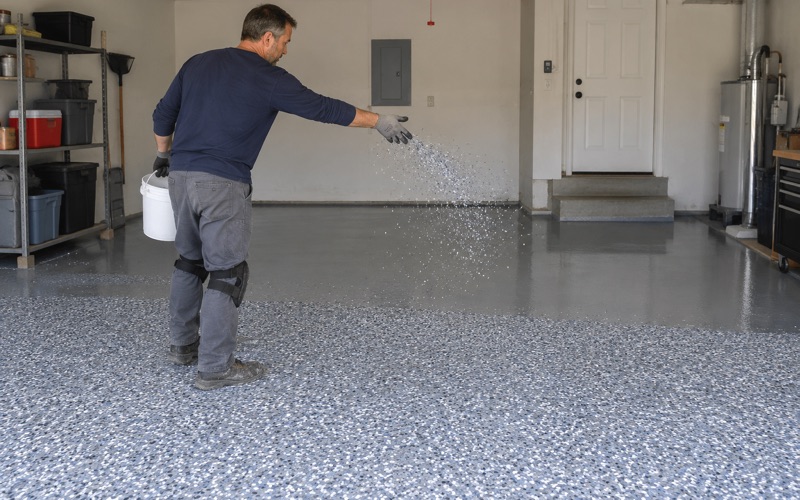
Once the old surface is gone, we grind to an ICRI concrete surface profile that suits the system, usually CSP 2 to 3 for a broadcast garage floor. A typical build is a 100% solids epoxy base, a vinyl flake or quartz aggregate broadcast, and a polyaspartic or polyurea topcoat. Garage systems are built to stand up to the calcium chloride brine and rock salt that ride in on tires each winter, and to resist hot tire pickup.
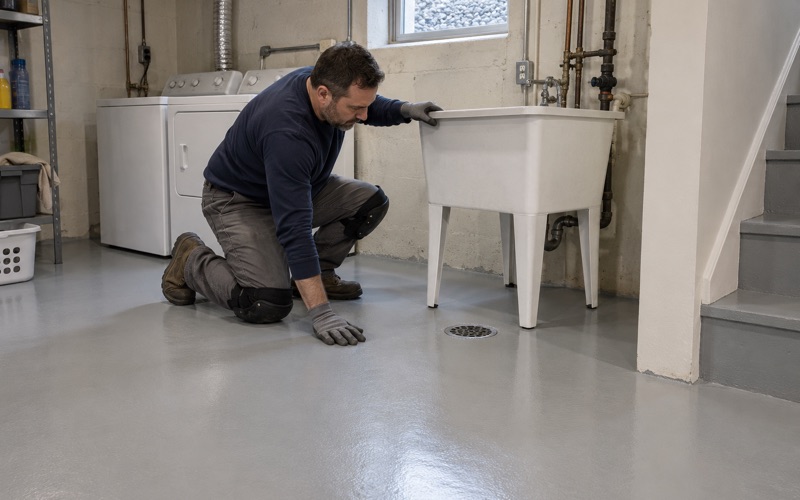
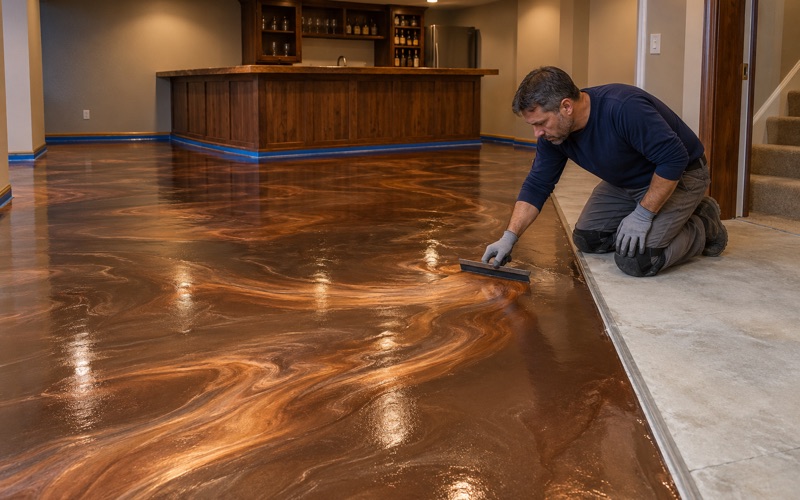
A basement often calls for a different build. A room headed for finished living space may suit a lower-sheen epoxy, or a urethane cement where moisture readings run close to the limit, while a utility basement can take the same broadcast system as a garage. We explain the trade-offs and put the choice in writing.
A Moraine Rich in Lakes and Swamp Land: Test First
Lindenhurst lies within the Valparaiso moraine, ground described as rich in lakes and swamp land. Of the village’s 4.86 square miles, 0.34 is water, and the Lindenhurst Park District counts two beaches among its 19 named park sites. It is a landscape shaped by water, and that is worth keeping in mind before sealing a concrete slab under a film of resin.
What the landscape does not tell us is the moisture condition of any one floor. Groundwater depth under Lindenhurst homes has not been measured, and we will not guess at it from a map. The only honest answer for a given slab comes from testing that slab.
The tests we run
On a garage or a basement, testing is part of the scope, not an upsell after a blister appears. Depending on the floor, we use the ASTM D4263 plastic sheet test as a first read, ASTM F1869 calcium chloride kits to measure moisture vapor emission, or ASTM F2170 in-situ relative humidity probes set into the slab. Results are compared against the coating manufacturer’s limits and the thresholds in ASTM F710.
When the numbers come back high
A high reading does not end the project. It changes the build, usually to a moisture-mitigation primer under the base coat, and it changes the warranty language, which we read out before you commit. In a basement we also check the sump pit, floor drains and any efflorescence before deciding where the coating should stop and how its edges are detailed. Where water has a history of pushing through at the cove or the cracks, hydrostatic pressure under the slab is something no coating will hold back, and we say so before anyone spends money on a floor.
Curing on the slab’s schedule
Resin cures to the temperature of the concrete and the dew point spread at its surface, not to a date on the calendar. We schedule around those readings, watch for amine blush on cool, damp days, and say plainly when an unheated garage has to wait for spring.
Lake Villa Fire Protection District, Village Hall and the Paperwork
Lindenhurst shares its fire service with its neighbors. The Lake Villa Fire Protection District covers Lake Villa, Lindenhurst and Lake Villa Township, serving about 32,000 residents across roughly 25.2 square miles from three stations in Lake Villa and Lindenhurst. It is one of the local agencies a commercial owner in town deals with, along with the Lake County Health Department for food plan review, and we schedule commercial floor work around the hours a building has to stay open.
Calling Village Hall about the permit
Building matters in the village run through Village of Lindenhurst Building & Engineering. The village lists finished basements and garages among projects that need permits, and for work such as flooring it tells residents to call Village Hall to find out whether one is required. We make that call for your project rather than guessing at the answer.
Lindenhurst lies in Lake Villa Township in Lake County, but for a home inside the village limits it is the village building office we check with. If a permit turns out to be needed, we arrange it before the floor is ground, so the schedule you approve already accounts for it.
Contracts, pamphlets and what Illinois does not license
Illinois issues no state license for flooring or coatings contractors, so we cannot hand you a license number and will not pretend otherwise. What we show instead is the registration, bond and insurance a village asks of us. Every home job also gets a written contract and the Home Repair: Know Your Consumer Rights pamphlet before work starts, as the Illinois Home Repair and Remodeling Act requires.
Products, noise hours and shared driveways
The coatings we install fall within the Illinois VOC limits in 35 Ill. Adm. Code Part 223, which bind the installer as well as the manufacturer. We work inside the hours the village allows for construction noise, and with 356 owner-occupied attached homes counted in the village, on townhome jobs we plan around association rules and the neighbors who still need their own garages. We also do not sell a floor coating as radon reduction, because in Illinois that work requires an IEMA radon mitigation license.
- 20+ Years Coating Concrete
- Moisture Tested Before We Coat
- Free Written Estimates