Palatine Epoxy Floors has spent more than 20 years on epoxy-flooring in Lincolnwood and across the north suburbs, and some of the jobs that need the most patience are on the newest slabs rather than the oldest. A floor poured a few years ago carries no peeling paint and no sealer from a previous owner, so it looks like the easy case. It is not always. Young concrete is still giving up water, and a coating laid over a slab that is not ready can lift long before a floor with decades behind it would.
That is why our quotes on newer buildings start with a test rather than a color chart. Moisture testing sits in the written scope as its own line, whether the slab is in a basement or a garage, so the reading happens before anyone orders material. If the numbers say wait, we say wait, and the proposal shows what we measured.
The sections below cover how we decide a young slab is ready, what a first coat on new concrete involves that a recoat does not, and which village office has to know about us before the work starts.
462 Units in One Decade, After Forty Quieter Years
Lincolnwood is a village in Niles Township, Cook County, that counted 13,463 residents in the 2020 census, and most of its housing went up long ago. The American Community Survey’s 2024 five-year table on year built counts 462 housing units completed between 2010 and 2019, plus another 21 since 2020. Set beside the decades before it, that is a real jump: 310 units in the 1970s, 172 in the 1980s, 424 in the 1990s and 186 in the 2000s. No decade since the 1960s added more.
What the count does and does not say
The survey counts housing units, not buildings, and it does not say what form those 462 units take. The same data records 968 units village-wide in structures of 50 or more, but that figure spans every decade, so it cannot be read as a description of the recent construction. What the count does establish is that a real share of Lincolnwood floors sit on concrete poured since 2010.
Why a newer slab changes the conversation
On an older floor, the first questions are about what is already on the surface and what it hides. On a slab poured in the last decade or so, there is usually nothing to strip, so the questions turn to the concrete itself. How long has it had to dry, is there anything beneath it to stop ground moisture, and will the finish the original crew left on it accept a coating? Those answers set the schedule more than the choice of coating does.
A newer garage is not automatically a drier one
The model residential code, at IRC R506.2.3, exempts garage floors from the under-slab vapor retarder it otherwise calls for. A garage poured fully to code can therefore sit on its base material with nothing between the concrete and the soil. We test a new garage slab the same way we test a basement, because assuming a young slab is dry is how a warranty claim starts.
Looking for epoxy-flooring closer to Bellwood? See Epoxy-Flooring in Bellwood.
How Old Does New Concrete Need to Be?
There is no single age at which a slab becomes ready, and Lincolnwood has no rule that sets one. The waiting period people often hear quoted is a rule of thumb about strength, not moisture, and a slab can reach its design strength while still holding more water than a resin system will tolerate. Slab thickness, the mix, how the surface was finished, whether the building was heated early on and whether a vapor retarder went in underneath all change the answer.
Why young slabs read high
Fresh concrete is mixed with more water than the cement needs, and the excess leaves slowly through the top surface. A closed-up interior, a cold building or a long wet cure can slow that further. A floor that feels dry to the hand can still be pushing vapor upward, and a resin film laid over it traps that vapor at the bond line, where it shows up later as blisters or a coating that peels in sheets.
Reading moisture instead of the calendar
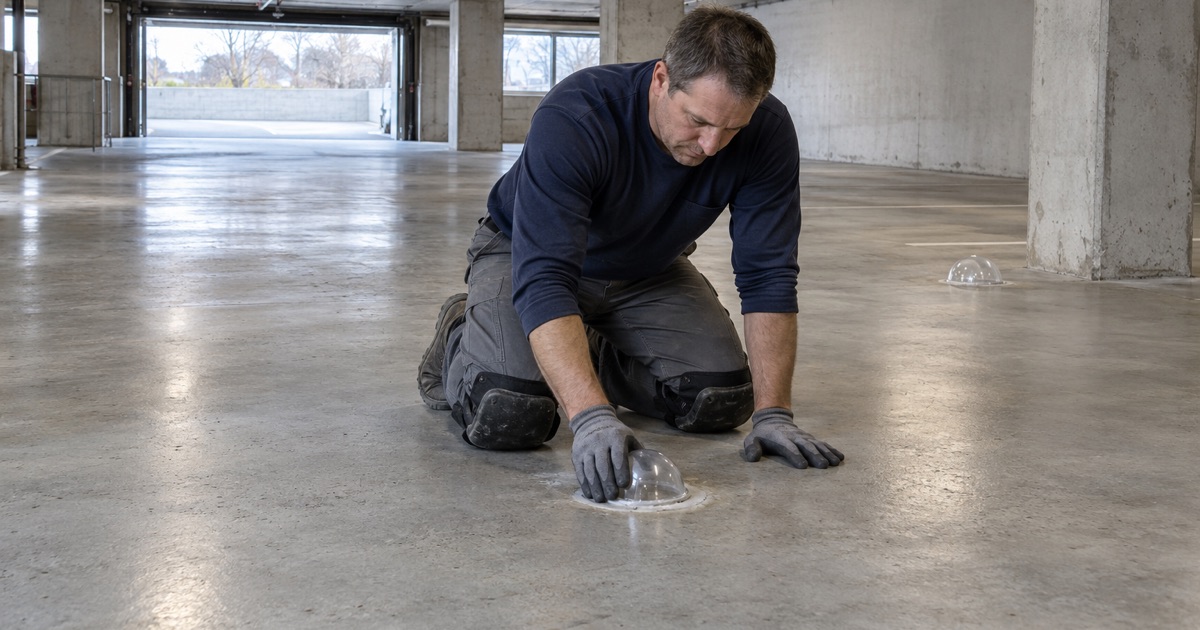
We decide readiness with measurements, starting with ASTM F2170, which sets relative humidity probes into drilled holes in the slab and reads the moisture inside the concrete, which is the test we lean on for a young floor because it sees below the surface. ASTM F1869, the calcium chloride test, measures the vapor emission rate coming off the top. For a quick screen, the ASTM D4263 plastic sheet test tapes plastic to the slab and checks for condensation underneath, though a clean result there never clears a floor by itself. We take more than one reading on a larger slab, since a floor can be drier near an open door than under a stored car or a corner that sees little air.
What the readings decide
The readings are compared against the limits the coating manufacturer publishes, which often follow ASTM F710 guidance, and we write the limit for the chosen product into the proposal. When a slab reads high, there are two honest options: wait and retest, or build the system on a moisture-mitigation primer rated for that condition. We price both so the owner can weigh time against cost. When we read out the warranty exclusions before the job is sold, moisture is the first one we name.
A First Coat Is a Different Job From a Recoat
A recoat begins by finding out what is already on the floor and getting it off. A first coat on new concrete skips that step but brings its own problems, and treating it as the easy version of the same job is a mistake we are sometimes called in to correct.
Curing compounds and a hard troweled finish
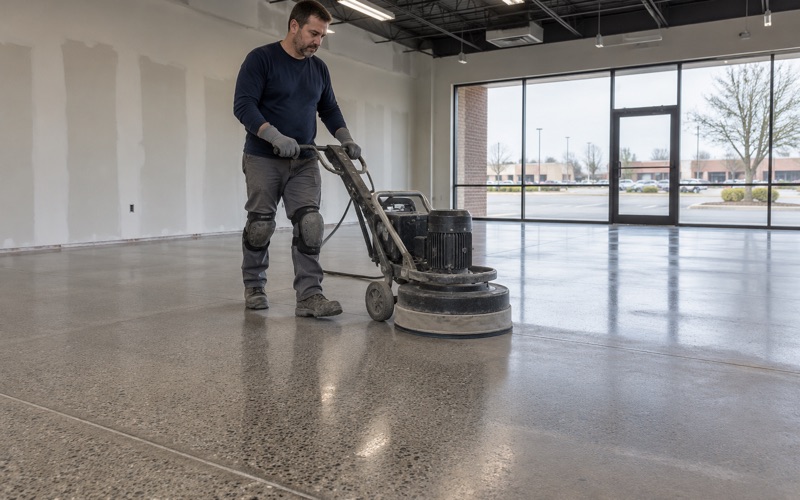
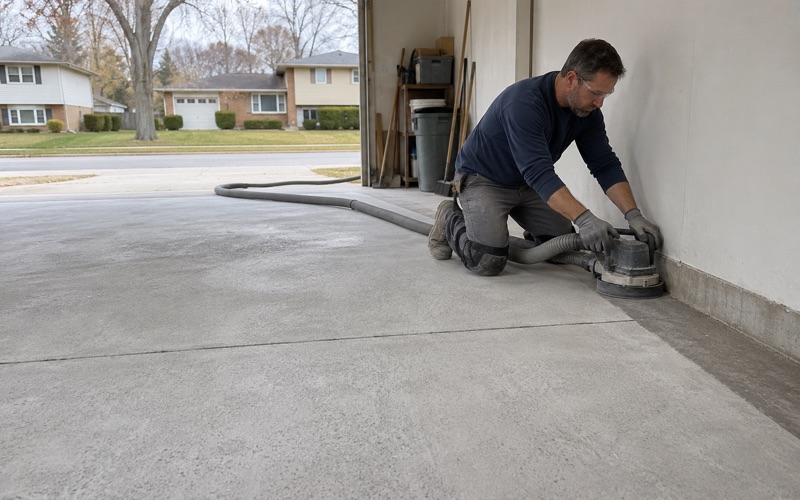
New slabs are often power-troweled to a dense, smooth surface and sprayed with a curing compound or sealer to hold water in while the concrete gains strength. Both leave a surface that resin cannot grip well. We open every slab mechanically with diamond grinding or shot blasting, and we never acid etch, to cut through that film and reach the ICRI CSP surface profile the product calls for.
Cracks on a young floor
Concrete shrinks as it dries, and some cracking in the first years is normal. We look at each crack and the control joints before we quote, and we say plainly whether a crack needs repair before the slab can be coated. We also explain up front that a coating is a film that follows the concrete under it: it will not stop movement, so a crack that is still opening will eventually show through.
Building the system
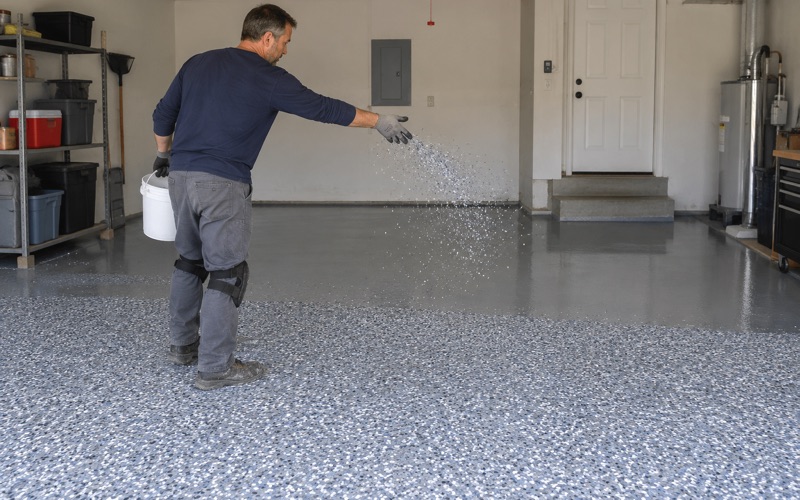
On a sound, dry, profiled slab, a typical garage build is a 100% solids epoxy base with a vinyl flake or quartz aggregate broadcast, finished with a polyaspartic or polyurea topcoat. A basement, a shop or a commercial floor may call for urethane cement or a different topcoat. Whatever the build, the proposal names the product, the system and the finished thickness, so the floor that goes down can be checked against the one that was quoted. We also choose coatings within the Illinois limits on VOC content, which bind the installer as well as the manufacturer.
The coating has to cure too
Once the slab is ready, the resin’s own cure becomes the schedule. We time each coat against the slab’s surface temperature and the dew point spread at the surface, not against a day of the week, because epoxy laid on a slab that is too close to the dew point can develop amine blush, a waxy film that weakens the bond to the next layer. If an unheated space cannot hold the temperature the product needs, we say so and set a later date rather than gamble on it.
Who to Register With Before the First Coat
In Lincolnwood the license that counts is the village’s. Illinois issues no license for general, flooring or coatings contractors, so there is no state number to look up for this kind of work. Instead, every contractor on a permitted job must hold a current Village of Lincolnwood contractor license, which is valid for one year.
What the village asks of contractors
A general contractor provides a $10,000 bond, a $1,000,000 certificate of insurance naming the village as additional insured and a $100 license fee. The village does not issue a permit until every contractor on the job has been identified and registered. We show that registration, bond and insurance in place of a license number, because those are the documents that actually apply here.
Inspections and the village desk
Building permits run through the Village of Lincolnwood, whose village hall sits at 6900 N. Lincoln Avenue. Fire inspection comes from the Lincolnwood Fire Department, whose 31 members include 28 provided under contract by Paramedic Services of Illinois, an arrangement that began with paramedic service in June 1977 and added firefighting in December 1989. For a commercial kitchen floor, food establishment inspections run through the village’s contract with the Cook County Department of Public Health.
Paperwork and scheduling on a home job
On a residential job we hand over a written contract and the Home Repair: Know Your Consumer Rights pamphlet before work begins, as the Illinois Home Repair and Remodeling Act requires. In a newer condominium or townhome building, we plan the work around the association’s rules and the neighbors’ access to their own garages. We also keep loud steps such as grinding inside the hours the village allows for construction noise, and commercial jobs are scheduled around the hours the building has to stay open.
- 20+ Years Coating Concrete
- Moisture Tested Before We Coat
- Free Written Estimates