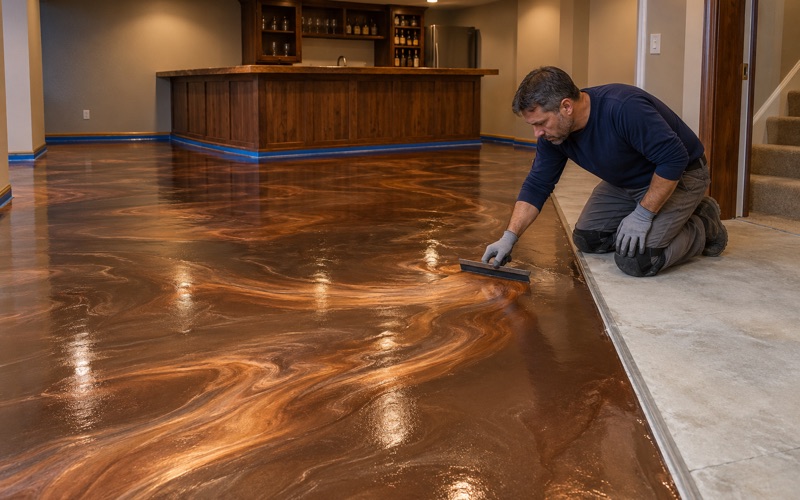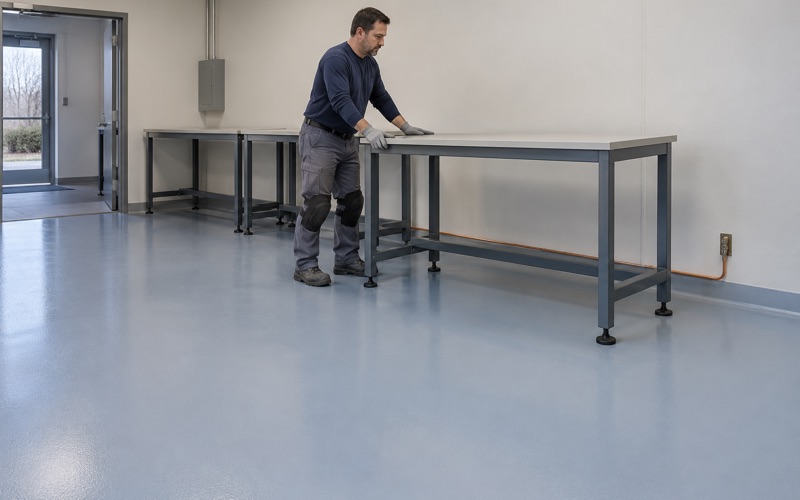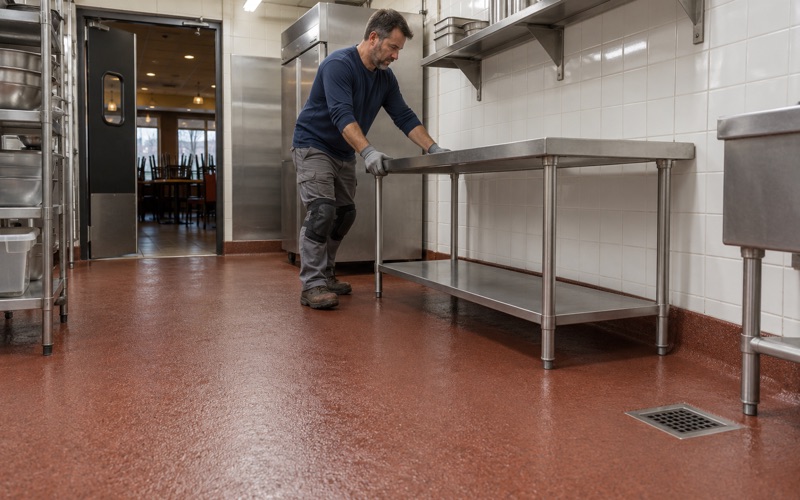
Palatine Epoxy Floors has spent more than 20 years on epoxy flooring, and in Lake Zurich the call about a large residential building rarely comes from someone who lives in it. It comes from whoever manages the property. That one difference decides who signs the proposal, who approves the dates and how far ahead the work has to be planned.
So we write the proposal for that reader. It names the product, the system build and the finished thickness, which lets an owner’s representative hold the installed floor up against the paperwork long after our crew has left. Moisture testing sits on it as its own priced line, not as an extra that surfaces after a coating has already lifted.
Homeowners get the same discipline plus the written contract and consumer-rights pamphlet Illinois requires on home repair work. Below is how a job here actually moves: the building types, the person booking the work, the permit calendar and the village services around it.
560 Units in Buildings of 50 or More, and None Owner-Occupied
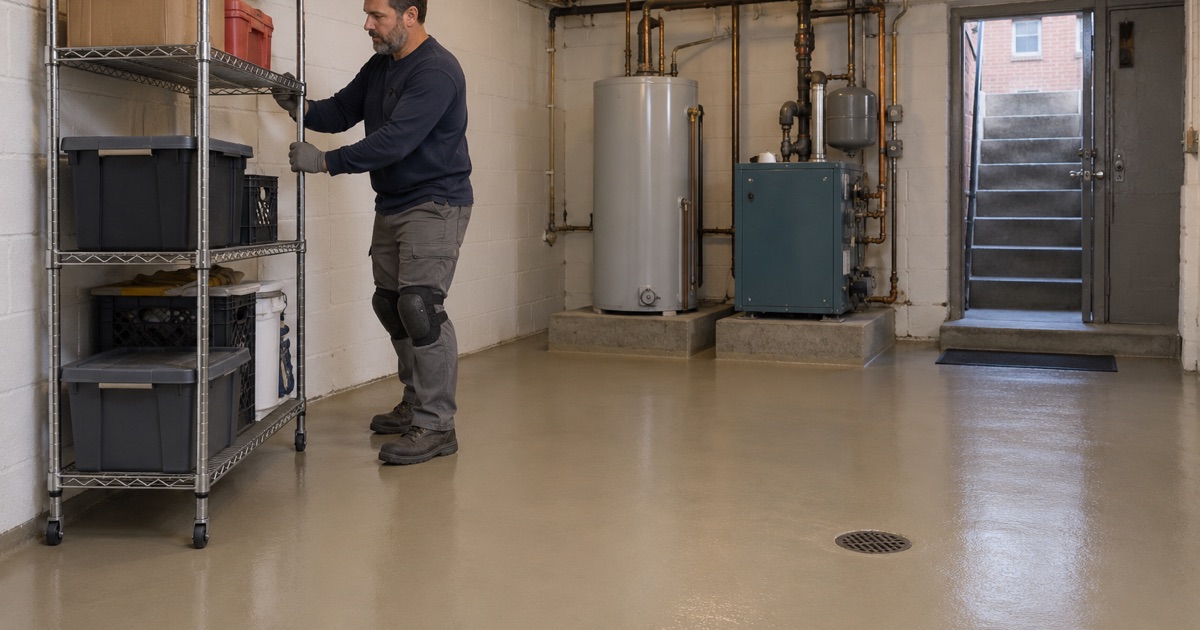
The census tables explain why so many of our Lake Zurich conversations start with a property manager. Most of the village is detached houses, but its largest residential buildings are a separate world with a separate kind of customer.
What the ACS counts show
The American Community Survey’s 2024 five-year estimates count 560 Lake Zurich housing units in structures of 50 or more units. Cross the same buildings against tenure and the owner-occupied figure for that size class is zero. Every one of those homes is rented, which means a floor decision in one of those buildings is made by an owner or the firm it hires, not by a resident.
Across the whole village, 1,640 of 7,392 occupied units are renter-occupied, 22.2 percent. That share is spread over every building type, but the big buildings are where it concentrates completely.
The 10-to-19-unit building: 415 more homes
The next tier down matters almost as much. The same survey counts 415 units in buildings of 10 to 19 units, another 140 in buildings of 20 to 49, and 191 in buildings of five to nine. A mid-size building like that often has a smaller management arrangement, sometimes one owner with a maintenance contractor rather than a full management company.
For us the practical change is the size of each work window. A 10-to-19-unit building has fewer residents to notify but usually less flexibility, because there may be only one route in and out of the area we are coating.
What that means for the quote
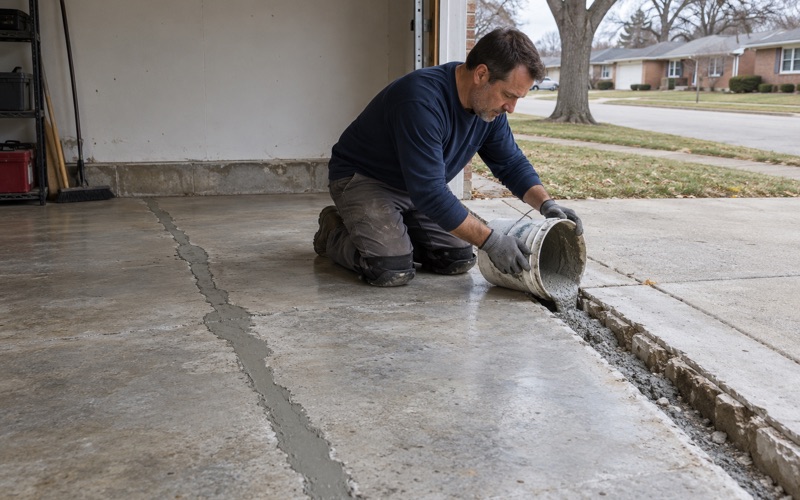
A manager answers to someone above them, so our proposals are built to be forwarded. The scope lists the surface preparation method, the primer, the body coat, any broadcast media and the topcoat by product, with a target thickness for the finished system. If the slab has cracks or an old coating that will not hold, the proposal says so plainly and prices the repair as a separate item rather than burying it.
We also state what a coating cannot do. A floor system is a film bonded to the concrete, and it follows that concrete. If the slab moves, a crack can telegraph through, and we say that before anyone signs.
Looking for epoxy-flooring closer to Prospect Heights? See Prospect Heights Epoxy-Flooring.
When a Property Manager Books the Floor
Booking a floor in an occupied rental building is mostly a scheduling exercise with chemistry attached. The manager has residents, an owner and sometimes a lender to answer to, and the floor has to cure on its own timetable regardless.
Notice, access and working hours
We plan commercial work around the hours a building has to stay open and functional, and we keep noisy steps such as grinding inside the hours the village allows for construction noise. Before a date is set we ask the manager which areas residents must be able to reach throughout the job, and we build the sequence around those routes rather than asking tenants to work around us.
For the 499 single-family attached homes in the village, the scheduling question shifts to the association. Townhome and condominium jobs are planned around the association’s rules and the neighbors’ access to their own spaces, which sometimes means splitting a job across separate days.
Testing before anything is applied
Concrete in an older or newer building can carry more moisture than its surface suggests. We start with an ASTM D4263 plastic sheet test as a quick screen, then use ASTM F1869 calcium chloride testing for a moisture vapor emission rate or ASTM F2170 in-situ relative humidity probes for a reading from inside the slab. Results are compared against the coating manufacturer’s limits, with ASTM F710 thresholds as the reference.
When readings come back high, the proposal changes before the job does: a moisture-mitigation primer goes into the system build, or the slab waits. Moisture is also the first exclusion we read aloud from the warranty, because it is the most common reason a coating fails.
Opening the slab mechanically
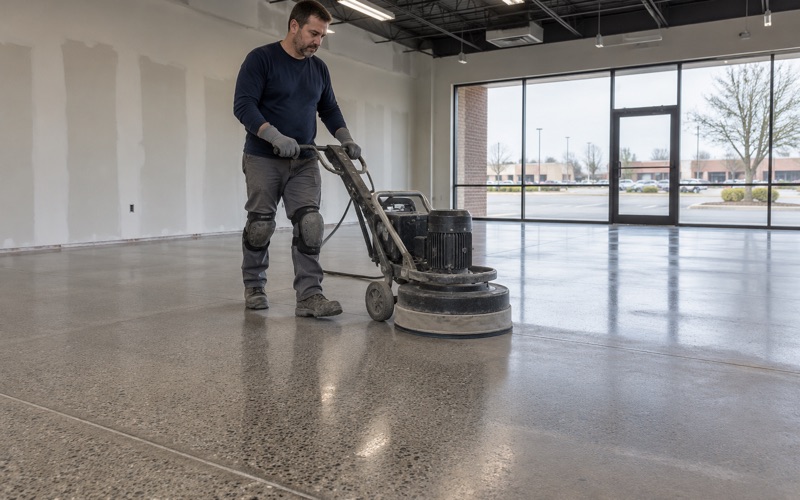
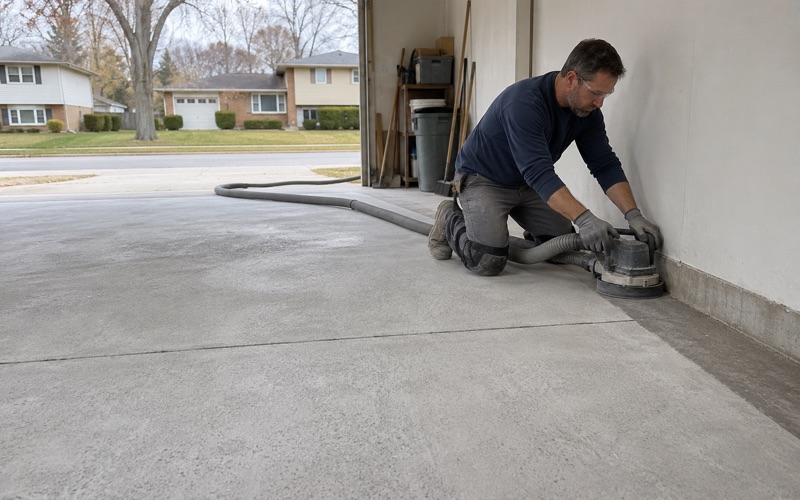
Every floor is opened with diamond grinding or shot blasting to a surface profile in the ICRI CSP range the chosen product calls for. We do not acid etch. Grinding gives a measurable, repeatable profile, removes weak surface paste and lets us see the cracks and old coatings we are actually dealing with.
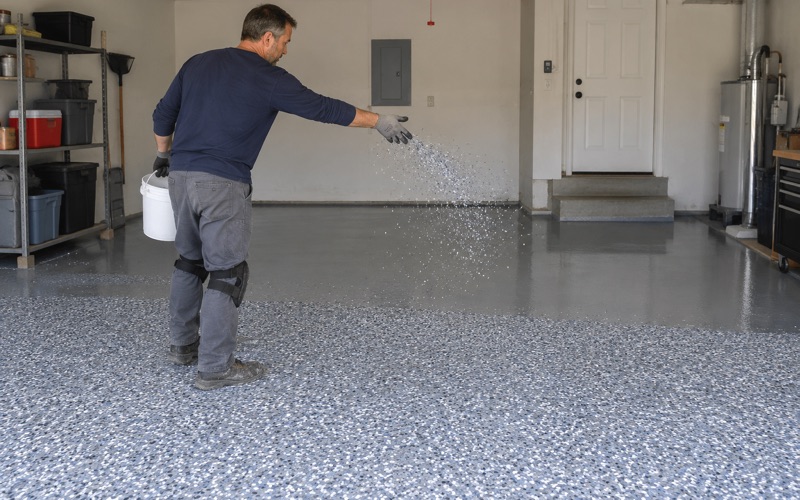
For most multifamily service areas we specify a 100% solids epoxy body coat with a polyaspartic or polyurea topcoat. Where traction matters, a vinyl flake or quartz aggregate broadcast goes into the system. Where a manager wants a bare, sealed slab instead of a coating, a lithium silicate densifier is the simpler answer, and we will say when that fits better.
Up to 15 Business Days at the Permit Desk
Lead time in Lake Zurich starts at village hall, not on the slab. The Village of Lake Zurich handles building permits through the Building and Zoning Division of its Community Services Department, and applications go to the permit desk by e-mail.
Building the lead time in
The village states that most applications are taking up to 15 business days to process. That is three working weeks before a permitted job can start, and longer if a submittal comes back for corrections. When a commercial floor job falls under a permit, that review period goes into the schedule before the crew date, not after it.
We do not tell a manager that a floor coating does or does not need a permit here. That depends on the scope and the building, and the Building and Zoning Division is the office that decides. Our part is to ask early, so a three-week review does not land in the middle of a tenant notice period.
Registration, bond and insurance
Illinois issues no state license for flooring or coatings work, so there is no license number for us to quote. Instead we show the village registration, bond and certificate of insurance that each municipality asks of a contractor, and we provide those documents to the manager with the proposal so the owner’s files are complete.
On product compliance, we choose coatings within the Illinois VOC content limits for architectural coatings in 35 Ill. Adm. Code Part 223 Subpart C. That rule binds the installer as well as the manufacturer, which matters in a building full of occupied homes.
Confirming which village is in charge
Lake Zurich sits in Ela Township in Lake County, and a Lake Zurich mailing address does not always settle which municipality holds the parcel. Before we name a permitting office in a proposal, we confirm the parcel’s jurisdiction, so a manager is not sending an application to the wrong desk and losing those 15 days twice.
A Village Fire Department That Also Serves Deer Park, Hawthorn Woods and Kildeer
Lake Zurich runs its own fire service. The Lake Zurich Fire Rescue Department is a village department with four stations covering the roughly seven square miles of the village itself.
One Fire Department for the Village and the Rural District
By agreement the same department also serves the Lake Zurich Rural Fire Protection District, 18 square miles that take in Deer Park, Hawthorn Woods, Kildeer and unincorporated areas. Both the village and the district carry an ISO class 3 rating. For a manager with buildings on both sides of the village line, that means one fire department across the portfolio even when the building permit offices differ.
We do not speak for the department on fire code questions. If a manager or the department has requirements for a specific building during floor work, we take them as part of the scope and plan the sequence around them.
Keeping an occupied building livable
A floor job in a building where people sleep has to respect the air and the walkways. Low-solvent 100% solids epoxy and VOC-compliant topcoats keep odor down, and we stage the work so that corridors and exits residents rely on stay clear while sections cure.
We also keep claims within our trade. A floor coating is not radon reduction, and in Illinois that work takes a state radon mitigation license, so we never sell a coating on that basis.
Cure timing and return to service
We schedule curing against slab temperature and the dew point spread at the slab surface rather than the calendar. Coating too close to the dew point invites amine blush and a weak bond between coats. When conditions in an unheated space are wrong, we say so and reschedule instead of pushing a floor down to hit a date.
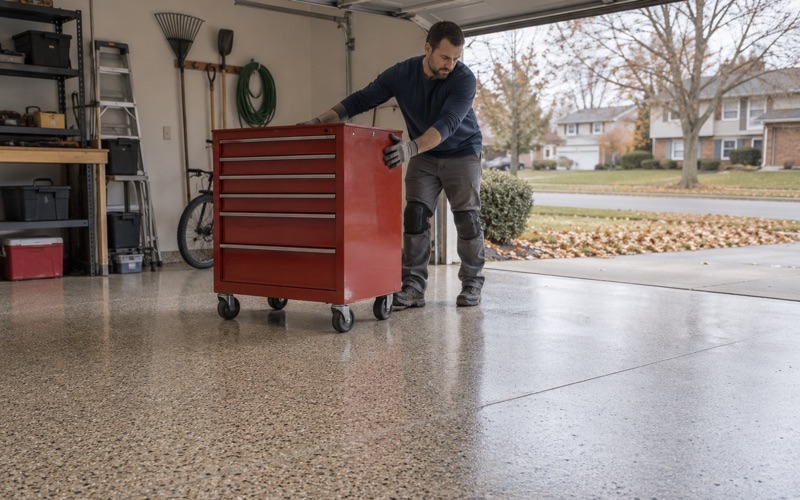
The proposal gives the manager clear return-to-service times: when residents can walk on the floor, when carts and equipment can roll on it, and when the system reaches full cure. Those are the dates a manager actually needs to send a tenant notice, and we put them in writing before the job begins.
- 20+ Years Coating Concrete
- Moisture Tested Before We Coat
- Free Written Estimates