Palatine Epoxy Floors brings more than 20 years of epoxy flooring work to La Grange Park, and most of what we do here starts with a question about timing. A floor coating is a sequence of grinding, priming, building and curing, and each step needs the room empty and the slab left alone. For a household that means a garage out of service for a few days; for a school, church hall or business it means finding the window when nobody needs the floor.
We plan that window before we quote. The slab is tested for moisture as part of the scope, ground open with diamond tooling or a shot blaster rather than acid etched, and inspected for cracks and failing old coating so a needed repair is named up front. The written proposal lists the product, the system build and the finished thickness, which gives a facilities manager or homeowner something concrete to check the finished floor against.
In La Grange Park we think about that planning through one kind of building in particular: the institution that grows over decades and has to do its floor work on a calendar set by someone else. The same discipline carries over to a two-car garage on a quiet residential street.
A Campus on Ogden Avenue, Built Up Over a Century
Founded in 1900, Opened in 1950
Nazareth Academy, a Roman Catholic college-preparatory high school, was founded in 1900 by the Sisters of St. Joseph and sits at 1209 West Ogden Avenue in La Grange Park. The school’s own history records that the cornerstone of the ‘New Nazareth’ was laid in October 1949 and that its doors opened in September 1950. That building is the core the rest of the campus grew around.
We mention it not because the school is a client, which it is not, but because a campus like this is the clearest local example of how institutional floors actually age. Slabs poured for the 1950 building sit beside slabs poured decades later, and the two behave differently under a coating.
Twenty Years of Additions
Beginning in 2005 the school undertook considerable renovations: new building wings, walkways and a new facade, the Romano Family Theatre in 2008, the Walsh Center in 2016 and a complete renovation of Valenta Stadium. Each phase joined newer construction to an older building on one connected property.
For a floor contractor, that kind of patchwork is the real story. A coating that runs from an older slab onto a newer one crosses a construction joint, and a coating is a film that follows the slab under it. We say plainly that it will not stop two slabs from moving independently, and we plan the joint detail rather than pretend the seam will disappear.
Old Slab, New Slab, Same Test
A newer slab is not automatically a dry one. Whether a vapor retarder went under it depends on how it was built, and an older slab may have none at all, so we test both rather than guess. ASTM F2170 in-situ relative humidity probes and ASTM F1869 calcium chloride testing tell us what each section of floor is holding or releasing before any primer goes down.
Where readings come back high, the answer is a moisture-mitigation primer under the system or a decision to wait, and we name which one before the job is scheduled. That conversation is far cheaper before a coating than after it has blistered.
Looking for epoxy-flooring closer to Warrenville? See Epoxy-Flooring Services in Warrenville.
Gym, Locker Room, Theater and Kitchen: Four Different Floor Briefs
School and institutional buildings tend to group very different rooms under one roof, and each asks something different of a resinous floor. We have not seen the floors inside any building on Ogden Avenue and make no claim about what they contain. What follows is how we approach these room types wherever we find them.
Locker Rooms and Wet Corridors
Locker rooms see standing water, cleaning chemicals and constant foot traffic in wet shoes. A 100% solids epoxy base with a quartz aggregate broadcast builds texture into the surface, and the grit can be tuned so the floor still cleans with a mop and a deck brush. Floor drains need their own detailing so water reaches them instead of pooling at the coating edge.
The Work Behind a Stage
A theater’s public spaces are usually carpet or wood, but the work happens behind them in scene shops, loading paths, storage rooms and dressing rooms. Those floors take rolling carts, dropped hardware and spilled paint, and a vinyl flake broadcast under a polyaspartic topcoat holds up to that while hiding the scuffs. Where heavy equipment rolls every day, a thicker system is worth the extra material.
Kitchens and Food-Service Rooms
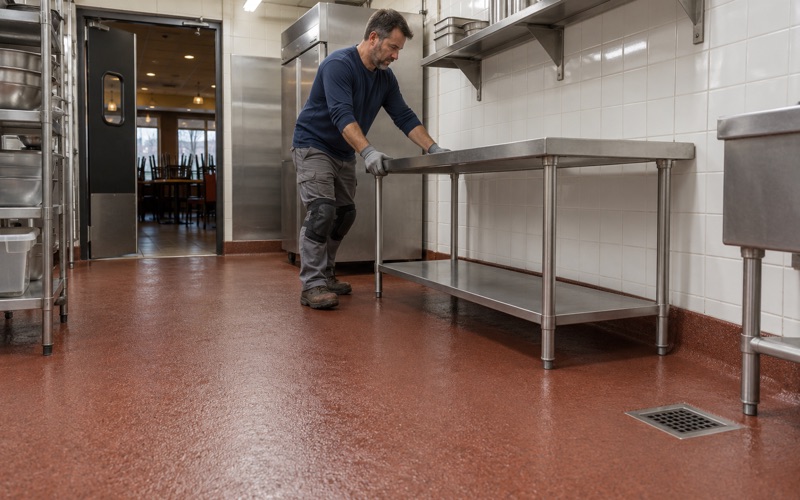
Commercial kitchen floors take hot water, grease and thermal shock from washdowns, conditions where urethane cement often outlasts a standard epoxy. The Illinois Food Code adopts the 2022 FDA Food Code, and section 6-201.13 calls for coved junctures where floor meets wall so the corner can be cleaned. In La Grange Park, food-service inspection falls to the Cook County Department of Public Health, so we build the cove and the finish to the code that inspector works from.
Gyms Are Often Another Trade
Competition gym floors are usually hardwood or synthetic sports surfacing rather than epoxy, and we say so when asked. Where a resinous floor does fit is the weight room, the equipment corridor and the entrance where grit and water come in on every pair of shoes. Weight rooms in particular take dropped plates and sliding equipment, and a thicker epoxy build or a rubber mat zone is a choice we talk through with whoever runs the room.
Two Elementary Districts Inside One Village
Public elementary schooling in La Grange Park runs through two districts rather than one: LaGrange Elementary School District 102 and Brookfield-LaGrange Park School District 95. Two families in the same village may follow different school calendars as a result. That matters more to a floor job than it sounds, because school breaks are when many households can most easily give up a garage or basement for a few days.
Public Buildings, Public Process
District buildings are publicly governed, and how a district buys floor work is a process that district sets for itself. We do not claim a place on any district’s vendor list. What we can hand a facilities office is a scope detailed enough to compare line by line with any other proposal, down to the resin, the number of coats and the mil thickness at the end.
Older school buildings in any district also tend to carry layers of past floor finishes, from tile adhesive to earlier coatings. We read what is on the slab before quoting, because a new system laid over a failing one inherits every weakness underneath it.
Planning a Garage Around Break Weeks
For a household, the practical point is simpler. Spring break, winter break and the summer weeks are when cars may be parked elsewhere for travel and a garage can sit empty for the several days a coating needs. Tell us your district’s break dates and we will plan backward from them, starting with the moisture test. Townhome and condominium owners can add the association’s rules to that list, since neighbors still need access to their own garages while one unit’s garage is closed.
Every home job comes with a written contract and the Home Repair: Know Your Consumer Rights pamphlet before work begins, as the Illinois Home Repair and Remodeling Act requires. Illinois issues no state license for flooring or coatings work, so in place of a license number we show whatever registration, bond and insurance the village asks for.
Fitting Floor Work Into a School Calendar
Why Break Weeks Are the Window
An institution cannot close a locker room or kitchen on an ordinary Tuesday in October. The window is a break week or the summer, and a floor job has to fit inside it with time left for curing before the building fills again. Missing that window by two days is not a small slip, because it can push the whole job to the next break.
Building the Schedule Backward
We plan from the reopening date in reverse. Moisture testing comes first, because a slab that fails needs a different system or repair, and learning that on the first day of a nine-day break is too late. Grinding to an ICRI CSP profile, crack and joint repair, the base coat, the broadcast and the topcoat each get their own slot, followed by cure time before carts and foot traffic return. We share that day-by-day plan in writing, so a facilities office or a family knows which day the grinders run, which day it smells of resin and which day it can take weight again.
Cure Conditions, Not Dates
Curing is scheduled against slab temperature and the dew point spread at the slab surface rather than against a date on a calendar. A building with its ventilation turned down for a break can run cooler and damper inside than anyone expects, which slows the cure and invites amine blush on an epoxy coat. We check the conditions in the room and adjust the sequence or the product rather than build a new coat over a compromised film.
Noise, Fumes and the Rooms Still in Use
Diamond grinding and shot blasting are loud, so the loudest steps run inside the hours the village allows for construction noise. In a building that stays partly open, we sequence rooms so the spaces in use keep working around the crew. Coatings are chosen within the Illinois VOC limits in 35 Ill. Adm. Code Part 223, which binds the installer as well as the manufacturer and matters when staff are working down the hall.
Before anything is signed, we read the warranty exclusions aloud with moisture named first, and explain what each one means for a floor that can only be repaired during a break. A school, a parish hall or a family garage gets the same conversation, because the questions about timing, moisture and movement do not change with the size of the room.
- 20+ Years Coating Concrete
- Moisture Tested Before We Coat
- Free Written Estimates