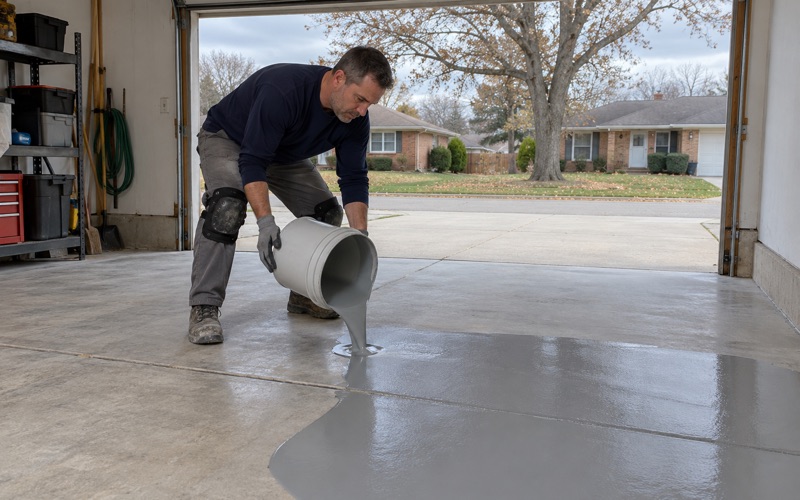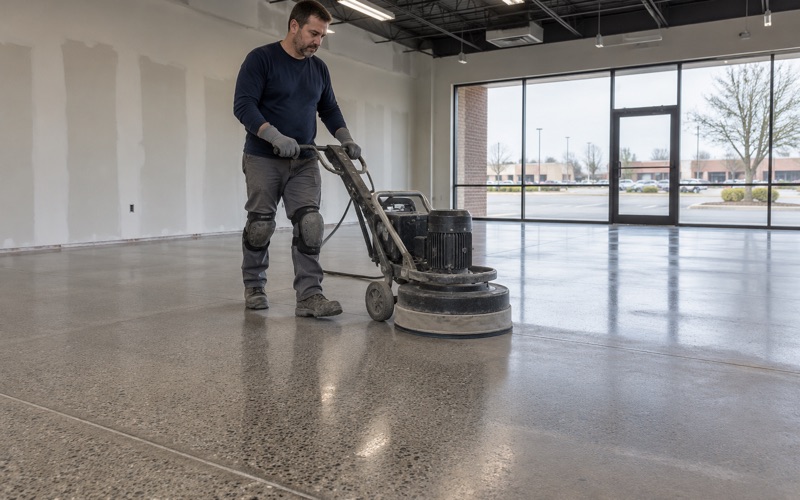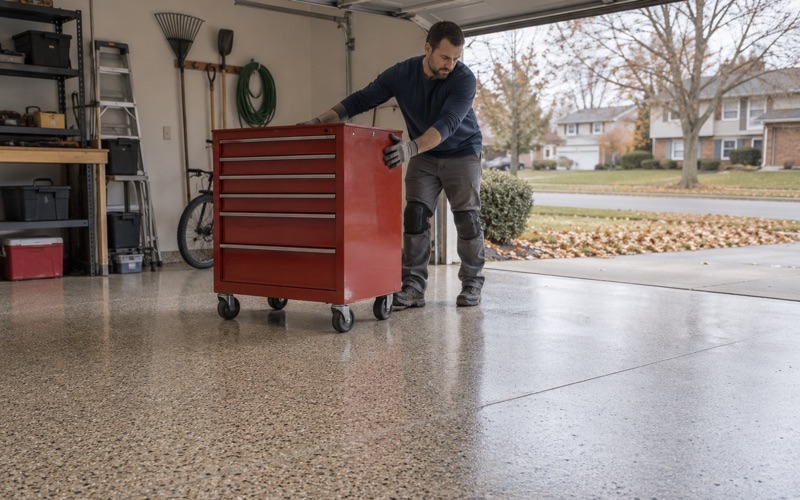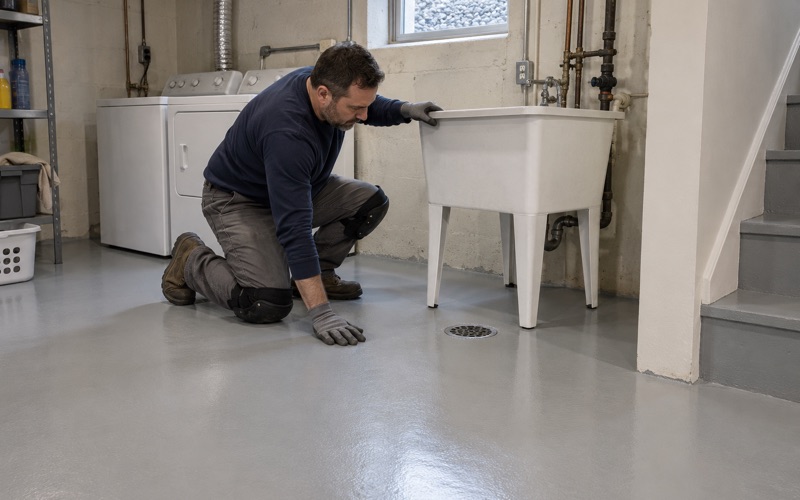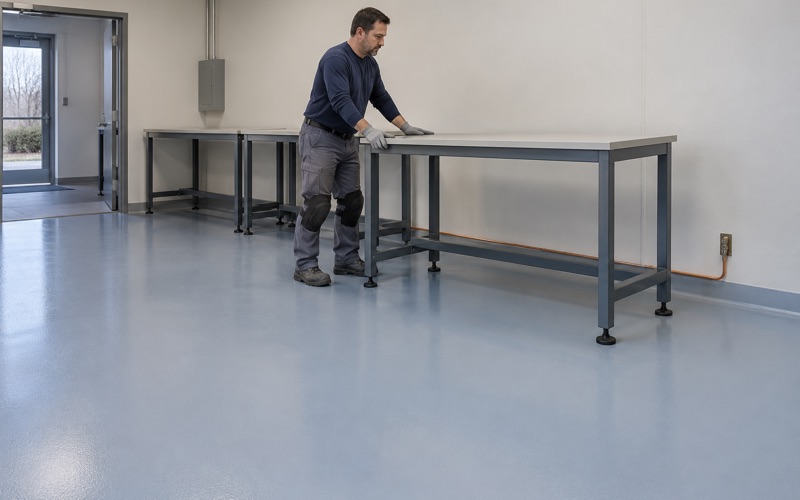
Palatine Epoxy Floors handles epoxy flooring in Hinsdale with more than 20 years in the trade behind every scope, and much of the work here sits under a business that has to reopen the next morning. A salon, a coffee shop, a boutique stockroom or a restaurant kitchen gives us a narrow window and very little room for surprises once the old floor comes up.
That is why the inspection comes before the price. We read the cracks, the old coating and whatever adhesive is left behind, and we tell an owner plainly when the slab needs repair before anything can go over it. The proposal then names the product, the system build and the finished thickness, so the floor that goes down can be checked against the floor that was quoted.
Residential garages and basements are part of our work in the village too, but the floors that set Hinsdale apart are on the storefront side: older commercial rooms, layered floors, and owners who cannot close for a week. We plan every one of those jobs around the hours the doors have to stay open.
A Downtown Listed on the National Register
Downtown Hinsdale is not just old; it is formally recognized. The Downtown Hinsdale Historic District was added to the National Register of Historic Places on May 30, 2006, and it covers 73 buildings and one park, roughly bounded by Maple, Lincoln, Garfield and Second streets. The styles inside that boundary run from the 1880s to after 1955, which means a single block can hold rooms built generations apart.
That range matters underfoot. A room from the early end of it and one from the late end may sit on very different structures. Some older storefronts have a wood floor or a basement below rather than a slab on grade, so we confirm what is actually under a room before we talk about a coating.
58 Buildings Built for Commerce
Of those 73 buildings, 58 were built for commerce. Three were built for government, including the Village Hall on the north side of the railway, nine for transportation, and one as a theater. The shops themselves cluster south of the BNSF line, and that cluster is where a storefront floor job in the district usually lands.
A building designed for commerce tends to be reused many times over. A room that opened as a dry goods store may since have been a bank lobby, an office and a boutique, and each tenant changed the floor to suit the business of the moment.
The nine transportation buildings are a reminder of how closely this downtown grew up around the railroad. The line still carries Metra’s BNSF service, with stations at Hinsdale, Highlands and West Hinsdale. For us that matters mostly at load-in, when a crew has to stage equipment on a block that commuters are also using.
What the Register Listing Does and Does Not Cover
Owners sometimes ask whether the listing means their shop floor needs a historic review. Nothing we have seen shows that National Register status regulates an interior floor, so we treat the district as a fact about the building’s age rather than a sign-off on the coating. The permit question is a separate one: most commercial projects in the village take a combination permit through Village of Hinsdale Community Development, and we confirm what a given job needs before it is scheduled. If a landlord or building owner has its own rules for contractors, we work inside those as well.
Looking for epoxy-flooring closer to Fox Lake? See Fox Lake Epoxy-Flooring.
Shop Floor, Back Room and Kitchen Under One Roof
A downtown storefront is rarely one floor. The sales room, the back room and, in a restaurant, the kitchen each carry different traffic, and a system that suits one can be the wrong choice for the next room over. We scope them separately, even when they share a slab.
The Sales Floor and the Salon Chair
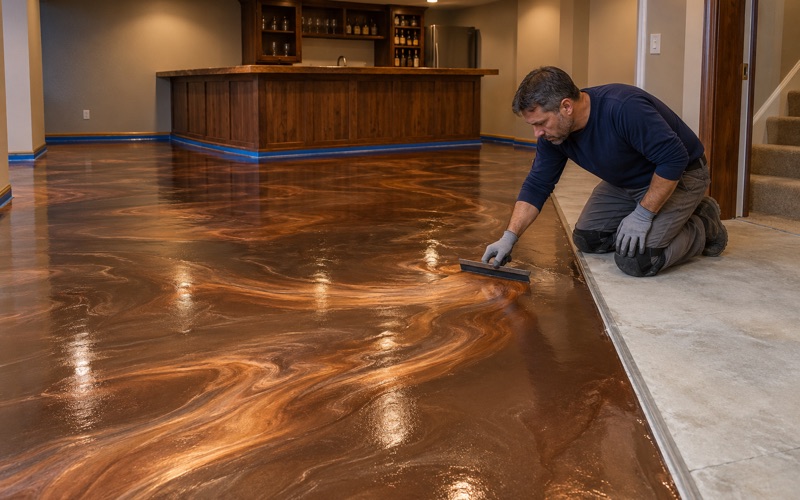
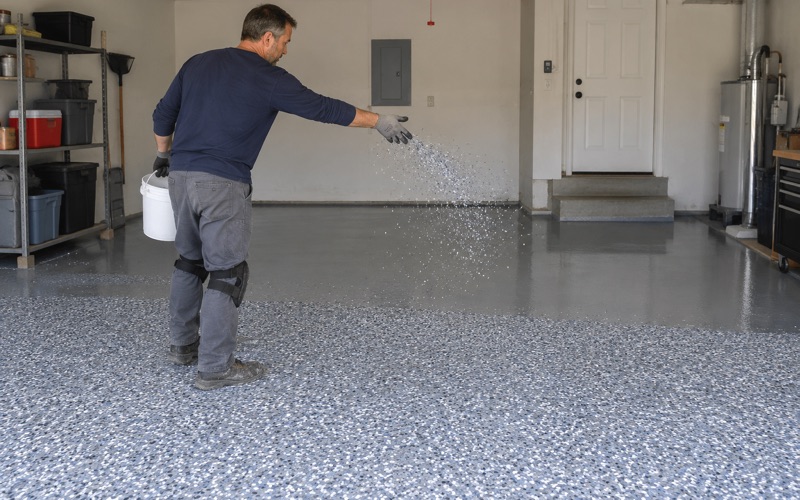
A retail or salon floor is judged on looks as much as wear. A vinyl flake broadcast or quartz aggregate broadcast under a polyaspartic or polyurea topcoat hides small slab flaws, cleans easily and can be returned to service quickly, which matters when the shop is dark for a single day. Salon floors also take chemical spills and rolling chairs, so we size the build to the station layout rather than to the room as a whole.
Color and flake size are picked with the owner’s fixtures in mind, and we lay a sample board in the actual light of the room before the order is placed. A storefront window can change how a broadcast reads from one hour to the next.
The Back Room
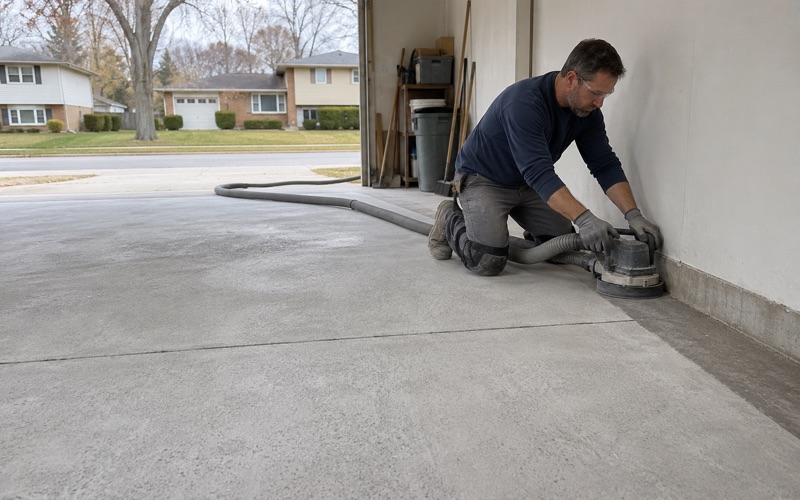
Stockrooms and service corridors carry carts, hand trucks and the occasional pallet jack. There a 100% solids epoxy over a properly opened slab is usually the better value, and a lithium silicate densifier can suit a room that only needs dust control. Every slab we coat is opened by diamond grinding or shot blasting to a measured ICRI CSP profile first; we do not acid etch, because an etched surface in an old building tells us nothing about what the acid failed to reach.
The Restaurant Kitchen
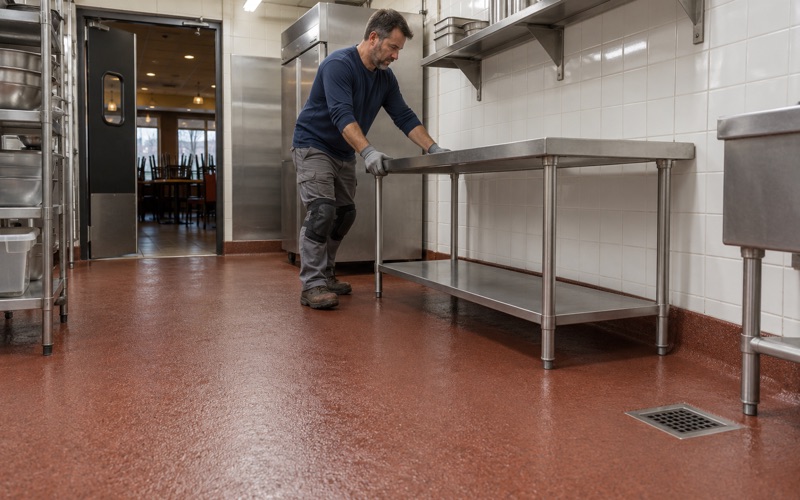
Kitchen floors answer to the food code, which in Illinois means the Illinois Food Code adopting the 2022 FDA Food Code. Section 6-201.13 calls for coved floor and wall junctures, and section 6-201.11 allows an antislip finish, so we detail the cove, the floor drains and the texture together rather than as afterthoughts. Urethane cement is often the right system for a hot, wet kitchen line.
Front-of-house dining rooms in older buildings sometimes sit on a different floor than the kitchen, and the transition between them is planned so a server is not crossing a lip with a full tray. We set the height of the coved base and the threshold together.
A kitchen is also the room least able to wait. We plan the cut-back, the cove and the coating so that the line can be reassembled on the schedule the owner gives us, and we say before the job if the slab’s condition makes that schedule unrealistic.
What Usually Hides Under the Last Tenant’s Floor
Older commercial rooms collect floors the way they collect paint. When we pull up a worn finish in an older commercial building, we expect to find more than one generation of material under it, and the quote depends on how many there are and what holds them down.
Layered Prior Floors
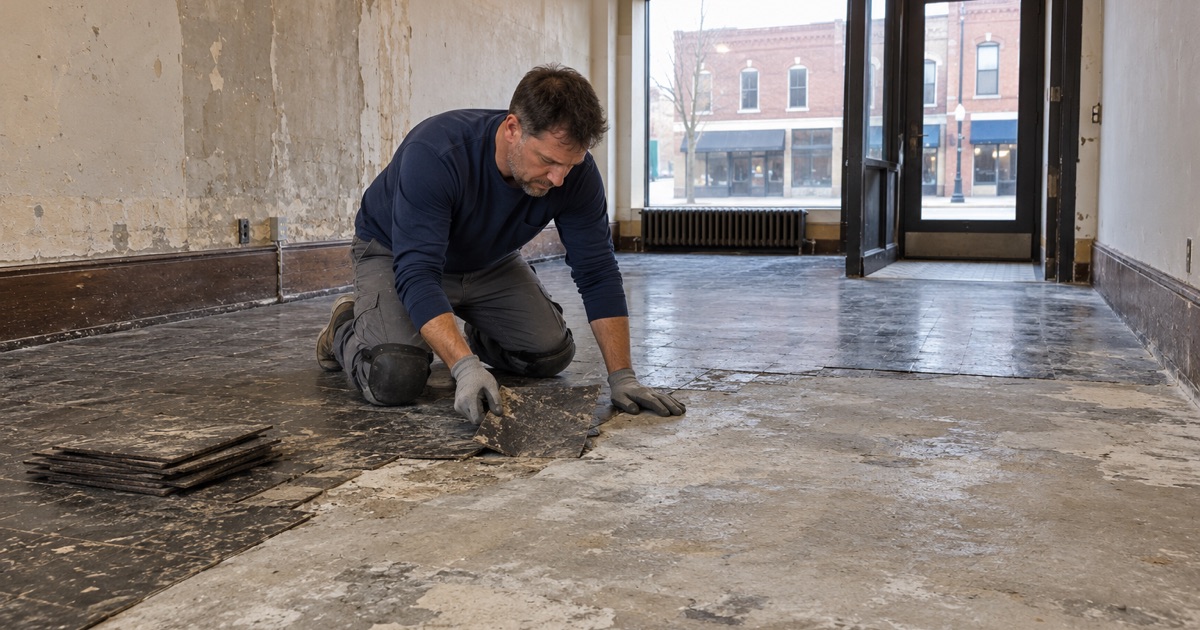
Typical layers in commercial rooms of this age include vinyl tile over a mastic, a thin self-leveler poured to flatten an older floor, carpet glue, and sometimes a previous coating that was rolled onto an etched slab. Each of those has to come off, or be proven sound, before anything bonds. A coating is a film that follows whatever is under it, so a new floor laid over a loose layer simply inherits the failure.
Removal is done mechanically, which also tells us how well each layer was holding. Where a previous tenant’s leveler is sound and bonded, we may keep it; where it sounds hollow under a hammer, it comes out.
A previous epoxy is its own case. We test how well it is holding and look for peeling at the edges and at the door; a coating that lifts with a scraper comes off entirely rather than being topcoated.
Cracks, Joints and Old Repairs
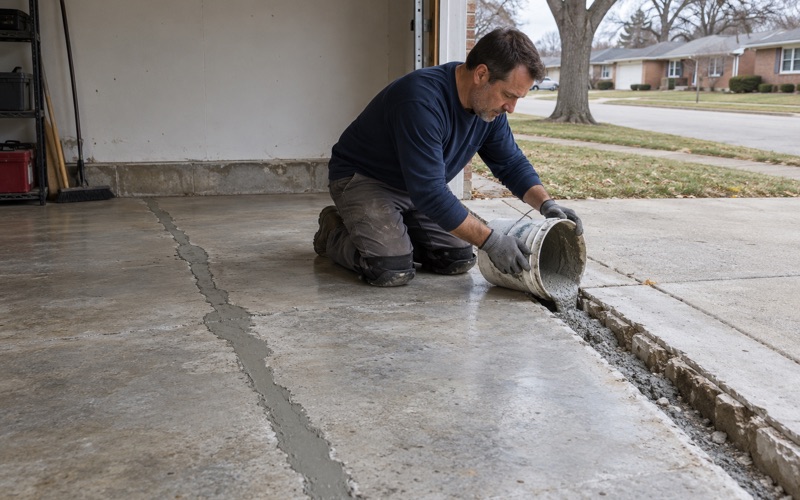
Once the floor is down to concrete, we read the cracks and any patched trenches left from old plumbing or electrical work. Some can be filled and coated over; others are moving and will telegraph through any film. We tell the owner which is which before we price the coating, and we do not promise that a coating will stop a slab from moving.
Moisture in an Older Slab
A slab in a building this old may predate under-slab vapor retarders meeting ASTM E1745, and a floor that looked dry under vinyl can release moisture once the vinyl is gone. Moisture testing is a written line in our scope: ASTM F2170 in-situ relative humidity probes or ASTM F1869 calcium chloride testing, read against the product’s limits. Where the numbers are high, a moisture-mitigation primer goes into the build, and moisture is the first exclusion we read out when we go over the warranty.
Working Around a Downtown That Stays Open
Few shop owners can close for the several days a full grind, prime, broadcast and topcoat can take. We plan commercial jobs around the hours the building has to stay open, working in sections, after closing, or across a weekend, and we keep that schedule inside the hours the village allows for construction noise.
Phasing a Storefront
A phased job usually starts in the back room so the sales floor stays usable, then moves forward once the first section can take traffic. Fast-return polyaspartic topcoats help here, but only when the slab under them has been opened and tested like any other. We agree on where the joint between phases will fall before work starts, so it lands at a doorway or a fixture line rather than across the middle of the room.
Before the crew arrives, the owner gets the schedule, the cure times for each section and the point at which fixtures can go back. A shop that knows exactly when it can reopen can tell its customers, and we treat that date as part of the job.
Cure, Odor and Air
Curing is scheduled against slab temperature and the dew point spread at the slab surface, not the calendar, because a coating laid too close to the dew point can blush or fail to harden. That matters in older buildings with uneven heating and doors that open onto the street all day. When a section has to open the next morning, we tell the owner in advance whether the conditions that night support it, and we would rather move a date than hand back a soft floor.
Shared walls and upstairs neighbors can come with an older commercial building, so odor is part of the plan. Our coatings are chosen within the Illinois VOC limits in 35 Ill. Adm. Code Part 223, which bind the installer as well as the manufacturer, and we talk through ventilation with the owner before the first coat goes down.
Paperwork Before the First Pass
Illinois issues no state license for flooring or coatings work, so we show the registration, bond and insurance the village asks for instead of a license number. If the job includes the owner’s home garage as well as the shop, that part gets a written contract and the Home Repair: Know Your Consumer Rights pamphlet, as the Illinois Home Repair and Remodeling Act requires.
- 20+ Years Coating Concrete
- Moisture Tested Before We Coat
- Free Written Estimates