Palatine Epoxy Floors brings more than 20 years of epoxy flooring work to Franklin Park, and a large share of what we see in this village starts on a floor somebody else chose. An industrial slab here is rarely a blank one. It usually carries a previous coating, faded aisle striping and a patchwork of repairs, none of which were planned with the next occupant in mind.
So we read a floor before we price it. We look at the cracks, the old coating and how well it is still bonded, and we say plainly when a slab needs repair before anything new can go over it. The proposal that follows names the product, the system build and the finished thickness, which lets a facilities manager hold the finished floor up against the quote.
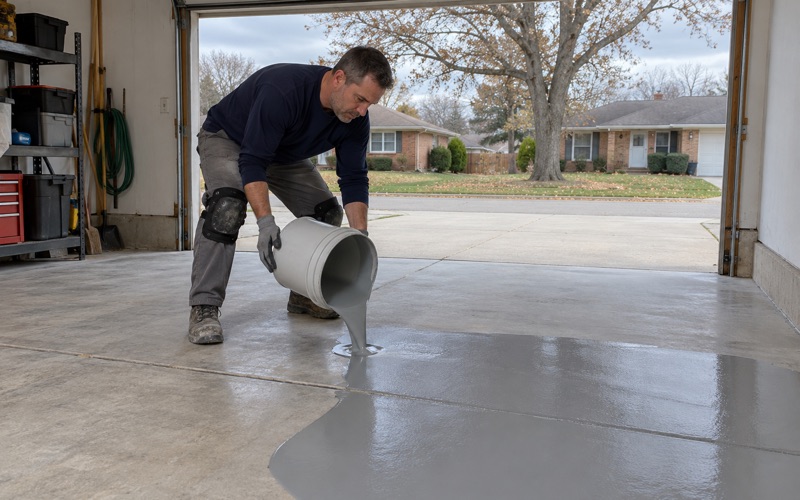
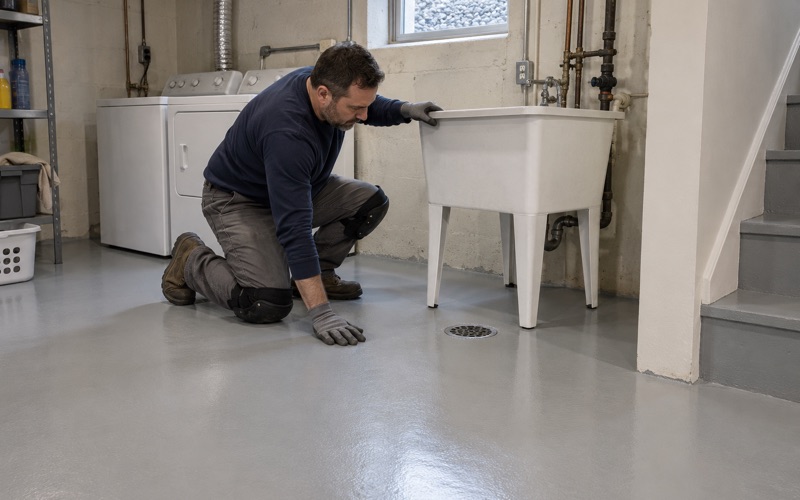
Homeowners get the same method on a garage or basement slab, only at a smaller scale. Every floor we coat is opened mechanically first, and moisture testing is written into the scope instead of offered after a coating has already lifted.
Ten Years of the Village’s Employer List, Side by Side
The clearest picture of how industrial floors turn over in Franklin Park comes from the village itself. Its FY2025 audit report carries a table of major employers located within village limits, citing the Official Statement of the Village as its source, with one column for 2011 and another for 2021.
Who is on one list and not the other
The 2011 column names Fresh Express Corporation with 557 employees, Bretford with 500 and DHL Global with 450. None of those three appear in the 2021 column. That later column adds DB Schenker at 409, Koch Foods at 500 and Moss Inc at 250, while Transcendia sits on both lists but falls from 550 in 2011 to 250 in 2021.
The table does not explain any of it. It gives no reason an employer dropped off, and it does not say which buildings were vacated, re-leased or sold, so we will not guess. What it does show is a decade in which produce, furniture and freight names gave way to a different mix, and every one of those operations stood on concrete.
Why that matters to a floor
A coating is specified for a process. A produce operation, a furniture plant and a freight terminal each ask different things of a slab: washdown and cold for one, dust and fixtures for another, wheel traffic and long aisles for the third. When the occupant changes, the floor usually stays, and the new tenant inherits a surface that was chosen for someone else’s work.
The scale of the industrial base is in the village’s utility numbers too. In 2024 Franklin Park served 1,237 commercial and industrial water and sewer customers against 4,664 residential ones, so roughly one account in five belongs to a business.
Looking for epoxy-flooring closer to Norridge? See Norridge Epoxy-Flooring.
What a Previous Tenant Leaves on the Floor, and How It Comes Off
The first walk-through on an inherited slab is mostly an inventory. We want to know what is on the concrete, how firmly it is attached and what has soaked into it, because each of those decides how the floor has to be prepared.
Old coatings, striping and adhesive
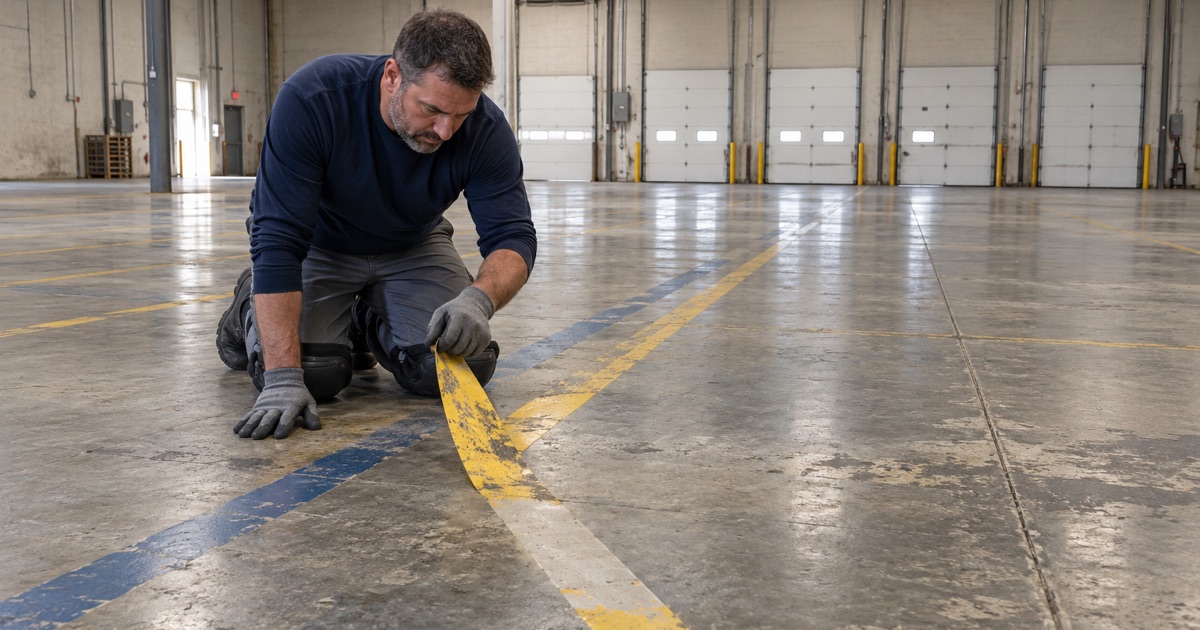
Most re-occupied buildings show more than one layer of history. There may be an epoxy or urethane system from the original fit-out, safety striping repainted over it several times, glue from carpet tile or vinyl in an office corner, and shadows where racking or machinery was anchored. A coating that is peeling at the edges is often still bonded tightly in the middle, and the two areas cannot be treated the same way.
New material put over a weak layer only shares that layer’s bond. If the old film lets go, everything on top of it goes too. For that reason we remove a failing coating down to sound concrete instead of scuffing it and hoping the new system holds.
Grinding and shot blasting to a measured profile
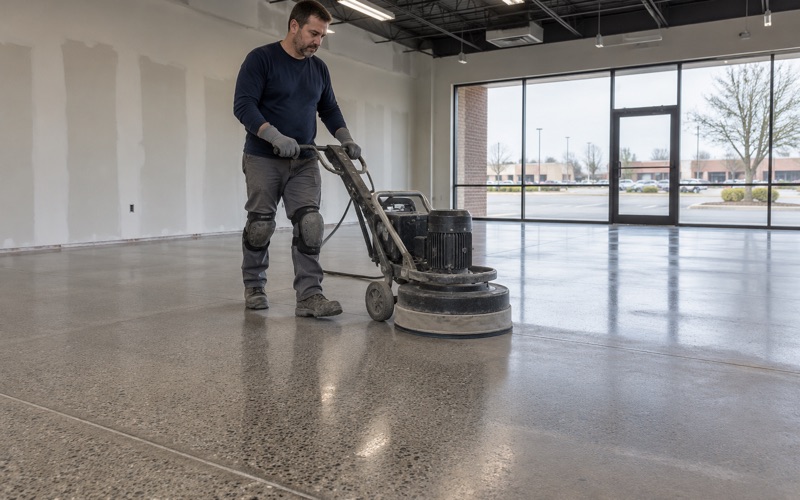
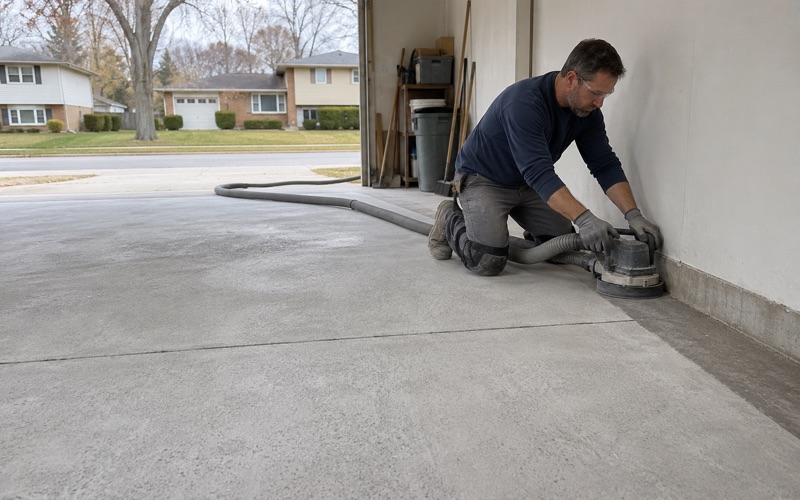
We open every slab mechanically, with diamond grinding or shot blasting, and we do not acid etch. Grinding is the better tool for stripping a hard coating, cutting off adhesive and leveling lippage at joints. Shot blasting suits large open floors where the goal is an even profile across thousands of square feet.
The target is a surface profile matched to the system, described on the ICRI CSP 1-10 scale. A thin sealer needs a light profile, while a thicker broadcast or urethane cement build needs a rougher one. Getting that right is what lets the new floor bond to the concrete and not to whatever the last tenant left behind.
Oil, stains and filled anchor holes
Years of machine oil or spilled product can work into the pores of a slab and keep resurfacing after grinding. Those areas get extra cleaning and sometimes a dedicated primer, and we tell the owner when a stain is deep enough that it may shadow through a light-colored finish. Old anchor holes and spalled joints are filled and ground flush before the coating goes down.
Reading the cracks before quoting
An inherited floor also inherits its cracks. Some are shrinkage cracks that have long since stopped moving, and some open and close with loads or seasons. We map them during the walk-through, decide which can be filled and coated over and which need a repair first, and put that decision in writing so the new occupant knows what the finished floor will and will not hide.
Re-Specifying a Floor for a Different Use
Once the slab is clean and open, the real question is what the next occupant needs from it. A change of use from produce or furniture to logistics, or the reverse, changes the system we would recommend.
From process floors to freight floors
A logistics tenant generally cares about abrasion from pallet jacks and forklifts, clear lane markings and a surface that is easy to sweep. A 100% solids epoxy with a quartz aggregate broadcast, finished with a polyaspartic or polyurea topcoat, is a common answer for heavy traffic. Where a slab will stay bare in racking zones, a lithium silicate densifier can harden the concrete without a film. Striping is laid out for the new tenant’s traffic pattern rather than traced over the old lines, which rarely match how the next operation moves.
A food or wet operation moving in asks for something else. Under the Illinois Food Code, which adopts the 2022 FDA Food Code, floor and wall junctures in those areas are expected to be coved under section 6-201.13, and urethane cement is often the right choice where hot water, steam or heavy washdown is routine. Electronics or sensitive equipment may call for a static-dissipative system tested to a stated resistance range.
Moisture testing on an older slab
An industrial slab that has been sealed under a coating for years can hold more moisture than its age suggests. We test before we coat, using ASTM F1869 calcium chloride vapor emission tests or ASTM F2170 in-situ relative humidity probes, and compare the results against the manufacturer’s limits. When the readings are high, a moisture-mitigation primer goes into the scope as a priced line.
Warranty exclusions are read to the owner before the contract is signed, and moisture is named first. A coating is also a film that follows the concrete under it, so a moving crack will eventually show through, and we say that before the job instead of after.
Scheduling around a working building
Many re-occupied buildings are already partly in use when the floor goes down. We phase commercial work around the hours the building has to stay open, and cure times are planned against slab temperature and the dew point spread at the surface. Floor coatings are chosen within the Illinois VOC limits in 35 Ill. Adm. Code Part 223 Subpart C, which bind the installer as well as the manufacturer.
The O’Hare East Industrial TIF and Who Signs Off
Franklin Park is a village in Leyden Township, Cook County, and the paperwork for a floor job here runs through village offices. The village has also set up tax increment financing districts that are part of the background for industrial property owners.
The TIF in the village’s own books
The village’s FY2025 audit report lists the O’Hare East Industrial TIF Fund as a major debt service fund, alongside a Downtown Franklin Avenue TIF carried as a major special revenue fund. A tax increment district directs growth in property tax revenue inside its boundaries toward that district’s obligations. Whether a given building sits inside the O’Hare East district, and what that means for an owner’s plans, is a question for the village, and we would point an owner there before assuming anything.
Permits, registration and the building department
The Village of Franklin Park Building Department, at 9500 Belmont Avenue, handles contractor licensing and permits. Illinois issues no state license for flooring or coatings work, so the credentials we show are the village registration, bond and insurance it requires. Work is scheduled inside the hours the village allows for construction noise.
Garages and basements across the village
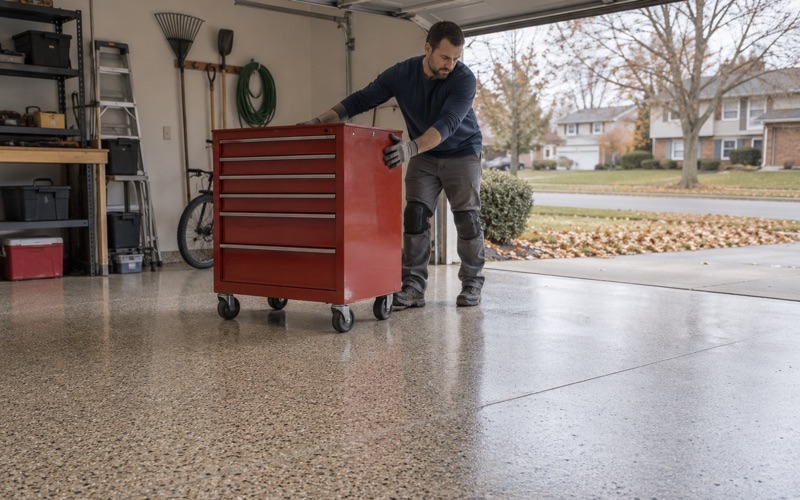
The residential side of Franklin Park is mostly older detached houses, with 62.0 percent of homes built before 1960. On an older garage slab we expect previous paint or coatings, patched cracks and an unknown history underneath, and the same rule applies as on a warehouse floor: grind it, test it and price only the system it can carry. Every home job comes with a written contract and the Home Repair: Know Your Consumer Rights pamphlet before work starts, as the Illinois Home Repair and Remodeling Act requires.
- 20+ Years Coating Concrete
- Moisture Tested Before We Coat
- Free Written Estimates