Palatine Epoxy Floors brings more than two decades of floor work to epoxy-flooring in Fox Lake, and here the job starts with a question many coating crews never ask. Before we talk about colors or flake blends, we want to know whether water has ever stood on the slab, how long it stayed and what it left behind in the concrete.
That question shapes everything after it. A basement or garage slab that has been soaked can look sound and still be carrying moisture, salts and old coating failures that will push a new film off within a season. So we open every floor mechanically, test it as a written line item, and tell you plainly when the slab needs drying or repair before anything goes down.
What we will not do is sell a coating as protection against the next high water. A floor coating is a thin film that follows the concrete beneath it; it does not hold back river water or pressure from below. What it can do, on a slab that has been properly dried and prepared, is give you a durable surface that cleans up easily, sold with its limits stated up front.
When the Chain O’Lakes Came Into the Basements
July 2017 on the Chain
On July 17, 2017, CBS Chicago reported that several hundred homes in the village of Fox Lake had flooded as the Chain O’Lakes rose. The Fox Lake gauge was expected to crest above 8.2 feet, the Illinois Department of Natural Resources said levels were higher than it had seen on the Chain, and the village ran sandbag stations on Covington Road and Forest Avenue.
One resident described about four feet of water in his basement and two feet in his crawlspace. For a floor, that is not a cosmetic event. Concrete that sits under floodwater absorbs it deep into the slab, and whatever was on the surface, from old paint to carpet adhesive, has usually let go or trapped moisture underneath.
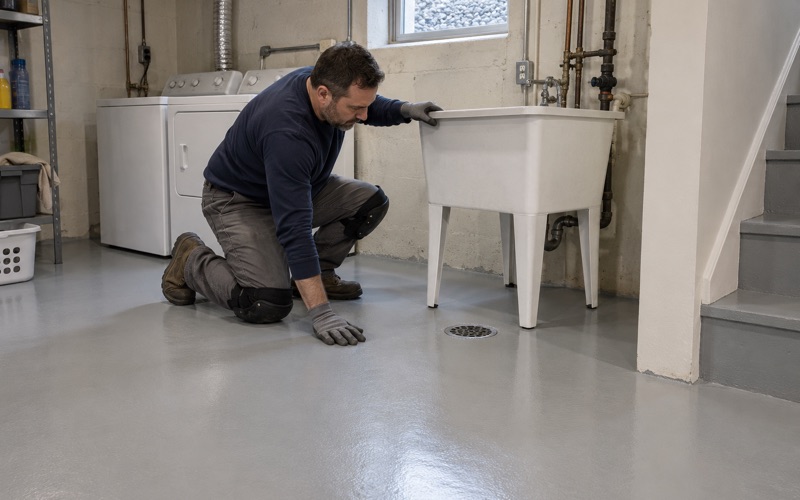
That is why the first visit to a lake-side basement or garage is an inspection, not a sales call. We look for the high-water line on the walls, efflorescence on the slab, lifting or blistered coating, and staining around the sump pit and floor drain, because each one tells us something about where the water came from and where it still sits.
Floodplain work and the WDO permit
The Village of Fox Lake’s general permit information is direct about it: all work located within a floodplain or near a wetland requires a permit under the Lake County Watershed Development Ordinance. The village administers that ordinance alongside the building codes it has adopted, and floodplain sites carry additional submittal information and fees.
The same permit list names basement remodels, garages, foundation repair, driveways, patios and seawalls. Whether a floor coating on its own triggers a permit is not something we decide for you, and it is not something we will guess at. When a job sits near the water or involves slab repair, we put the question to the village before we schedule the work.
Who signs off in the village
That call belongs to the Village of Fox Lake Community Development Department at 66 Thillen Drive, which handles permits under the 2015 International Residential and Building Codes and the watershed ordinance. The village also asks every contractor for an original $10,000 surety bond, and since Illinois issues no license for coatings work, the bond, registration and insurance are what we show you instead of a license number.
Looking for epoxy-flooring closer to Western Springs? See Epoxy-Flooring in Western Springs.
Testing and Drying a Slab That Has Been Under Water
Drying comes before testing
A slab that flooded needs time and air before any test means much. We ask when the water came in, when it left, whether the space has had dehumidification since, and whether the sump and any check valve on an overhead sewer have been working. Testing a slab that is still drying only tells you it is wet, which you already knew.
Once the space has had a fair chance to dry, moisture testing goes into the proposal as its own line item. That is true on a basement slab and a garage slab alike, and it is true on newer concrete too. A garage slab poured to code may have no vapor retarder under it at all, because IRC R506.2.3 exempts garages, so age alone does not tell us a slab is dry.
The tests we run
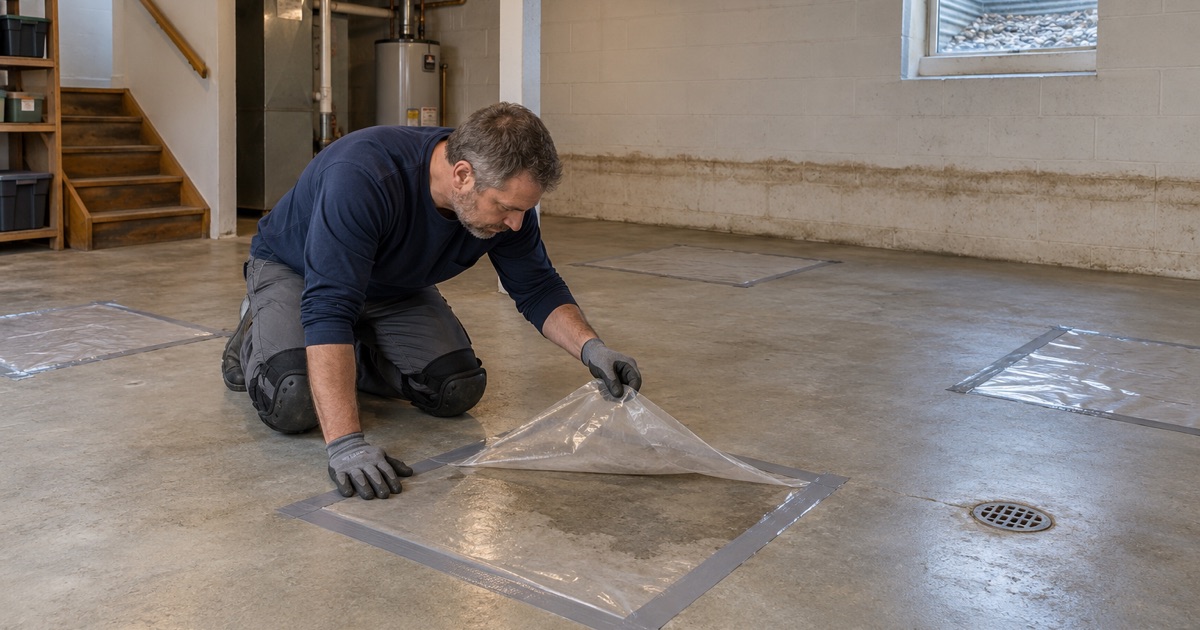
We start with the ASTM D4263 plastic sheet test as a quick screen, then move to numbers. ASTM F1869 calcium chloride testing measures the moisture vapor emission rate at the surface, and ASTM F2170 in-situ relative humidity probes read what is happening inside the slab. We compare the results to ASTM F710 thresholds and to what the coating manufacturer will warrant.
When the readings run high, the choice is between waiting longer, using a moisture-mitigation primer rated for the condition, or telling you the floor is not a good candidate yet. Warranty exclusions get read aloud before you sign, and moisture is the first one we name.
Reading what the water left
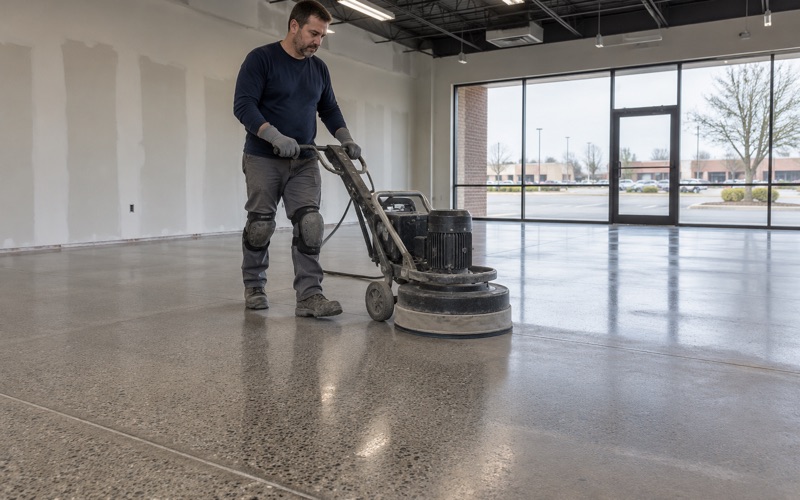
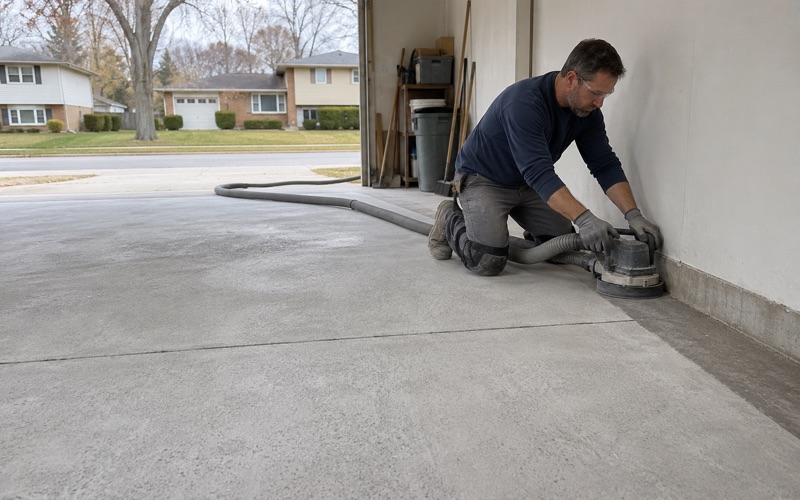
Floodwater rarely leaves a slab clean. We expect efflorescence, silt in the pores, softened patching and old coatings that have released in patches, and we remove all of it with a diamond grinder or shot blaster down to a clean ICRI surface profile. We do not acid etch, which only adds more water and residue to a slab we have worked to dry.
Cracks get the same scrutiny. A coating is a film that follows the concrete under it, so a crack that is still moving will show through, and we say so before the job rather than after. If the flood undermined a section or the slab has settled, we tell you it needs repair first, and that repair may be its own permit question for the village.
Marina Service Bays and Winter Boat Storage
Boats are as much a part of the village’s floor market as cars. Donovan Day, the village’s economic development director, has described Fox Lake as having 10 marinas with more than a thousand boat slips, and some of those businesses offer service and winter inside storage.
What a boat bay asks of a floor
A boat service bay is a harder job for a floor than a home garage. Trailers pivot on the coating, lifts and jack stands put point loads on it, and hulls come in off the water still dripping. Fuel, oil, bottom paint and cleaning chemicals end up on the floor, and the space often has a floor drain that needs to be detailed rather than coated over.
Winter storage buildings carry a different load. Boats sit for months on stands and trailers, the building may be heated only partly or not at all, and spring launch week puts heavy traffic across the slab in a short window. Where a storage building only needs dust control and a harder surface rather than a full coating, a lithium silicate densifier on a ground slab can be the honest answer, and we will say so.
Building the system for wet hulls
For bays like these we usually look at a 100% solids epoxy base with a quartz aggregate broadcast for grip, finished with a chemical-resistant polyaspartic or polyurea topcoat. Urethane cement earns a look where hot pressure washing and heavy chemical exposure are routine. The proposal names the product, the system build and the finished thickness, so what you paid for can be checked against what went down.
Commercial work gets scheduled around the hours your shop has to stay open, which for a marina usually means sections at a time or the slower weeks between seasons. A storage building with a slab that has seen high water gets the same moisture testing a flooded basement does.
Older Houses, Townhomes and Owners Who Come and Go
1970s slabs and resort-era cottages
Fox Lake’s housing has two very different slabs in it. The 1970s was the village’s biggest building decade, with 1,560 units, and those garages and basements are now old enough that many have been coated, painted or patched before. We find out what is on the surface before quoting, because a coating over a failing old one inherits the failure.
At the other end, 685 units predate 1940, some of them resort-era houses from the years when the village’s summer peak ran to about 50 hotels and 2,000 cottages. Floors in houses that old may be thin, uneven or poured in stages, and they often carry layers of old finishes. We grind to sound concrete and tell you plainly whether what we find can hold a coating.
Townhomes and associations
The village counts 1,123 owner households in attached single-family homes, and their garage and basement decisions may run through an association. We ask you to check those rules before we schedule, and then we plan the work around them and around your neighbors’ access to their own garages.
Shared walls and shared drives also mean noise and fumes travel. We work inside the hours the village allows for construction noise, and we choose coatings within the Illinois VOC limits under 35 Ill. Adm. Code Part 223, which bind the installer as well as the manufacturer.
Owners who are not always here
Fox Lake has 349 units held for seasonal or occasional use, and those owners want the work done on their calendar, not ours. A floor coated while you are away still needs someone to manage cure time, keep the space closed and confirm it is ready before a car or boat trailer rolls onto it.
We set that plan in writing before we start. Curing is scheduled against slab temperature and the dew point spread at the surface rather than a date on the calendar, so we will tell you if an unheated garage has to wait for spring. Every home job also comes with a written contract and the Home Repair: Know Your Consumer Rights pamphlet, as the Illinois Home Repair and Remodeling Act requires.
- 20+ Years Coating Concrete
- Moisture Tested Before We Coat
- Free Written Estimates