
Palatine Epoxy Floors handles concrete floor repair for homes and businesses in Palatine, IL, drawing on more than 20 years of preparing slabs for coatings, and we serve surrounding cities including Barrington, Lake Zurich, Prospect Heights, Deerfield, Wood Dale. Cracks, spalls, scaled surfaces and broken joints are repaired so the floor is sound, safe and ready for whatever goes on top.
Most of the repair work we see is the reason a floor coating would fail if it went down without it. A coating is a film that follows the concrete beneath it, so every loose edge, hollow patch and moving crack eventually shows through. Fixing those first is what makes a coated floor last, and it is also what makes an uncoated floor safe to walk and drive on.
We read the cracks and the condition of the slab before quoting, and the written proposal lists each repair as its own line. When a slab has problems a surface repair cannot solve, we say so plainly instead of patching over them.
Crack Repair in Concrete Floors
Shrinkage Cracks and Stable Hairlines
Almost every slab develops fine shrinkage cracks as it cures, and most of them stop moving within the first year or two. Those stable cracks are routed or ground open, cleaned and filled with a rigid epoxy or polyurea repair material, then ground flush with the surrounding surface. Under a coating, they vanish from view and stay closed.
Left open, even hairline cracks collect dirt, moisture and winter brine. In a garage, salt water working into a crack accelerates the damage along its edges, which is why we fill them even when they look harmless.
Moving Cracks and Settled Sections
Some cracks keep opening and closing with temperature and soil moisture, and some have one side higher than the other. Those tell us the slab or the ground under it is still moving. A rigid filler in a moving crack will simply crack again, and a coating over it will follow.
For active cracks, we may use a flexible filler or treat the crack as a joint, and we explain the tradeoff before the job is sold. Where a section has settled or heaved enough to create a real offset, lifting or replacing the concrete has to come before any surface repair.
Spalls, Pitting and Salt Scaling
Garage Door Edges and Driveway Aprons
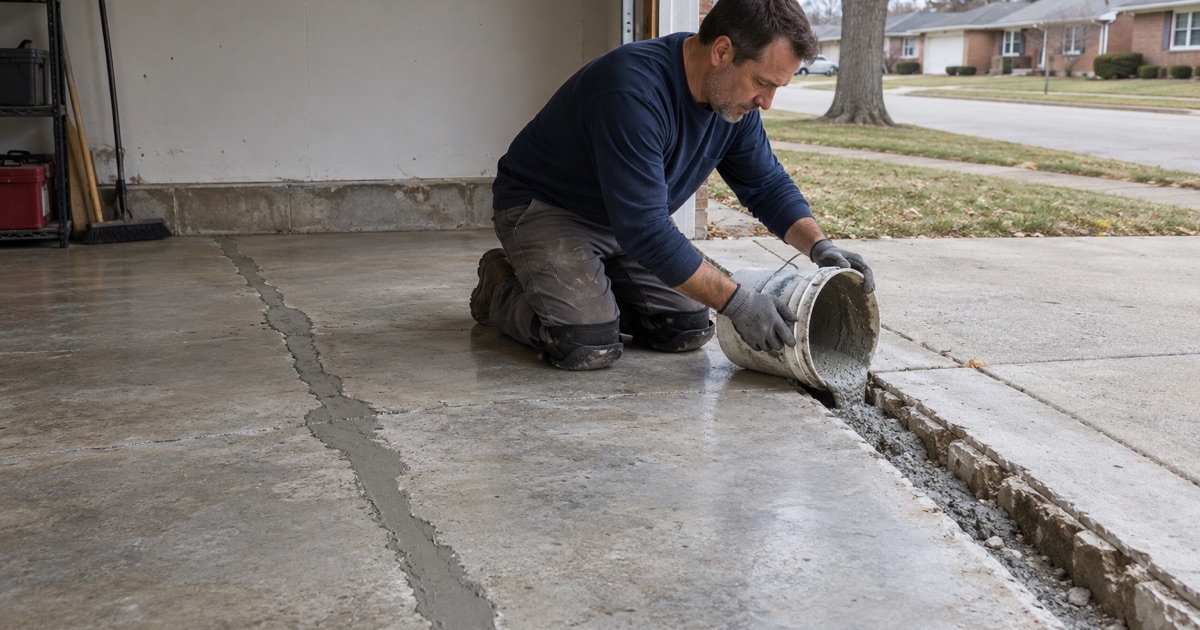
The edge of a garage slab at the overhead door takes the most punishment, from tires, plows and pooled meltwater. Palatine requires a thickened, reinforced edge at the garage door, but even a well-built edge chips and spalls over decades of northern Illinois winters.
We saw-cut and remove loose concrete along the edge, rebuild it with a fast-setting repair mortar, and grind it flush. A clean, solid edge is also where a new coating terminates, so this repair directly affects how long the rest of the floor holds.
Salt Scaling on Garage Floors
Scaling looks like the top of the slab is flaking away in patches, often in the parking lanes and near the door. It happens when calcium chloride and rock salt brine soak into the concrete, freeze and expand, and break the surface layer loose one winter at a time.
The repair is to grind away the weakened concrete until we reach sound material, then rebuild the surface with a resurfacing mortar or epoxy mortar. Sealing the repaired floor under a coating is what keeps the brine from starting the process again.
Pitting, Popouts and Surface Wear
Popouts are small conical pits where a piece of aggregate near the surface has broken away, and general pitting comes from wear, chemical spills or poor original finishing. On their own they are cosmetic, but they trap dirt and moisture and show through thin coatings.
We fill pits and popouts with a repair compound that grinds smoothly, so the floor ends up level and uniform. On heavily worn floors, a thin resurfacer can rebuild the whole surface instead of filling hundreds of individual spots.
Joints, Edges and Leveling
Control Joint Repair
Control joints are cut into slabs so cracks form along straight lines rather than at random. Over time, their edges can chip under wheels and their old filler can fail, leaving gaps that catch carts, pallet jacks and heels.
We clean out failed filler, rebuild chipped joint edges and refill with a semi-rigid joint filler in commercial spaces or a suitable filler in garages. On a coated floor, joints can be honored with a clean line or filled and coated over, depending on how much the slab moves.
Leveling and Resurfacing Uneven Floors
Basement and garage floors in older homes often have low spots, rough patches or old repairs at different heights. Self-leveling underlayments and resurfacing mortars can flatten and smooth those areas before a coating or polish is applied.
Most of Palatine’s homes were built between 1960 and 1989, so many slabs have decades of patches, removed fixtures and anchor holes. We grind high spots, fill low ones and create a consistent surface rather than coating over the history.
What Repair Cannot Fix
Water and Moisture Problems
Repair mortars fill damage but do not stop water. If a basement crack is actively leaking or the slab shows heavy efflorescence, the moisture source needs attention first. Palatine’s poorly drained till soils carry a seasonal water table close to the surface in late winter and spring, so we test moisture before any coating decision.
Where moisture readings are high but there is no liquid water, a moisture-mitigation primer can allow the repaired slab to be coated. We put the test result and the chosen primer in writing.
Structural Problems and Failed Slabs
Slabs broken into many loose pieces, badly heaved sections and floors over voids need structural attention, not surface repair. We will point those out during the estimate and recommend lifting or replacing the concrete, even though it means we are not the right contractor for that part of the job.
Once the slab is sound again, we can come back to grind, repair any remaining defects and coat or polish the finished floor. New concrete needs time to cure before it can be coated, and we test it before we do.
- 20+ Years Coating Concrete
- Moisture Tested Before We Coat
- Free Written Estimates