Palatine Epoxy Floors installs commercial epoxy flooring for warehouses, manufacturing plants, laboratories, service shops, retail stores and offices in Palatine, IL, with more than 20 years of concrete floor experience, and we serve surrounding cities including Barrington, Lake Zurich, Prospect Heights, Deerfield, Wood Dale. Every commercial system is matched to the traffic, chemicals and cleaning routine the floor actually faces.
Commercial floors fail for predictable reasons: a coating too thin for forklift traffic, a resin the cleaning chemicals soften, a floor coated over damp concrete, or a schedule that rushed the cure to reopen sooner. Each of those is decided during planning, which is why our proposals spell out the system, the build thickness and the phasing before anyone touches the floor.
Preparation is shot blasting or diamond grinding, never acid etching, and moisture testing is part of the scope. When a slab needs joint repair or crack work before it can carry a coating, we list it plainly as its own line.
Warehouse and Distribution Floors
Forklift and Pallet Traffic
Distribution and logistics buildings put the hardest wheel loads on a floor, with forklifts turning in place, pallet jacks rolling over joints and loads dropped at the dock. Thin coatings wear through in the busiest lanes within months. We specify thicker 100% solids epoxy systems, or epoxy mortar in the worst areas, sized to the equipment that crosses the floor.
Palatine’s employers include logistics firms and a postal distribution center, and its commercial redevelopment runs along Rand Road, Dundee Road and Northwest Highway. Many of those buildings sit on older slabs that have seen decades of traffic, so we assess wear, joints and contamination before recommending a build.
Joint Repair and Dock Areas
Control joints are where warehouse floors break down first, as wheels chip the edges and old filler fails. We rebuild damaged edges and refill joints with a semi-rigid filler that supports wheels while allowing slight movement. Dock plates and the slab just inside the doors get extra attention, because they take impact loads and winter meltwater.
Where trucks track in road salt and slush, the floor near the doors needs a chemical-resistant topcoat and a texture that stays safe when wet. Those zones are often coated with a different build than the dry storage areas behind them.
Striping, Walkways and Safety Zones
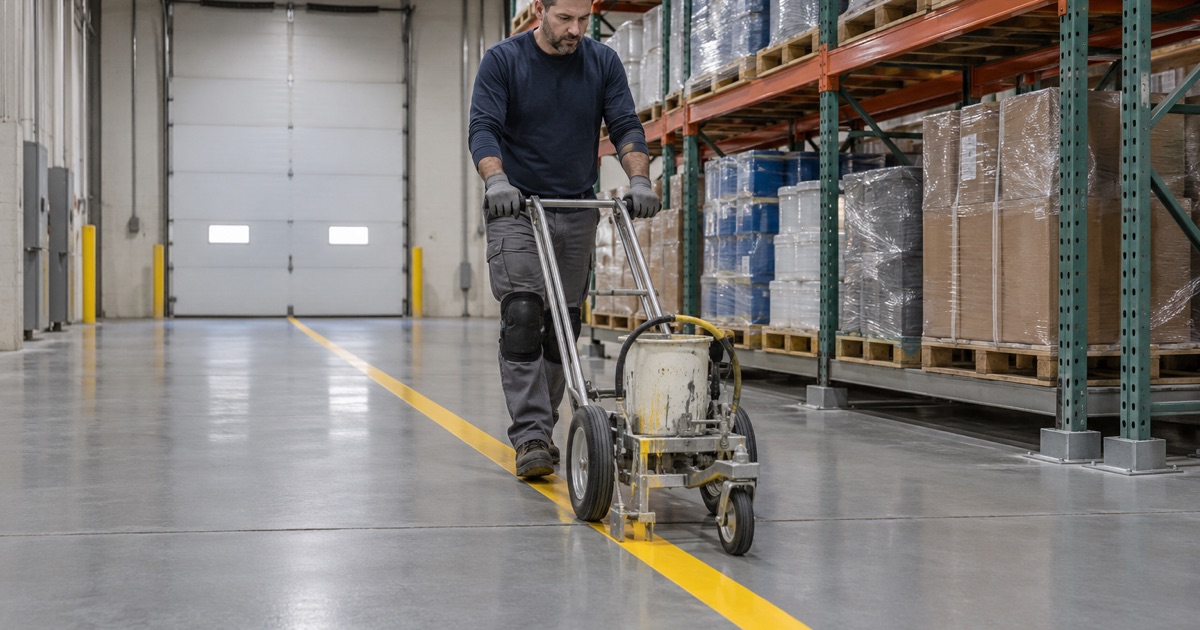
Aisle lines, pedestrian walkways, forklift lanes and hazard zones can be built directly into the coating system. Lines sealed under a clear topcoat last far longer than paint on bare concrete, and colored zones help keep people and equipment separated.
We lay out striping with your operations team so it matches racking, traffic flow and any safety plan your facility follows. Lines can be added in a later phase if the layout is still changing.
Manufacturing, Labs and Specialty Floors
Chemical-Resistant Systems
Manufacturing floors face oils, coolants, solvents, acids and caustic cleaners. No single resin resists everything, so we match the system to the chemicals actually used, often a novolac epoxy or a specific topcoat for aggressive exposure. A coving detail at walls keeps spills from reaching the joint between floor and wall.
Laboratories need the same approach on a smaller scale, with seamless floors that resist reagents and cleaning agents and do not trap contamination in grout lines. We confirm the chemical list with lab managers before choosing a topcoat.
Static-Dissipative and ESD Floors
Electronics assembly, clean rooms and server spaces often require floors that control static discharge. ESD systems include conductive layers and grounding points, and the finished floor is tested against the resistance range the facility specifies. We coordinate with the facility’s own requirements rather than guessing at a number.
An ESD floor only works as a system, so grounding connections, the conductive primer and the topcoat all have to be installed and tested together. We record the readings from the finished floor and hand them over for the facility’s records.
Washdown and Thermal Shock Areas
Food processing and commercial kitchens with hot water or steam washdown need urethane cement instead of standard epoxy, because it handles thermal shock and constant moisture. We specify it for those zones even when the rest of the building takes epoxy.
These areas also need integral coving where floor meets wall and floors sloped to drains, so water never stands at the edges. Palatine’s food establishment inspectors work from the Illinois Food Code, which follows the 2022 FDA Food Code, and we build those details in from the start.
Retail, Office and Service Spaces
Showrooms, Stores and Lobbies
Retail floors, showrooms and lobbies need a durable surface that looks good and cleans quickly. Flake, quartz, metallic and solid-color systems under a polyaspartic or urethane topcoat give businesses choices in appearance without sacrificing wear resistance.
Older storefronts often have tile adhesive or old floor coverings to remove first. Grinding them out and coating the slab avoids adding another layer of flooring with its own joints and edges.
Auto Service Bays and Maintenance Shops
Service bays combine hot tires, jack stands, dropped tools and spilled fluids. A thick epoxy base under a chemical-resistant topcoat with light texture keeps the floor safe and cleanable, and we detail trench drains, lift pads and bay doors where fluids and water collect.
A light color in a service bay also brightens the work area and makes dropped bolts and fluid leaks easy to spot. We pick a topcoat that resists brake fluid and gasoline, since those soften many standard coatings.
Scheduling, Compliance and Registration
Working Around Business Hours
We phase commercial floors into sections, coordinate shutdowns, and choose fast-curing products where reopening time is short. Palatine bars construction work between 8:00 p.m. and 7:00 a.m., and loud Sunday work cannot start before noon, so after-hours phasing is planned within those limits.
The proposal shows each phase, its cure window and the return-to-service time, so managers can schedule staff and deliveries with confidence. If a phase has to shift, we agree the change in writing before work moves.
Registration, Bonds and VOC Limits
Illinois issues no state license for flooring or coating work, so we show the village registration, bond and insurance each municipality requires instead of a license number. Palatine registers contractors through its online portal with trade-specific bonds.
Every product we install is chosen within the Illinois VOC limits for floor and industrial maintenance coatings, which bind the installer as well as the manufacturer. Product data sheets are available for your facility records on request.
- 20+ Years Coating Concrete
- Moisture Tested Before We Coat
- Free Written Estimates