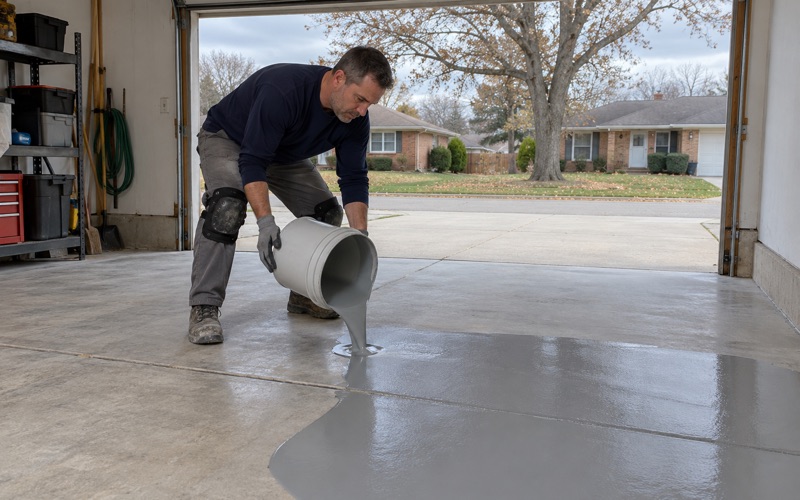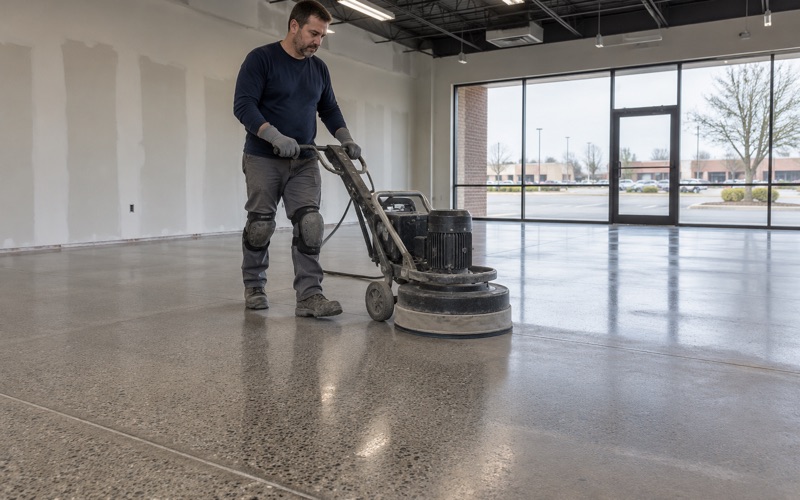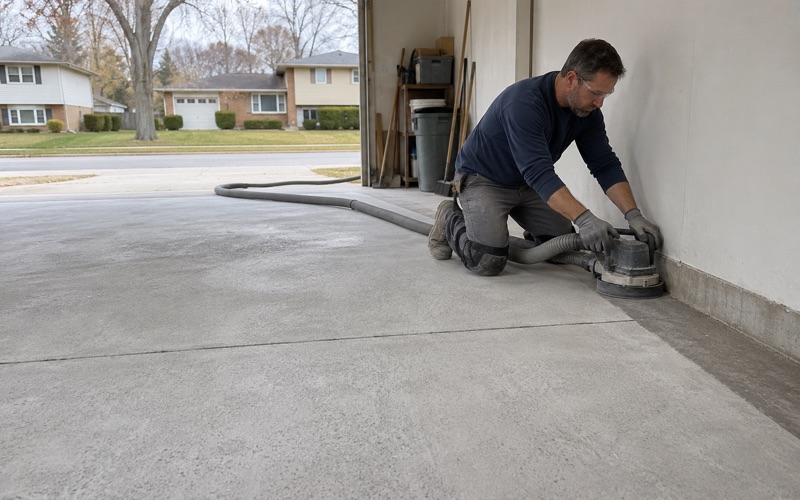
Palatine Epoxy Floors has spent more than 20 years on epoxy flooring in Cary, and every garage or basement we take on here starts the same way: a grinder goes on the slab before anything wet comes out of a pail. A diamond grinder or a shot blaster opens the concrete to a profile we can see and measure. We never acid etch, because etching leaves a surface nobody can check and a residue nobody can fully rinse away.
Before a price is written, we read the cracks and any old coating on the floor, and we tell you plainly if the slab needs repair first. Moisture testing sits in the scope as its own line. The proposal names the product, the system build and the finished thickness, so you can hold what went down against what was quoted.
Every home job carries a written contract and the state’s consumer-rights pamphlet before work starts, as the Illinois Home Repair and Remodeling Act requires. The rest of this page covers what makes floors in this village different, starting with who owns them.
1,031 Attached Homes and the Owners Who Live Above the Bay
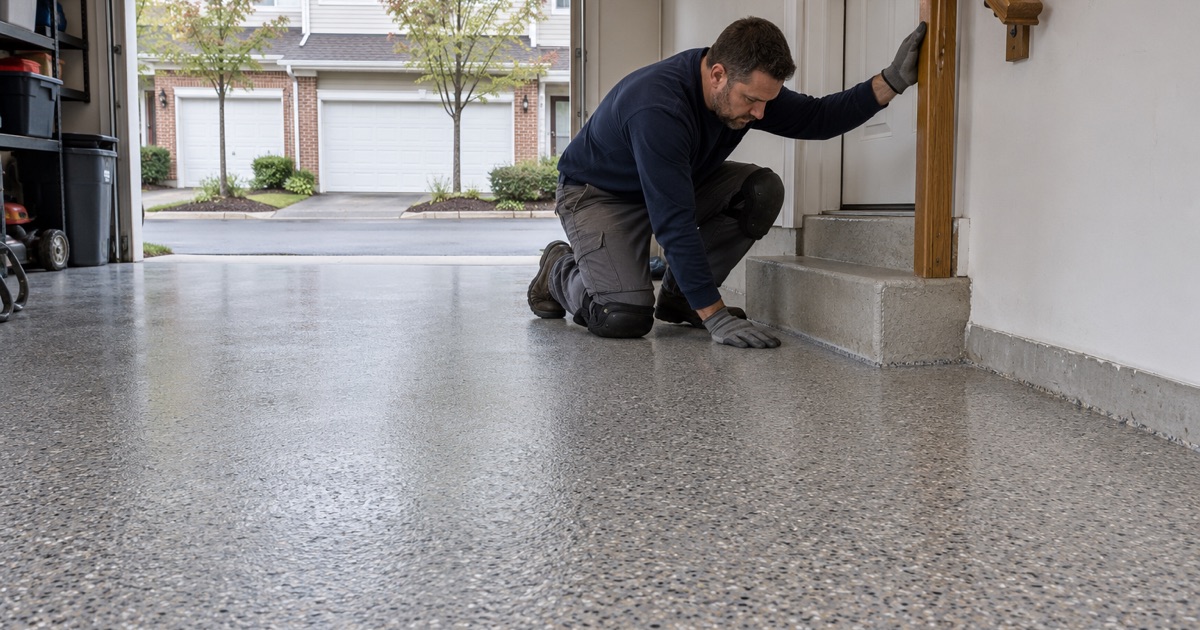
Cary is a townhome village as much as a house village. The ACS 2024 five-year estimates count 1,031 single-family attached units here, 15.4 percent of the village’s 6,677 homes, and 848 of those attached homes are owner-occupied. Put another way, roughly one garage in six or seven belongs to a townhome, and in most of them the person who signs our contract sleeps upstairs.
That ownership pattern runs through the whole village. Of 6,468 occupied units, 84.8 percent are owner-occupied. The buyer we meet in Cary is almost always the person who will park on the floor for years to come, not a landlord pricing the cheapest finish before a turnover.
A shared wall and one owner’s floor
A townhome garage is one owner’s slab sitting beside a neighbor’s. The floor is yours to coat, but the wall, the driveway and often the drive lane are shared in practice. We capture grinding dust at the tool with a vacuum, keep the overhead door workable during cure, and park so that no neighbor finds their own garage blocked.
Where an association sets rules about contractors, parking or work hours, we schedule around them. We also keep to the hours the Village of Cary allows for construction noise, which matters more when the grinder is one wall away from someone else’s kitchen.
The build that suits a townhome bay
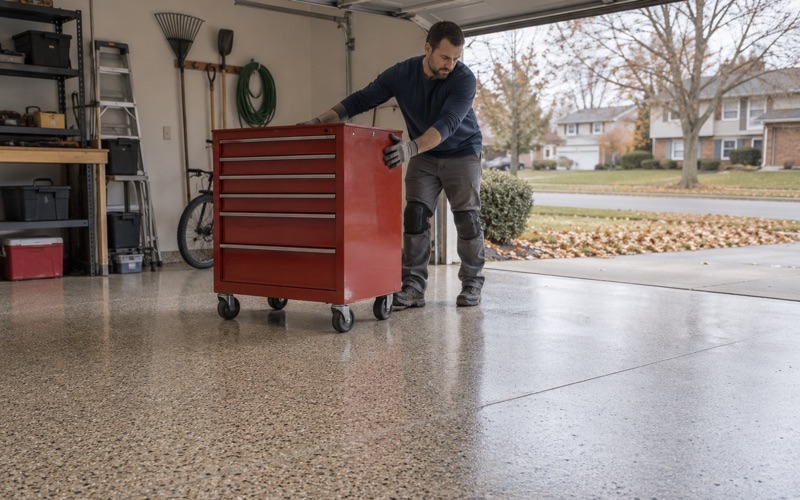
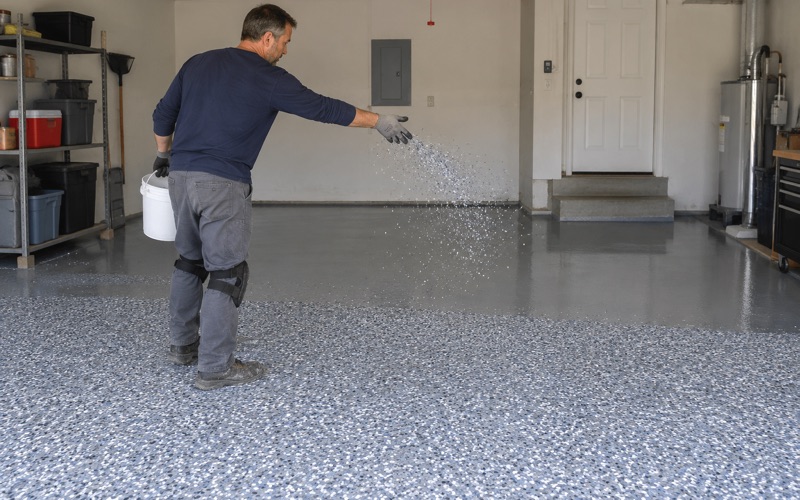
Most townhome bays we coat get a 100% solids epoxy base, a full vinyl flake broadcast and a polyaspartic topcoat. The flake hides the small surface marks any slab carries, and the topcoat resists hot tire pickup, the failure where a warm tire lifts a thin coating off the concrete. Polyaspartic also cures faster than an epoxy top, which shortens the stretch a single-bay owner spends parking on the street.
Testing before we coat
A garage slab poured to code may have no vapor retarder under it, because IRC R506.2.3 exempts garages from that requirement. So we test rather than assume. An ASTM D4263 plastic sheet test is the quick screen, and where the job calls for a number we use ASTM F1869 calcium chloride kits or ASTM F2170 in-situ relative humidity probes.
Looking for epoxy-flooring closer to Lake Forest? See Lake Forest Epoxy-Flooring.
Four Decades of Slabs, From the 1970s Through the 2000s
Cary did not go up in one wave. The census counts 1,263 homes built in the 1970s, 1,456 in the 1980s, 1,356 in the 1990s and 1,033 in the 2000s, so 5,108 units, 76.5 percent of the housing stock, date from those four decades. Another 239 were added from 2010 to 2019, and the estimates record none built in 2020 or later.
For a floor contractor, that spread means there is no single Cary slab. A forty-five-year-old garage floor and a twenty-year-old one can sit on neighboring streets, and the two need different conversations even when both owners want the same finished look.
Garages from the 1970s and 1980s
A slab from these decades has usually lived through years of vehicles, spills and patching. We separate the hairline shrinkage cracks a coating can bridge from the moving joints and settled sections that need repair first. A coating is a film that follows the slab under it; it will not stop a crack that keeps moving, and we would rather say so at the estimate than after a line reappears through the flake.
Older garages also tend to carry a previous paint or coating. A one-part garage paint has to come off completely, and grinding to an ICRI CSP 2 or CSP 3 profile gets us back to sound concrete the new system can bond to.
Floors from the 1990s and 2000s
Newer is not the same as dry. These floors can look clean and tight, yet the garage exemption means there may be nothing below them to stop vapor, and a basement slab of the same age can still carry moisture from beneath. Testing is in our scope for both, rather than something sold after a floor has already blistered.
Where a reading comes back high, we quote a moisture-mitigation primer under the system, or a urethane cement base in a basement that calls for it. Warranty exclusions are read out before the job is sold, and moisture is the first one we name.
Curing against the slab, not the calendar
Whatever the slab’s age, we schedule the cure against slab temperature and the dew point spread at the surface rather than a date. When an unheated garage is too cold to cure a coating properly, we tell you it has to wait for spring. A coat that cures with amine blush on its surface will not hold the next layer.
The Older Core: 557 Homes From Before 1950
Cary’s railroad station opened in 1856, and the village was incorporated in 1893 in Algonquin Township, McHenry County, with a portion reaching into Cuba Township in Lake County. The census counts 557 homes built before 1950, 8.3 percent of the stock, including 416 built in 1939 or earlier. These are the oldest floors we see in the village.
A garage or basement that old was poured long before any modern specification, and it often has decades of repairs layered on it. We treat every one of these as a slab to assess in person, never a slab to price over the phone.
Basements in the oldest homes
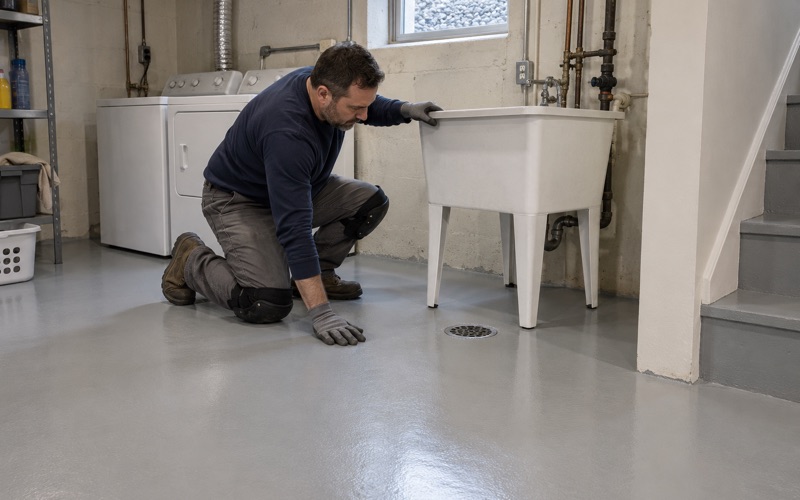
In an older basement, the questions are efflorescence, past water and how the floor drain and sump pit meet the slab. A white, powdery bloom on the concrete is mineral salt carried up by moisture, and it is a reason to test before anything is applied. We detail the coating around drains and sump pits so the edge stays bonded where water is most likely to reach it.
We do not sell a floor coating as radon reduction, in these basements or any other. In Illinois that work requires an IEMA radon mitigation license, and a coated floor is not a mitigation system.
The few rented houses
Cary has 391 renter-occupied detached houses, a small number against 4,616 owner-occupied ones. When one of those owners calls, the job is the same job: the same grind, the same moisture test and the same written proposal naming product, build and thickness.
Read the Documents First: Exterior Rules and the Floor Inside
Before a townhome job is scheduled, we ask the owner to read their own association documents for anything covering contractors, work hours, parking or equipment in the drive. We have not read any Cary association’s rules and do not assume what they say. What we do is plan around whatever the owner finds there.
Inside the unit, the garage slab, the basement slab and the finish on them are interior work. Our proposal covers that work in writing, so the owner has one document that says what is being installed and how thick it will be.
Who governs what in Cary
The building authority is the Village of Cary, through its building and community development office. Fire protection comes from the Cary Fire Protection District, a separate district at 400 Cary-Algonquin Road operating two stations, rather than a village fire department. On a commercial floor, a fire-code question goes to the district, while building matters go to the village.
Registration, bond and insurance instead of a license number
Illinois issues no state license for flooring or coatings work, so no contractor here can honestly show one. What we show instead is the village registration, bond and insurance each municipality asks for. We also choose coatings within the Illinois VOC limits in 35 Ill. Adm. Code Part 223, which bind the installer as well as the manufacturer.
For shops and offices in the village, we schedule commercial work around the hours the building has to stay open. The same grind, the same moisture testing and the same written scope apply there as they do in a townhome bay.
- 20+ Years Coating Concrete
- Moisture Tested Before We Coat
- Free Written Estimates