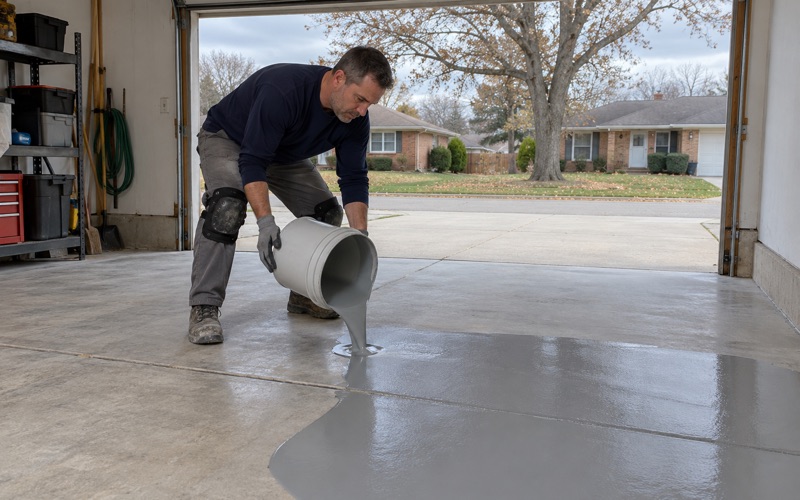
Palatine Epoxy Floors brings more than 20 years of epoxy flooring work to Bensenville, and the first question we ask on a walkthrough is whether the floor is the only thing changing. A garage that needs a new trench drain, a basement that needs an outlet moved, or a shop that wants a heater circuit run before the coating goes down is no longer a coating job alone. Those additions bring other trades into the project, and in this village those trades answer to their own licensing rules.
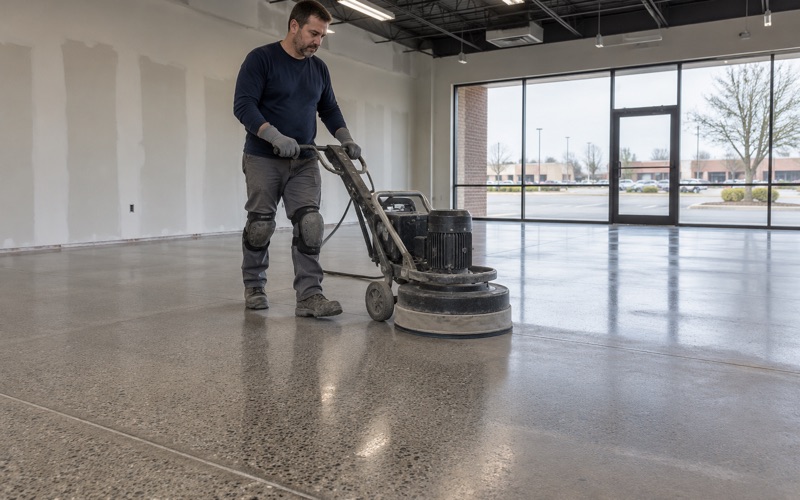
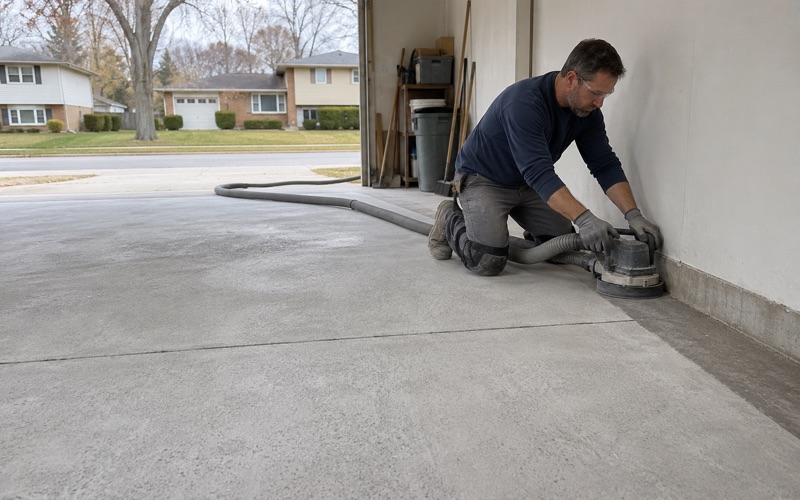
Our part is the slab itself. We open every surface with a diamond grinder or a shot blaster rather than acid, price moisture testing as its own line in the quote, and write the product, the system build and the finished thickness into the proposal so the floor that goes down can be checked against the floor that was sold.
When a project also needs a licensed electrician or plumber, we plan our days around their work instead of pretending it is ours. The rest of this page explains how that division works here, and why the order of the trades matters as much as the coating.
Who Bensenville Licenses, and the Bond Behind the License
Bensenville Community Development handles building permits for the village, and its permit paperwork sorts contractors by the authority that licenses them. Electrical and plumbing contractors must hold a license issued by an Illinois municipality. Roofing contractors must hold a State of Illinois license instead. That sorting matters to a homeowner because it decides who can legally do each piece of a larger project.
The village spans DuPage and Cook counties, but the permit desk is the village’s own on either side of the line. Community Development ran with nine full-time employees in 2024, so it pays to hand the office everything it asks for the first time.
An Original $10,000 Surety Bond on File
On top of that municipal license, electricians and plumbers must submit an original $10,000 surety bond to the village. An original means the bond document itself rather than a copy, and it is posted with Bensenville rather than with whatever town the contractor works in most often.
The practical check for you is simple. Before an electrician or plumber starts on your project, ask whether their bond is already on file with Bensenville, because a trade that has never worked in the village may need time to arrange one. A delay there pushes back every step that follows, including ours.
Where Coating Work Sits in That Sorting
The bond rule was written for electrical and plumbing contractors, and we do not read it onto floor coating. Illinois issues no state license for flooring or coatings work, so we never quote a license number we do not have. What we show instead is our insurance and any registration the village asks of us.
Whether a coating by itself needs a permit is a question we put to Community Development for the specific scope, rather than answering from memory. When drain or electrical work is part of the job, that work carries its own paperwork through the licensed trade doing it.
Looking for epoxy-flooring closer to Cary? See Epoxy-Flooring Services in Cary.
When a Floor Job Stops Being Only a Floor Job
Most of our Bensenville quotes start as a coating and nothing more. The scope widens when an owner wants something built into the slab or along its edge, and that usually happens in one of three ways.
Trench Drains and Floor Drains
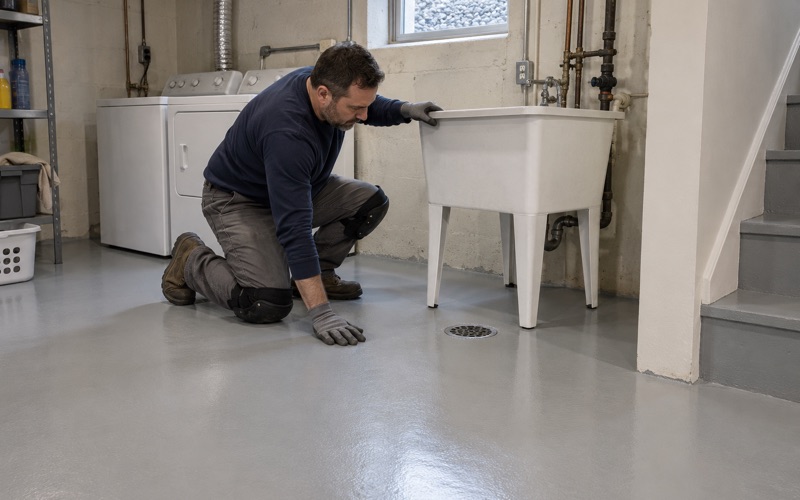
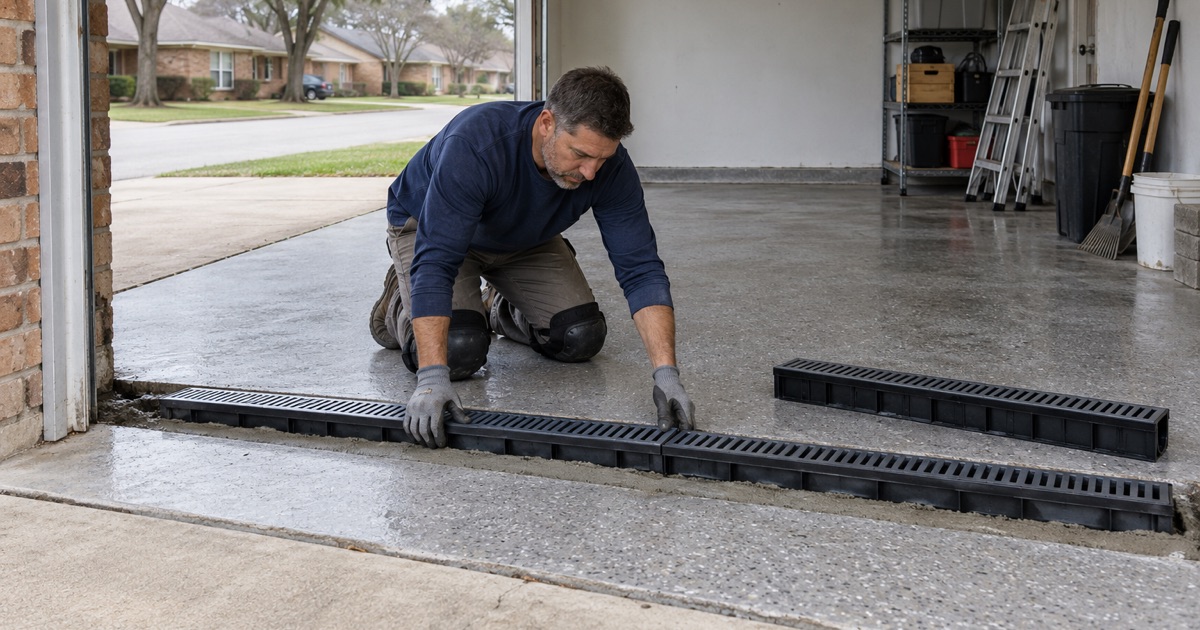
A trench drain cut across a garage apron, or a floor drain added to a basement, means saw-cutting the slab, running pipe and tying into the building’s drainage. That is plumbing work, and under the village’s rules it belongs to a municipally licensed plumber with a bond on file. We are not plumbers, and we do not install drains.
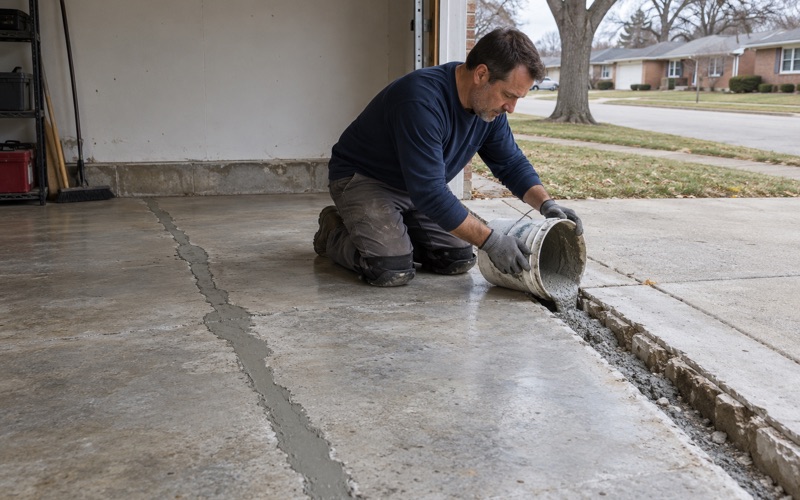
What we do is detail the coating around the finished drain. The fresh concrete patched in around a trench drain holds more water than the old slab, so we test it before coating and grind it to the same profile as the rest of the floor, usually ICRI CSP 2 or 3 for a broadcast system. A drain body set proud of the slab shows through every coat, so we ask the plumber to set it flush or a hair low.
Outlets, Heaters and Floor-Level Wiring
Moving an outlet that sits low on a garage wall, adding a circuit for a heater, or wiring a floor box in a workshop puts an electrician on the job. Their rough work needs to be finished before we coat, because cutting a chase through a cured floor ruins the system around the cut. A patched coating never quite matches the original flake broadcast.
Floor-level wiring also changes how we finish an edge. Where a box or conduit meets the slab, we stop the broadcast cleanly and seal the joint so resin does not run into the fitting, and the cover plates stay off until the coating has hardened.
The Order That Keeps Trades Off Each Other’s Work
The sequence we follow is trade work first, then any inspection that work needs, then slab repair, grinding, testing and coating last. Grinding throws fine dust that settles into open boxes and drain bodies, so we cover and tape both before the grinder starts.
Once the coating is down, nobody should drill, cut or set equipment on it until it has cured. If an inspector still needs to see a drain or a box after we finish, we need to know that before we schedule, not after the topcoat is on.
The Homeowner Exception for Electrical Work
Bensenville’s permit rules carry one exception to the licensing requirement. A homeowner may do electrical work on an owner-occupied single-family house that is their primary residence without being a licensed, bonded contractor. The exception covers electrical work only, and only on that kind of property.
Who It Actually Fits
That narrows it more than it sounds. The village is close to half renters, with 3,553 owner-occupied homes against 3,462 rented ones, and only about 3,080 of the owner-occupied homes are single-family detached houses. A renter, a landlord wiring a rental unit, or an owner in a multi-unit building does not fit the exception as the village states it.
For the owners it does fit, the exception is an option rather than a requirement. Many homeowners still hire a licensed electrician for a heater circuit, and either path works for us as long as the wiring is complete before we start.
How We Schedule Around a Homeowner’s Wiring
When a homeowner plans to run a heater circuit or relocate an outlet, we treat that work exactly as we would a contractor’s. It needs to be finished, and inspected if the village calls for that, before our grinder comes in. We do not wire anything ourselves, and we will not coat over an open box or a temporary splice left for later.
Attached Homes and Association Rules
Owners of attached townhomes should read their association’s rules before planning any trade work, since shared walls and shared drives often come with limits on who works when. We schedule coating days around those rules and around the neighbors’ access to their own garages.
Coating an Older Bensenville Slab Once the Trades Are Done
About 73.8 percent of the village’s housing was built before 1980, much of it between the 1950s and the 1970s. A slab of that age has often been painted, patched or sealed at least once, and it may have no vapor retarder under it at all.
Testing Before Anything Is Applied
We test every slab before we coat it. A garage starts with an ASTM D4263 plastic sheet test and moves to ASTM F2170 relative humidity probes when the reading or the floor’s history calls for it, while a basement gets the probes from the start. A newer slab is not exempt, because the model code lets a garage go without a vapor retarder, so age alone tells us little.
Reading Cracks and Old Coatings
Old paint and sealer have to come off completely, and the diamond grinder is how they come off. While it runs, we read the cracks underneath and tell you plainly when a slab needs repair before it can take a coating.
A coating is a film that follows the slab under it. It will not stop a moving crack from telegraphing through, and we say that before the job is sold rather than after the floor is down.
Building the System and Timing the Cure
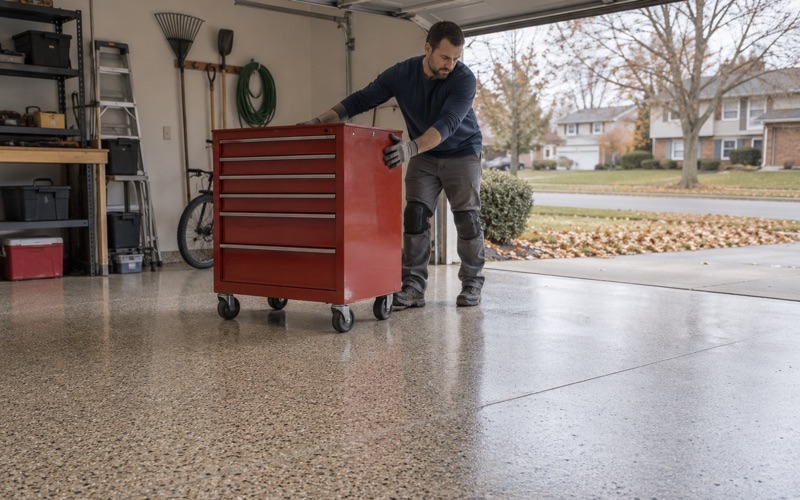
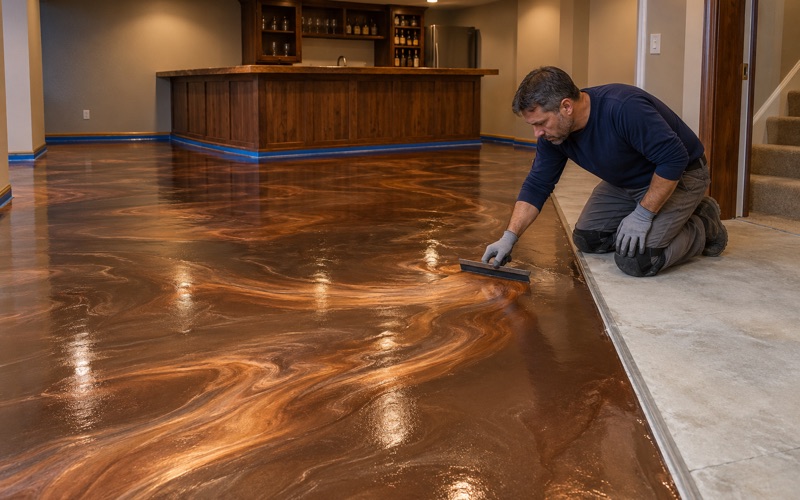
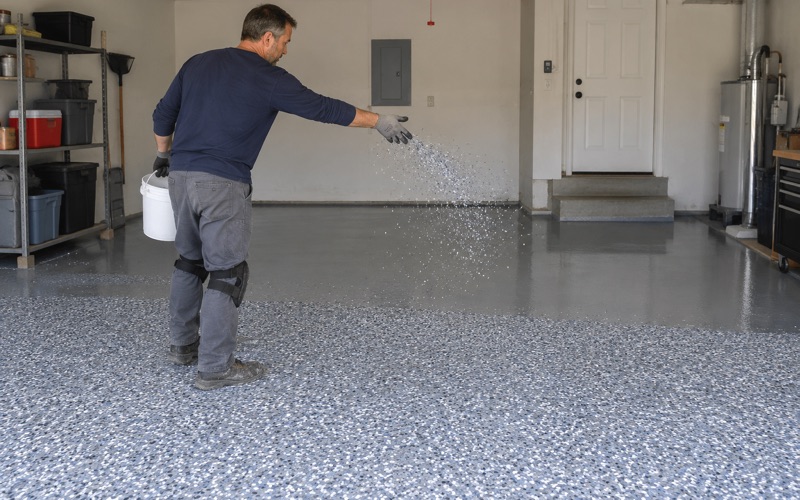
For a garage we usually lay a 100% solids epoxy base, broadcast vinyl flake to refusal and finish with a polyaspartic topcoat that resists hot tire pickup. A basement reading near the limit gets a moisture-mitigation primer first. Curing is scheduled against slab temperature and the dew point at the surface rather than the calendar, and we tell you when a cold, unheated garage is not ready to coat.
Before any home job starts you receive a written contract and the Home Repair: Know Your Consumer Rights pamphlet, as the Illinois Home Repair and Remodeling Act requires. We read the warranty exclusions out at the same time, moisture first. Our coatings are chosen within the Illinois limit on VOC content, and the work itself runs inside the hours the village allows for construction noise.
- 20+ Years Coating Concrete
- Moisture Tested Before We Coat
- Free Written Estimates