
Palatine Epoxy Floors installs basement floor epoxy in homes across Palatine, IL, with more than 20 years of coating concrete that sits below grade, serving surrounding cities including Barrington, Lake Zurich, Prospect Heights, Deerfield, Wood Dale. Every basement job starts with the same step: finding out how much moisture is moving through the slab before choosing anything else.
A basement floor sits in the ground, surrounded by soil that holds water for part of the year. That water does not care how dry the floor looks in August. It moves through concrete as vapor, carries salts with it, and pushes up against anything bonded to the surface, which is why a basement coating chosen by color alone so often blisters and peels.
We test the slab, read the cracks, inspect the drains and pits, and only then write a proposal that names the primer, the system layers and the finished thickness. When a basement needs plumbing or drainage work before it can be coated, we tell you that first, because a floor laid over an unsolved water problem is money spent twice.
Moisture Comes First in a Palatine Basement
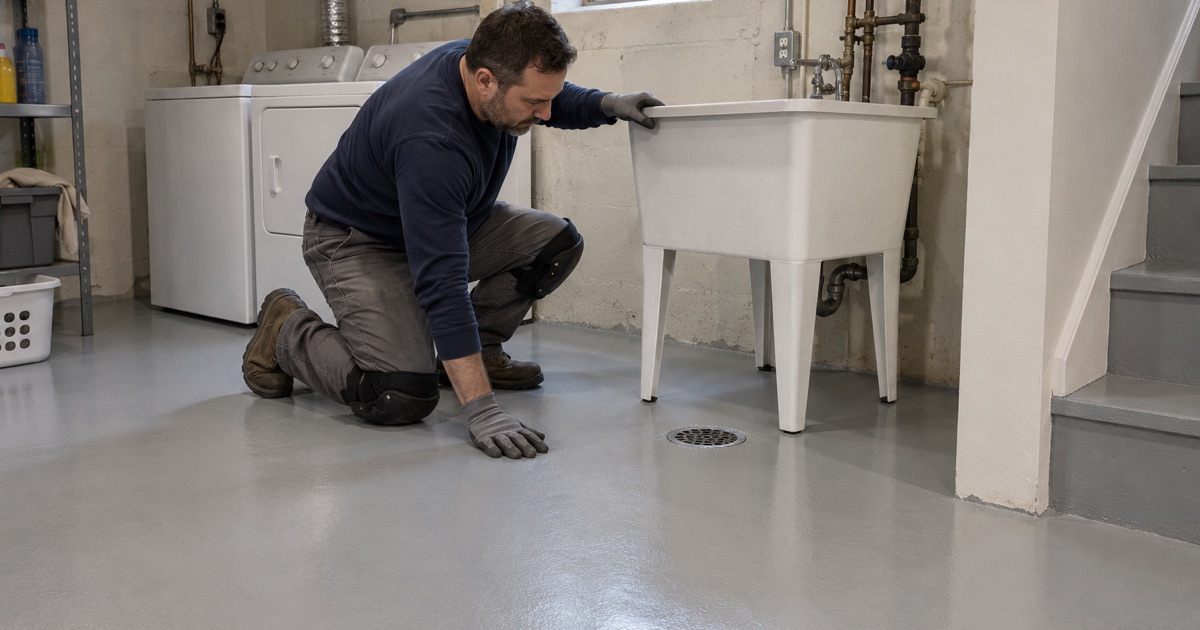
Wet Spring Soils Under the Slab
Central Palatine sits on glacial till-plain soils mapped as the Markham, Ashkum and Beecher complex, with Ashkum silty clay loam and Peotone silty clay loam nearby. Ashkum is poorly drained, with a seasonal water table that ranges from 6 inches above to 12 inches below the surface between January and May. Markham drains better but still carries a perched water table at 2 to 3.5 feet in spring.
That groundwater sits against basement walls and beneath slabs for months each year, and it exerts hydrostatic pressure on the concrete. A slab that tests fine in late summer can read very differently in April, so we account for the season when we read a test and choose a primer with that spring peak in mind.
Three Moisture Tests and What Each Measures
One phrase, moisture test, actually covers three different instruments. The ASTM F1869 calcium chloride test measures the rate at which vapor leaves the slab surface over a set period. The ASTM F2170 test places relative humidity probes inside drilled holes and measures the moisture state within the slab. The ASTM D4263 plastic sheet test simply shows whether moisture collects under a taped sheet.
The thresholds contractors quote, such as 3 pounds per 1,000 square feet in 24 hours or 75 percent internal relative humidity, come from ASTM F710 and from manufacturers’ data sheets rather than from the test methods themselves. We test, compare the reading with the limits published for the specific product we propose, and write both into the scope.
Efflorescence and What It Tells Us
The white, chalky deposit on many basement floors is efflorescence: mineral salts carried up through the concrete by moving water and left behind when it evaporates. It is a sign that moisture is active, and it often concentrates along cracks, at the base of walls and near the sump.
Efflorescence has to be removed completely by grinding before coating, because a resin bonded to salt crystals is bonded to dust. Its presence also points us toward a moisture-mitigation primer, and it tells us where to look for cracks or joints that may be letting water through.
Drains, Pits and Basement Plumbing
Sump Pits, Ejector Pits and Floor Drains
Palatine homes built after 1972 generally have a separate sump pump for foundation drainage and overhead plumbing for sewage. In a converted older home, the village standard routes every below-grade drain to a vented ejector pit and the footing drains to a separate sump pit, so a basement may have two pits and their lids to work around.
We grind and detail the concrete at each pit and floor drain, end the coating cleanly at every opening, and keep lids removable for service. The floor is left so water still runs toward the drain, because a coating edge that dams water is where peeling begins.
Overhead Sewers, Check Valves and Footing Drains
The village treats older basements, where footing drains may still be tied into the sanitary line, as exposed to sewer backup. Through its Basement Protection Program, Palatine cost-shares 50 percent of an automatic backup check valve up to $750, an overhead sewer conversion with footing-drain disconnection up to $6,000, and a footing-drain disconnection alone up to $2,500, with a $6,000 overall cap.
If you are planning any of that work, schedule it before the floor is coated. Plumbing conversions mean cutting the slab and adding pits, and coating first means patching a new floor later. We are happy to coordinate timing with your plumber.
Coating After a Sewer Backup
A basement that has taken a backup needs cleaning, disinfection and thorough drying before any coating is considered, and the concrete may hold contamination below its surface. We grind deeper in affected areas, remove any old coating or adhesive that was soaked, and retest moisture after the slab has had time to dry.
Where the cause of the backup has not been addressed, we say so plainly. Coating a floor that is likely to flood again leaves you with a damaged coating as well as a wet basement.
Choosing a Basement Floor System
Moisture-Mitigation Primers
When readings exceed what a standard epoxy primer tolerates, a moisture-mitigation primer goes down as its own layer. It is formulated to bond to damp concrete and resist vapor pressure from below, and it is rated by the manufacturer for a specific maximum reading, which is why the test number matters.
The mitigation layer adds material and labor, and it is listed as its own line in the proposal so you can see exactly what it costs. On many Palatine basements it is the single most important part of the system.
Flake, Solid Color and Quartz for Lower Levels
A full vinyl flake broadcast under a clear topcoat is the most popular basement finish, because it hides minor slab imperfections and adds subtle texture. Solid color coatings suit laundry and utility rooms, and quartz broadcast floors give extra grip where the floor is often wet, such as near a basement bathroom or a laundry tub.
Metallic epoxy can turn a lower-level bar or media room into a showpiece, though it requires a very smooth base and shows slab flaws more readily. We bring samples and show how each looks under basement lighting before you choose.
Playrooms, Home Gyms and Workshops
A coated basement slab suits playrooms, home gyms and hobby shops because it wipes clean, resists spills and handles dropped weights and tools without scratching through to concrete. A matte or satin topcoat hides scuffs better than high gloss in spaces that see hard use.
We leave the perimeter ready for baseboards, wall panels or rubber flooring, and we can stop the coating short of areas where carpet or flooring will be installed later, saving material where it would never be seen.
What a Basement Coating Can and Cannot Do
A Coating Is Not Waterproofing
A floor coating is a bonded film on top of the slab. It will protect the concrete, brighten the space and make cleaning easy, but it will not stop water entering through cracked walls, failed joints or poor grading. Those need drainage, waterproofing or plumbing work first.
A coating also follows the slab beneath it. Cracks that are still moving with the seasons will eventually show through, and we point those out before the job is sold rather than promising a floor that hides them forever.
Radon Is a Separate Job
No floor coating qualifies as radon mitigation, and in Illinois that work requires a license through the state emergency management agency. Sealing a floor does not replace a properly designed mitigation system, and we never suggest otherwise.
If your home has a mitigation system, we coat around the suction point and leave the pipe and any sealed openings exactly as the mitigator left them. The system keeps working, and the floor around it is finished to match the rest of the room.
Warranty Exclusions Read Before You Sign
Almost every coating warranty excludes failures caused by moisture rising through the slab, and many exclude damage from flooding or backups. We read those exclusions to you before the contract is signed, with moisture first.
Every residential job also comes with a written contract and the Home Repair: Know Your Consumer Rights pamphlet, as the Illinois Home Repair and Remodeling Act requires, so you know your rights before any work begins.
- 20+ Years Coating Concrete
- Moisture Tested Before We Coat
- Free Written Estimates