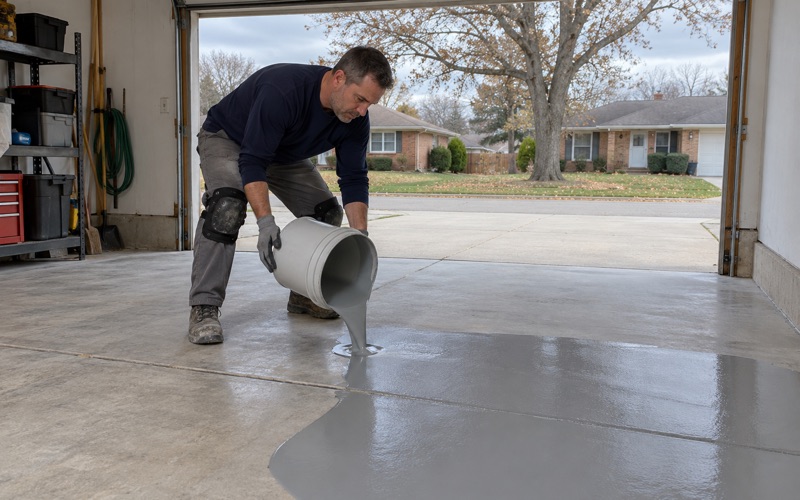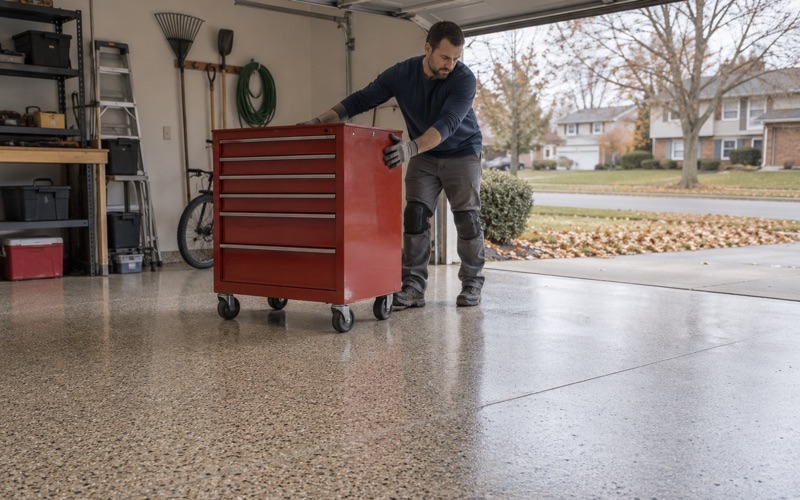
Palatine Epoxy Floors brings more than 20 years of epoxy flooring in Barrington to garages, basements and commercial rooms, and every one of those jobs opens with two questions that have nothing to do with resin: whose building is this, and which offices answer for it? The answers decide who we call about work hours, registration and any commercial review, so we settle them before the proposal is written rather than after a crew has unloaded.
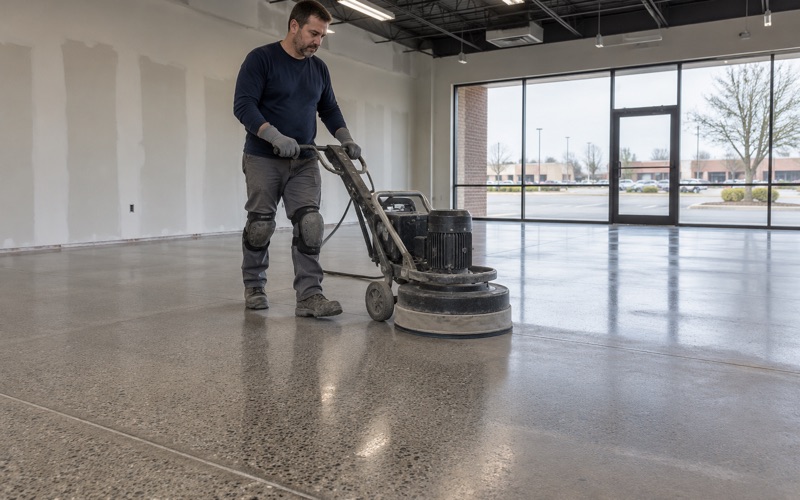
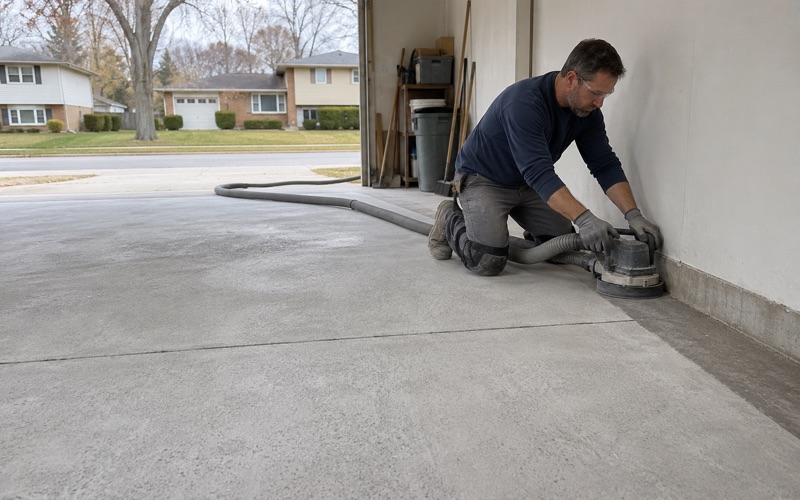
The floor gets the same scrutiny. Every slab is ground or shot blasted open before a single coat goes down, and we never acid etch. Moisture testing sits in the scope as its own priced line, and the written proposal names the product, the system build and the finished thickness, so an owner can hold the finished floor up against the page and check it.
What follows explains why the question of address carries more weight here than in most towns we serve, and what we confirm on a Barrington job before we quote a single square foot.
One Name, Two Fire Authorities Since January 1, 2014
For years the Village of Barrington and the countryside around it were served together under an intergovernmental agreement. The Barrington Countryside Fire Protection District ended that agreement effective January 1, 2014. Since then the Barrington Fire Department, a village department, has covered the village’s roughly five square miles, while the district serves about 46 square miles of surrounding communities on its own.
Why a small village changes the conversation
Five square miles is a small footprint next to everything people call Barrington. A great deal of the area that answers to the name, and that most customers would describe as living in Barrington, sits in the district’s territory rather than the village’s. Two buildings a short drive apart can have different fire authorities, different village governments and different paperwork expectations, even when both owners write the same town on an envelope.
Where the split actually shows up
For an attached garage or a finished basement, the fire authority rarely enters the job at all. We have not read any fire district rule about floor coatings or any inspection tied to a garage floor, and we will not tell a homeowner one exists. The split matters on commercial work: a tenant space, a shop floor or a storage building where the owner is already in conversation with the fire service about the occupancy. In that case the right office depends on which side of the village line the parcel falls, and we make sure the owner knows which one to ask before we schedule.
What we bring onto an occupied commercial site
Commercial jobs are planned around the hours the building has to stay open, with grinding and coating sequenced so a business can keep operating in the rooms we are not in. The coatings themselves are chosen within the Illinois VOC limits in 35 Ill. Adm. Code Part 223 Subpart C, which bind the installer as well as the manufacturer. A 100% solids epoxy base with a polyaspartic topcoat is a common build for that reason, though the system we propose follows the slab and the use, not a habit.
Looking for epoxy-flooring closer to Lake Zurich? See Epoxy-Flooring Services in Lake Zurich.
A Barrington Address Is Not a Barrington Permit
The mailing address is the least reliable fact on a work order here. A Barrington address and ZIP code reach well past the village boundary, and the same is true of large institutions, not only houses on rural lots. Advocate Good Shepherd Hospital publishes a Barrington address on Highway 22, yet the Census geocoder’s nearest match on that road falls inside North Barrington village, in Cuba Township, Lake County. Whichever neighboring village holds the hospital’s parcel, it is not Barrington village.
Cook County or Lake County
The village itself spans Cook and Lake counties. It was chartered by the Illinois legislature on February 16, 1865, and today it is a home-rule municipality with a council-manager government, a village president and six trustees. A house a few streets from another can sit in a different county, which matters most on commercial food work. Under the Illinois Food Code, which adopts the 2022 FDA Food Code, a kitchen floor answers to a health department, and the Cook County and Lake County departments are separate offices. We have not confirmed on a village page which department reviews which part of Barrington, so we ask the owner to confirm with the operator’s own inspector before we finalize a kitchen scope.
Which of four townships
Barrington village takes in parts of four townships: Barrington, Palatine, Cuba and Ela. The township rarely changes how a floor is built, but it is one more line that tells us a parcel’s real location when the mailing address cannot. When a county record, a township name and a village registration all agree, we know whose rules the job runs under.
What we show instead of a license number
Illinois issues no state license for flooring or coatings work, so a contractor quoting a state license number for epoxy is quoting something that does not exist. What we provide is the village registration, the bond and the certificate of insurance the issuing municipality asks for, and that is exactly why we need to know which municipality it is. Every home job also gets a written contract and the Home Repair: Know Your Consumer Rights pamphlet before work starts, as the Illinois Home Repair and Remodeling Act requires, and our crews work inside the construction hours that same village allows.
Downtown Brick and Stone: Storefront Floors With Long Histories
Barrington’s downtown commercial buildings are largely brick and stone, construction that followed fires in the late 1800s. The Catlow Theater, listed on the National Register of Historic Places, stands among them. Buildings of that age have usually been through several tenants, and the floor inside a storefront tends to record every one of them.
Reading a floor that has had many owners
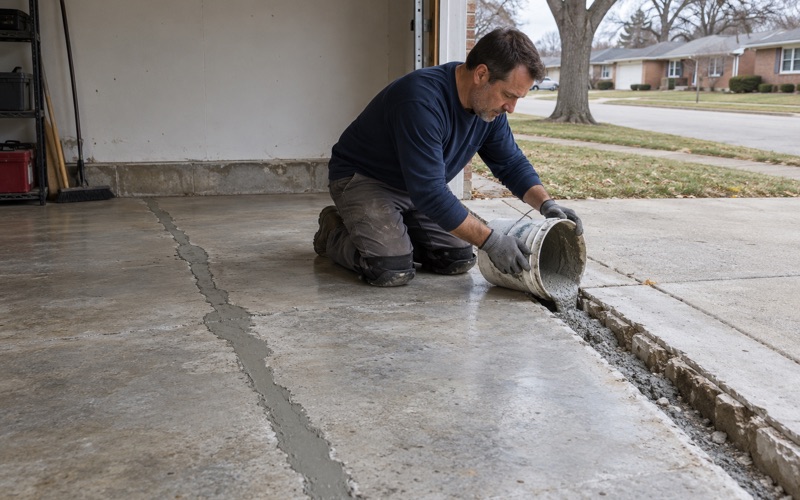
An older commercial slab may carry a patched trench where plumbing moved, a leveling pour over part of the room, adhesive from old tile or carpet, and a coating or two from earlier tenants. We read the cracks and the old coating before we quote, and when a slab needs repair before it can be coated, we say so in plain terms. Grinding to the right ICRI surface profile removes failed material down to sound concrete, and anything that will not bond is treated as a repair item rather than buried under a new film.
Moisture in an older building
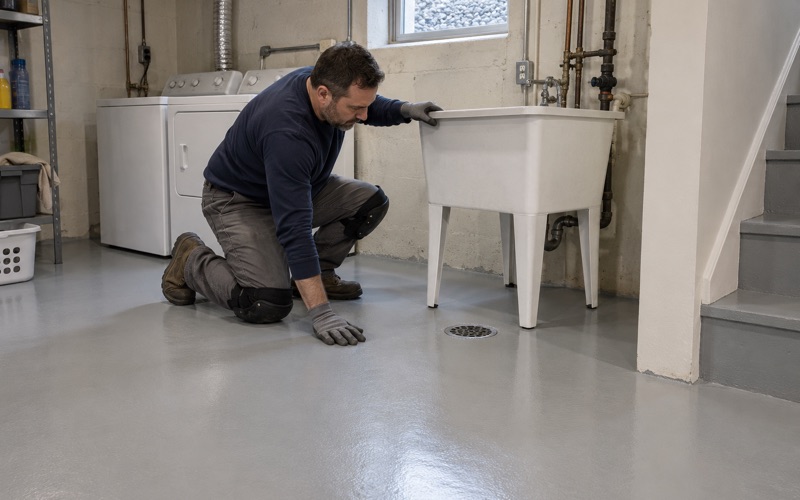
White efflorescence along a wall line or under old flooring tells us water vapor has been moving through that slab for a long time. We measure it rather than guess, with ASTM F2170 in-situ relative humidity probes and, where it suits the slab, ASTM F1869 calcium chloride testing. When the readings come in high, a moisture-mitigation primer goes into the system build and onto the proposal, and moisture is the first exclusion we read aloud when we go over the warranty.
Matching the system to the tenant
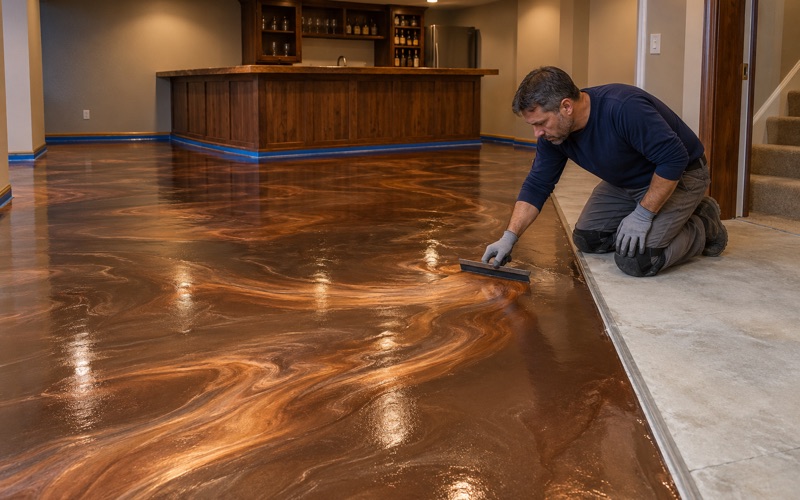
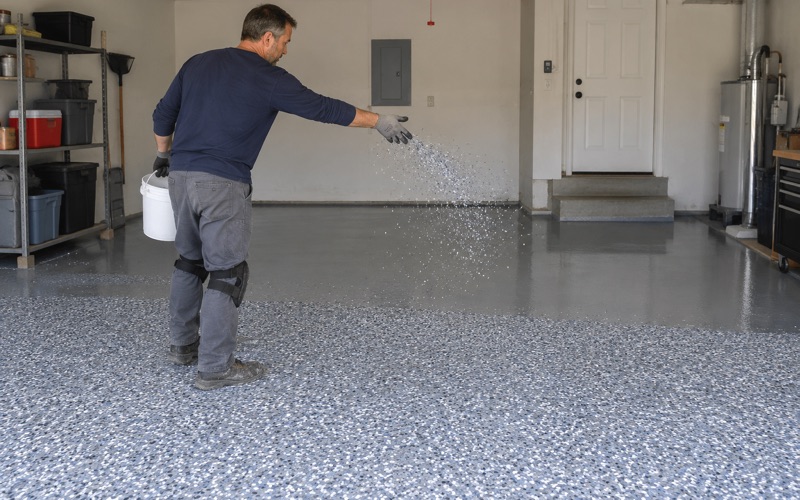
A retail floor, a salon and a restaurant kitchen ask for different builds. A quartz aggregate broadcast gives texture where a wet floor is a slip risk, urethane cement stands up to hot water and thermal shock in a kitchen, and coved floor-to-wall junctures follow FDA Food Code 6-201.13 where a food operation needs them. A coating is a film that follows the slab under it, so we explain before the job that it will not stop a moving crack in an old building from reflecting through.
Confirming the Parcel and the Slab Before the Quote
Our estimate visits in Barrington follow a fixed order. The parcel comes first, the concrete second, and the schedule last, because a schedule built before the first two are known is a schedule that slips.
The parcel
We confirm the county, the village that actually holds the address, and, for commercial work, whether the building falls under the Barrington Fire Department or the Barrington Countryside Fire Protection District. That tells us whose registration, insurance certificate and work-hour rules apply. It takes a few minutes with the owner and a property record, and it prevents the most avoidable delay a Barrington job can have.
The slab
Most of the village’s houses are not old. Of its 4,424 housing units, 1,959, or 44.3 percent, were built between 1960 and 1979, and 2,863 of the homes are owner-occupied detached houses. A garage slab poured to code in any decade may have no vapor retarder under it, because the model code exempts garages under IRC R506.2.3. A quick ASTM D4263 plastic sheet test screens the surface, and a measured test settles the question before we commit to a system. We test before we coat; we never assume a newer slab is a dry one.
The schedule
Curing is booked against slab temperature and the dew point spread at the surface rather than a calendar date, and when an unheated garage is too cold for the chemistry to cure properly, we tell the owner it has to wait for spring. For the village’s townhomes and condominiums, we plan around the association’s rules and the neighbors’ access to their own garages before a start date is set. Then the proposal goes out with the product, the build and the thickness written on it, ready to be checked against the floor we leave behind.
- 20+ Years Coating Concrete
- Moisture Tested Before We Coat
- Free Written Estimates